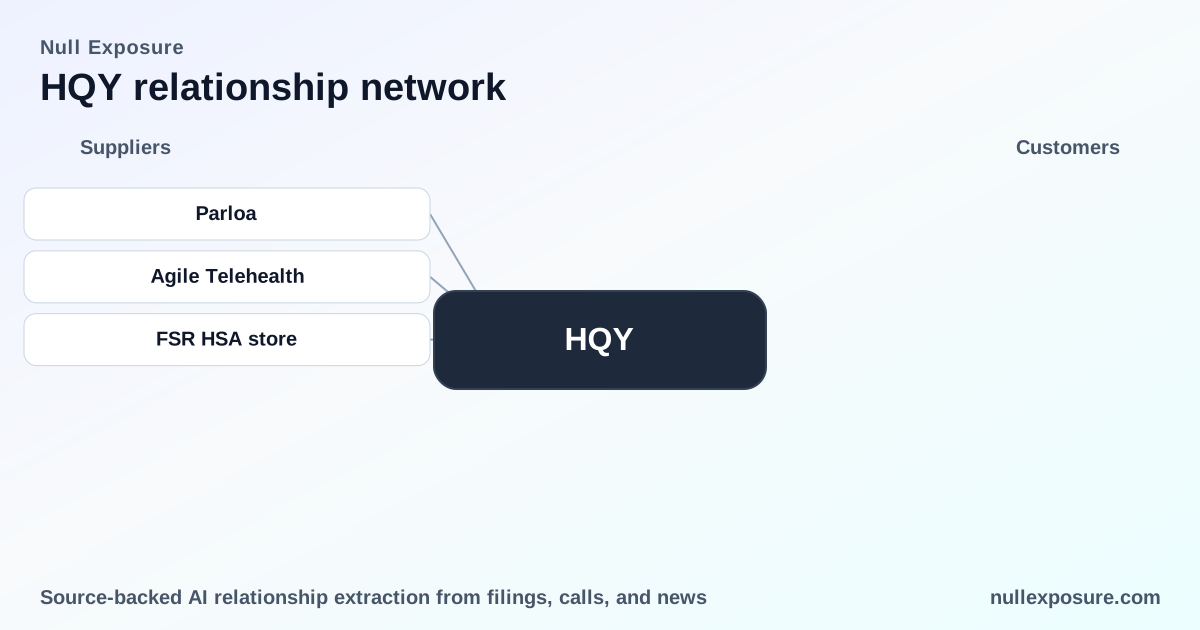
HealthEquity (HQY) — what investors need to know about supplier relationships
HealthEquity is a technology-enabled administrator of Health Savings Accounts (HSAs) and related consumer-directed benefits. The company monetizes through service and custodial fees, interchange and payment processing spreads, subscription and licensing fees for platform access, and acquisition-driven growth in HSA assets under administration (AUA); interchange and custodial economics scale with AUA, while recurring software and servicing contracts provide predictable revenue. For investors and operators evaluating supplier risk, the commercial picture is a blend of large strategic third-party dependencies, mixed contract tenors, and high-dollar portfolio acquisition activity that together shape operational resilience and margin durability. Learn more about supplier exposures and contract posture at https://nullexposure.com/.
High-level operating model signals that matter to buyers and counterparty managers
HealthEquity combines software, payments and custodial custody services into a single customer-facing platform. That hybrid model produces a specific set of supplier dynamics:
- Contracting posture: The company runs a mix of long-term financing and lease commitments alongside shorter-term operational agreements. Long-term credit instruments and non-cancellable leases co-exist with 12‑month or usage-based vendor arrangements for processing and cloud services.
- Concentration risk: HealthEquity relies on a single BIN sponsor for card issuance, which is a concentration point for payment processing and regulatory compliance.
- Criticality of providers: Several third-party services—transaction processors, card production, call centers, fraud management and cloud hosting—are declared critical to ongoing operations; transitions are resource-intensive and disruption risks carry material financial and reputational consequences.
- Spend and acquisition posture: The company executes large, strategic purchases (hundreds of millions) to expand AUA alongside routine technology and outsourcing spend in smaller bands; this produces both scale benefits and integration risk.
- Contract types in use: HealthEquity uses long-term financing and lease agreements, short-term operational contracts, usage-based interchange and processing arrangements, and licensed/subscription software for core systems.
These signals translate into practical risk-management priorities for investors and operators: focus diligence on payment rails and BIN sponsorship, review cloud and processor SLAs, and monitor integration execution on large portfolio acquisitions. If you need structured supplier intelligence, our platform consolidates these vendor signals — see https://nullexposure.com/ to get started.
How supply relationships show up in the business model
HealthEquity’s revenues and margins are sensitive to three supplier clusters:
- Payments and processing — interchange and card processing are usage-sensitive and influenced by card transaction volumes and network rules. Interchange costs include fixed and transaction‑proportional elements and therefore scale with member activity.
- Custodial and depository partners — as a non-bank custodian, HealthEquity relies on insured depository partners to hold HSA cash; failures or fee changes at those partners are labeled as material risks to operations.
- Technology and customer experience — licensed software, cloud hosting, telephony and contact center arrangements underpin member support and the customer experience; outages or poor-quality vendors have direct distribution and retention consequences.
Taken together, a services-first platform with heavy payments integration creates a supplier risk profile that is simultaneously high-impact and addressable through contract, monitoring and contingency planning.
Supplier relationships you should know (each relationship from the source results)
Parloa — integrated AI customer experience partner
HealthEquity has integrated CX work with Parloa to enhance voice, chat and web interactions across HSA Answers and HealthEquity Assist, enabling an AI-driven omnichannel member experience. This collaboration was referenced in an earnings call transcript published March 10, 2026. (Source: InsiderMonkey Q3 FY2026 earnings call transcript, Mar 10, 2026 — https://www.insidermonkey.com/blog/healthequity-inc-nasdaqhqy-q3-2026-earnings-call-transcript-1655216/)
Agile Telehealth — telehealth partner for obesity drug access
HealthEquity developed a telehealth offering in partnership with Agile Telehealth that enables patients to use HSA funds for weight-loss medications where appropriate, integrating clinical access with HSA payment mechanics to capture incremental transaction volume. (Source: GuruFocus news report, Mar 10, 2026 — https://www.gurufocus.com/news/3142502/healthequity-hqy-launches-telehealth-platform-for-affordable-weight-loss-drugs)
FSR HSA store — marketing and service revenue arrangement
HealthEquity referenced marketing arrangements with the FSR HSA store as part of its service revenue mix, indicating that partner marketing programs feed into reported service revenue streams. This detail was mentioned in the same earnings call transcript cited above. (Source: InsiderMonkey Q3 FY2026 earnings call transcript, Mar 10, 2026 — https://www.insidermonkey.com/blog/healthequity-inc-nasdaqhqy-q3-2026-earnings-call-transcript-1655216/)
What the constraints tell investors about resilience and risk
The explicit constraint signals from filings and disclosures summarize the vendor landscape as follows:
- Long-term financing and leases are entrenched. HealthEquity carries a five‑year revolving credit facility and $600 million of senior notes due 2029, together with multi-year leases; this is a corporate-finance structural factor, not a vendor dependency.
- Short-term and usage-based operational contracts coexist with long-term commitments. Processing and interchange arrangements include per‑transaction costs; cloud, call center and other SaaS contracts are often subscription or short-term in nature.
- Critical third-party services. The company identifies transaction processing, fraud management, telephony and call centers as critical: failures can temporarily or permanently discontinue services like card processing, creating outsized business risk.
- Concentration on a single BIN sponsor. Reliance on one BIN sponsor for card issuance is a central counterparty concentration that increases single-point-of-failure exposure.
- Material spend is large and acquisition-driven. HealthEquity executed a $425 million purchase of the BenefitWallet HSA portfolio (FY2025), demonstrating a corporate appetite for high-dollar acquisitions that materially affect AUA and custodial fees.
These constraints shape contracting priorities: ensure strong covenants and SLAs with processors, maintain contingency relationships for BIN sponsorship and card production, and prioritize integration controls after acquisitions.
Practical takeaways for investors and operators
- Payment and BIN concentration is the single largest supplier risk vector; underwrite scenarios where BIN terms change or a sponsor exits.
- Large acquisitions shift both revenue and supplier obligations; integration success determines whether interchange and custodial economics read through to profits.
- Operational resilience depends on cloud, processing and contact center execution; audit SLAs and disaster-recovery exercises for critical vendors.
- Contract mix is heterogeneous: long-term financing supports strategic initiatives while short-term, usage-based operational contracts introduce variable cost exposure.
If your diligence requires consolidated vendor mapping and contract posture analysis, Null Exposure centralizes these supplier signals and constraint evidence — start here: https://nullexposure.com/.
Final assessment and next steps
HealthEquity’s supplier footprint reflects a company that is both platform-driven and payment-centric: its revenue model benefits from scale in AUA and card usage, but it also creates concentrated third-party dependencies that investors must monitor. For portfolio managers and operators, the recommended focus areas are BIN sponsor stability, processor and fraud-management SLAs, and integration controls around large HSA portfolio acquisitions. For a structured supplier risk briefing you can act on, visit https://nullexposure.com/ to request a tailored intelligence package.