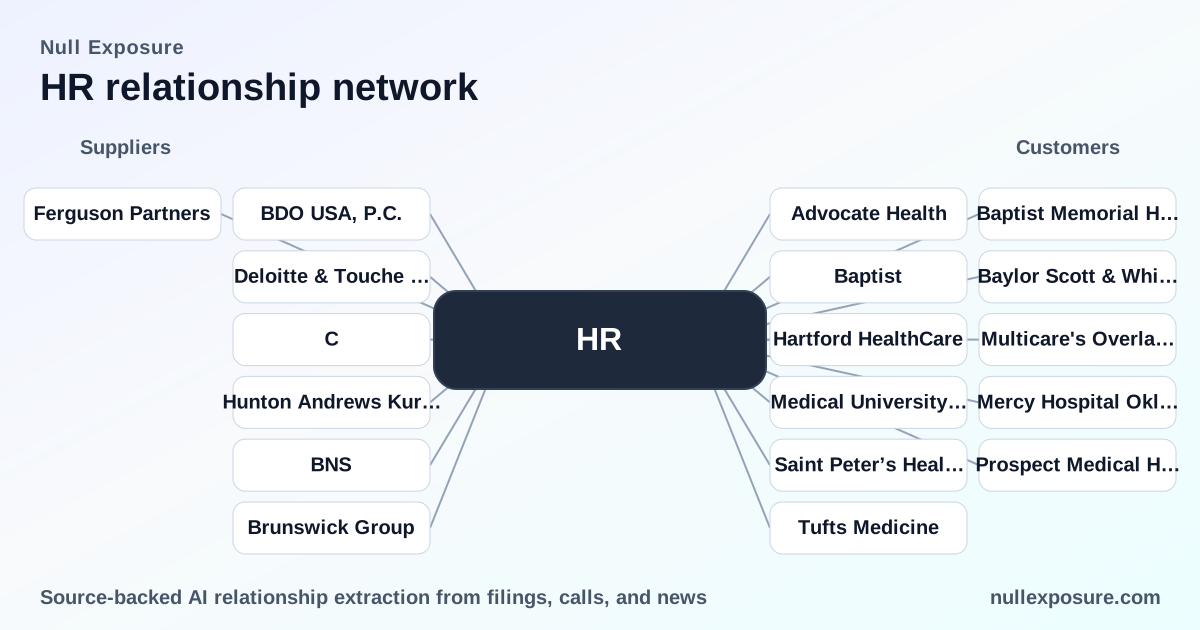
Healthcare Realty Trust (HR) — supplier relationships that shape financing and operational risk
Healthcare Realty Trust operates and monetizes as a specialized healthcare REIT: it acquires, develops, leases and manages outpatient medical properties and earns returns through rental income, development spreads and strategic asset sales while funding growth with debt and equity. The firm’s economics depend on long-duration ground leases, recurring tenant cash flows and active capital markets access to refinance and hedge interest-rate exposure. For investors evaluating HR’s supplier relationships, the key question is whether advisers, auditors and financing counterparties reduce execution risk or concentrate dependency that could impair access to capital. Explore more company supplier intelligence at https://nullexposure.com/.
Why supplier mapping matters for a capital-intensive REIT
Healthcare Realty is a high-leverage, asset-heavy business. Long-term contractual commitments, large-capital vendors and external advisors are intrinsic to the model — from auditors who validate financial statements to banks and advisers that enable M&A and debt placement. Filings show approximately $4.9 billion of outstanding indebtedness and extensive ground leases with weighted average terms measured in decades, so supplier posture directly affects funding flexibility and covenant management. The relationships below capture the most consequential counterparties disclosed in public notices and filings.
Quick link: if you want consolidated supplier profiles and risk flags, visit https://nullexposure.com/ for a focused investor view.
The operating model you need to know
Healthcare Realty’s supplier posture reflects a mature listed REIT with three operating characteristics that matter for investors:
- Contracting posture: long-duration exposure. The company holds hundreds of ground leases and long-dated notes; filings as of December 31, 2024 show ground lease expirations extending through 2119 and portfolio-level lease obligations stretching decades. This yields stable real estate cash flows but locks the firm into long-term counterparty and financing relationships.
- Concentration and criticality: capital markets and lenders are critical. HR’s filings emphasize that “access to external capital on favorable terms is critical to the Company’s success,” and roughly two-thirds of principal balances are scheduled after 2026 — a signal that refinancing capability is central to strategy.
- Maturity and spend profile: large, recurring vendor spend. The company runs both high-dollar hedges and capital programs (interest-rate derivatives ~ $1.1 billion; development and tenant-improvement commitments in the hundreds of millions), indicating a high spend-band profile that makes large financial and advisory suppliers material to operations.
Supplier relationships and what they mean for investors
Below I cover every relationship disclosed in the supplied results. Each entry gives a plain-English summary and a concise source reference.
BDO USA, P.C. — outgoing independent auditor
BDO served as Healthcare Realty’s independent registered public accounting firm and had provided audit and internal control attestation work dating back to 2005; the firm’s long tenure underpinned historical reporting continuity. According to the company’s 2024 filings, BDO issued an unqualified audit opinion for 2024 but was replaced by Deloitte in February 2026 (company filings and press releases, 2024–2026).
Deloitte & Touche LLP — incoming independent auditor
On February 19, 2026 Healthcare Realty’s Audit Committee replaced BDO with Deloitte & Touche LLP as the independent registered public accounting firm, a change that shifts primary external financial assurance to a large global auditor. The auditor transition was reported in market commentary in March 2026 and formalized in company disclosures (Simply Wall St coverage, March 2026).
Citigroup Global Markets Inc. — lead financial adviser on strategic combination
Citigroup acted as Healthcare Realty’s lead financial advisor in the $18 billion strategic combination with Healthcare Trust of America announced in February 2022, playing a central role in valuation, structuring and syndication strategy. This advisor relationship was disclosed in the company’s merger announcement (GlobeNewswire, February 28, 2022).
Hunton Andrews Kurth LLP — legal adviser for the 2022 transaction
Hunton Andrews Kurth served as legal counsel to Healthcare Realty in the 2022 strategic combination, advising on transaction documentation, regulatory matters and closing mechanics. The legal role was reported in the merger press release (GlobeNewswire, February 28, 2022).
Scotiabank — financial adviser role in 2022 combination
Scotiabank provided secondary financial advisory services to Healthcare Realty in the 2022 strategic combination, supporting deal execution and market outreach alongside Citigroup. The contribution is described in the same merger announcement (GlobeNewswire, February 28, 2022).
Brunswick Group — external communications partner in CEO transition
Brunswick Group acted as media contact in Healthcare Realty’s April 2025 announcement naming Peter A. Scott as President and CEO, indicating the company engaged a high-profile PR adviser to manage executive transition messaging. The role is visible in the April 7, 2025 press release (GlobeNewswire, April 2025).
Ferguson Partners — executive search advisor to the Board
Ferguson Partners supported the Board’s CEO search process that concluded with the April 2025 appointment, reflecting use of an executive search firm to source and vet senior leadership candidates. The assistance was disclosed in the company press release announcing the CEO appointment (GlobeNewswire, April 2025).
Mid-article investor takeaway
- Auditor change is a governance event investors should track: a move from BDO to Deloitte reallocates audit risk to a Big Four firm and can affect audit costs, scope and future disclosures.
- Advisers used in major transactions and leadership changes are established, suggesting deliberate governance of strategic execution.
If you want a compact supplier-risk dashboard for HR, visit https://nullexposure.com/ to see how these counterparties map to covenant and refinancing timelines.
Investment implications — four points for portfolio managers
- Refinancing risk is the dominant supplier-related hazard. High indebtedness and long-dated credit relationships make bank and capital markets counterparties critical to execution; a deterioration in funding markets would be consequential.
- Operational stability is supported by long leases but constrained by debt covenants. Long-term ground leases stabilize rental cash flows but limit liquidity flexibility when combined with restrictive debt covenants disclosed in filings.
- Vendor concentration at scale increases single-event impact. Large spend bands (development, tenant improvements, hedges) mean a small set of advisors, lenders and service providers can materially influence timing and cost.
- Governance and transparency improved by auditor upgrade. Transitioning to Deloitte signals a shift to a larger auditor platform that typically brings additional resources for complex accounting and internal control testing.
Conclusion and next steps
Healthcare Realty’s supplier map is consistent with a mature, capital markets–driven REIT: long-term contractual exposure, meaningful dependence on advisory and financing partners, and material vendor spend that together create both durability and concentration risk. Investors should prioritize monitoring covenant compliance, refinancing pipelines and the operational impacts of auditor and executive transitions.
For an executive supplier-risk summary and comparative benchmarks, see the HR supplier intelligence hub at https://nullexposure.com/. If you want a tailored briefing or peer comparison for portfolio due diligence, request a focused report via https://nullexposure.com/ and get a concise analysis aligned to your investment horizon.