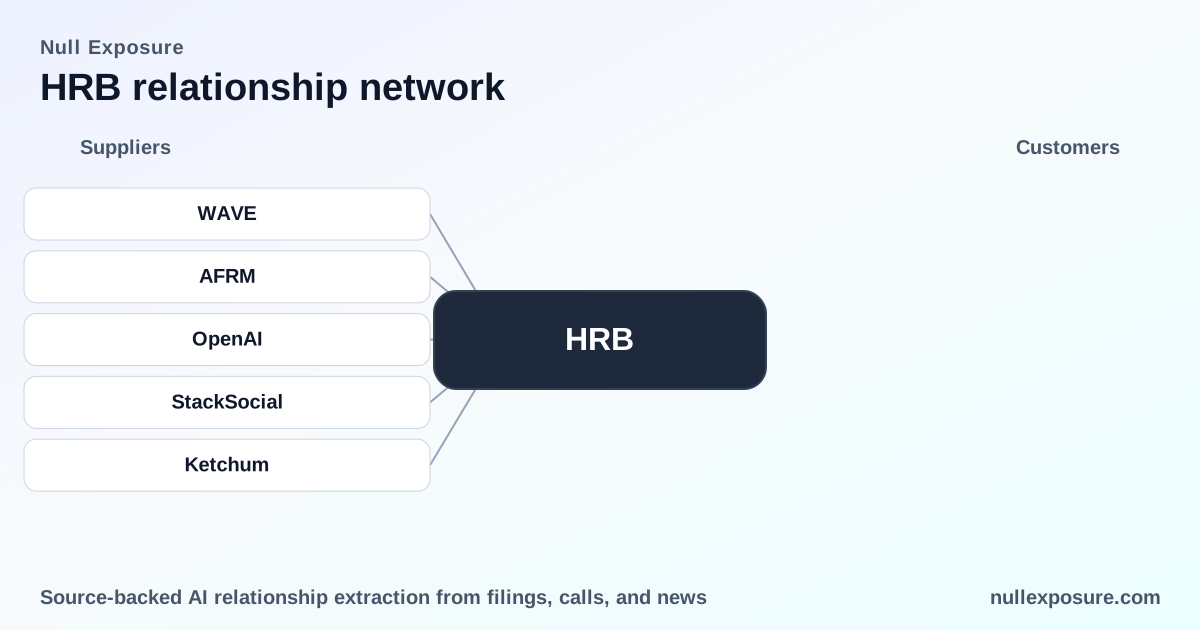
H&R Block (HRB) — Supplier relationships that shape distribution, payments and AI-enabled tax services
H&R Block operates a seasonal, scale-driven tax services and software business that monetizes through assisted preparation fees, DIY software sales, and embedded financial products such as Emerald Cards and client loans. The company leverages a mix of retail franchises, digital channels and third-party financial and technology partners to capture wallet-share during peak filing windows and to extend product economics year‑round via payments, lending participation and software distribution.
For investors evaluating supplier counterparty risk and upside from partnerships, the incremental revenue and customer‑acquisition lift tied to payments, digital distribution and generative AI integrations are the most material levers. Read on for a relationship-by-relationship breakdown and company-level operating constraints that drive procurement posture and vendor risk. If you want continuous monitoring of these counterparties, visit https://nullexposure.com/ for coverage and alerts.
What the partner list tells you about H&R Block’s operating model
H&R Block runs a hybrid go‑to‑market: seasonal retail offices plus digital distribution and embedded financial services. That hybrid model creates concentrated vendor dependencies (cloud, card processing, program management banks) and a mix of short and long contractual commitments that affect flexibility and cost structure.
- Contracting posture: The company maintains long-term credit and program management agreements for financing and liquidity, alongside short-term retail leases tied to tax seasons. This structure favors liquidity preservation and operational flexibility while locking in financing capacity through 2027–2030.
- Concentration and criticality: Technology, cloud, and financial‑services vendors are material to operations; failures in these areas would have a material impact on results. The firm intentionally engages a limited set of specialists for mission‑critical services, which increases vendor concentration risk but reduces integration overhead.
- Spend and maturity: Technology and outsourced services are high-dollar line items (hundreds of millions), indicating mature, high‑value vendor relationships that are active and in many cases renewing.
- Geography and resourcing: Operational footprint spans North America and APAC (Australia and shared services in India), which spreads execution risk but increases complexity for payroll, compliance and data sovereignty.
A focused investor takeaway: the strategic value of any payment, distribution, or cloud partner is amplified by H&R Block’s seasonality and high per‑client lifetime value. To track material shifts, monitor program management agreements, cloud SLAs, and any change in finance‑partner participation levels.
Active supplier relationships in the public record
Below I cover every relationship referenced in the supplied results. Each entry contains a short plain‑English summary and a concise source citation.
Wave — small‑business distribution channel
H&R Block distributes small business solutions through Wave as part of its online offering for business clients, positioning Wave as a digital retail channel alongside company‑owned and franchise offices. According to a Marketscreener piece tied to H&R Block commentary in March 2026, Wave is referenced as part of the company’s online small‑business solution mix (Marketscreener, Mar 2026 — see article URL).
Source: Marketscreener article on H&R Block dividend and business channels (2026-03-10) — https://www.marketscreener.com/news/h-r-block-keeps-quarterly-dividend-at-0-42-per-share-payable-april-6-to-holders-of-record-march-4-ce7e5adbd98bf32c
Affirm (AFRM) — Canada installment payments partnership
H&R Block Canada signed a partnership with Affirm to offer installment payments for tax services, a customer‑financing play designed to raise service uptake and average ticket values in Canadian retail channels. MarketBeat and TradingView reported the Affirm partnership as a FY2026 development expanding Affirm beyond retail categories into tax services (MarketBeat/TradingView, Mar 2026).
Sources: MarketBeat instant alert (2026-02-28) and TradingView/Zacks piece summarizing the Affirm–H&R Block Canada deal (Mar 2026) — https://www.marketbeat.com/instant-alerts/filing-ibex-wealth-advisors-has-524-million-stock-position-in-hr-block-inc-hrb-2026-02-28/ and https://www.tradingview.com/news/zacks:397685efd094b:0-affirm-expands-into-tax-services-with-h-r-block-canada-deal/
OpenAI — generative AI tooling for tax professionals and DIY users
H&R Block has collaborated with OpenAI to integrate GenAI tools into both professional (Tax Pro) and DIY workflows, using AI to improve throughput, quality control and user experience in tax preparation. Commentary and analysis in January 2026 highlighted this integration as part of the company’s product innovation push (Sahm Capital / SimplyWallSt, Jan 2026).
Sources: Sahm Capital analysis and SimplyWallSt summary noting the OpenAI collaboration and the January 2026 Tax Pro Review offer (2026-01-18 / Jan 2026) — https://www.sahmcapital.com/news/content/is-hr-blocks-hrb-free-tax-pro-review-trial-redefining-its-hybrid-moat-in-tax-prep-2026-01-18 and https://simplywall.st/stocks/us/consumer-services/nyse-hrb/hr-block/news/is-hr-blocks-hrb-free-tax-pro-review-trial-redefining-its-hy
StackSocial — third‑party retail software discounts
H&R Block software editions are distributed through discount platforms such as StackSocial, which lists promotional offers for H&R Block Tax Software Deluxe + State products. This amplifies retail reach for DIY products and drives incremental boxed‑software sales (6AMCity promotion, 2026).
Source: 6AMCity promotional listing for H&R Block tax software (Mar 2026) — https://6amcity.com/the-buy/h-r-block-tax-coupon-file
Ketchum — PR and media contact for Canadian communications
Ketchum is listed as the media contact for H&R Block Canadian communications around tax credits, handling press inquiries and distribution of corporate announcements; GlobeNewswire cited H&R Block c/o Ketchum in February 2026. This is a standard external communications relationship that supports regulatory and consumer messaging in Canada (GlobeNewswire, Feb 2026).
Source: GlobeNewswire press release referencing H&R Block media contact via Ketchum (2026-02-03) — https://www.globenewswire.com/news-release/2026/02/03/3230889/0/en/Expanded-tax-credits-help-offset-fertility-treatment-costs-for-Canadians.html
If you want ongoing alerts about these suppliers and how they impact HRB risk and revenue, check coverage at https://nullexposure.com/.
How these relationships map to enterprise risk and opportunity
- Payments partnerships (Affirm/Pathward participation): Payment financing lifts conversion and average spend, particularly in Canada; however, financing programs create credit and regulatory exposure and are tied to multi‑year program agreements and participation economics. This is a revenue amplifier with embedded counterparty risk.
- Cloud and AI providers (Microsoft, OpenAI): Generative AI and cloud compute are operationally critical and appear in the company’s risk disclosures as material; outages or degraded service would have a material impact. Technology partnerships are both high‑value and high‑risk.
- Distribution partners (Wave, StackSocial): Digital channels expand distribution and diversify customer acquisition cost, but the firm also keeps a large franchise and lease footprint, preserving offline economics and cross‑sell opportunities.
- Communications and advisory (Ketchum, Deloitte): External PR and audit relationships underscore governance and reputational risk management; these are necessary for regulatory compliance and investor transparency.
Midway CTA: For a deeper supplier risk scorecard and timeline of contract renewals, visit https://nullexposure.com/ and request HRB supplier intelligence.
Investment implications and final takeaways
H&R Block’s supplier posture is consistent with a mature services firm: high absolute spend on technology and outsourced services, long‑dated credit and program agreements for liquidity, and targeted short‑term lease commitments aligned with seasonality. The most investable dynamics are the commercialization of payments partnerships and AI‑enabled product improvements, which directly influence average revenue per client and retention.
Key investment signals:
- Positive: Payment partnerships (Affirm) and AI integrations (OpenAI) are additive to revenue per customer and could increase digital conversion without proportionate increase in fixed cost.
- Watchlist: Vendor concentration in cloud and financial services is material; operational disruptions or adverse contract re‑pricing would have an outsized effect on margins and service delivery.
- Governance: Audit and PR relationships are in place and active; monitoring program renewals and participation rates in financed products will be critical.
Closing CTA: Track active supplier changes and renewal events for HRB at https://nullexposure.com/ to convert vendor signals into actionable investment insight.