Harmony Biosciences (HRMY) — supplier relationships, licensing posture and operational constraints investors should price in
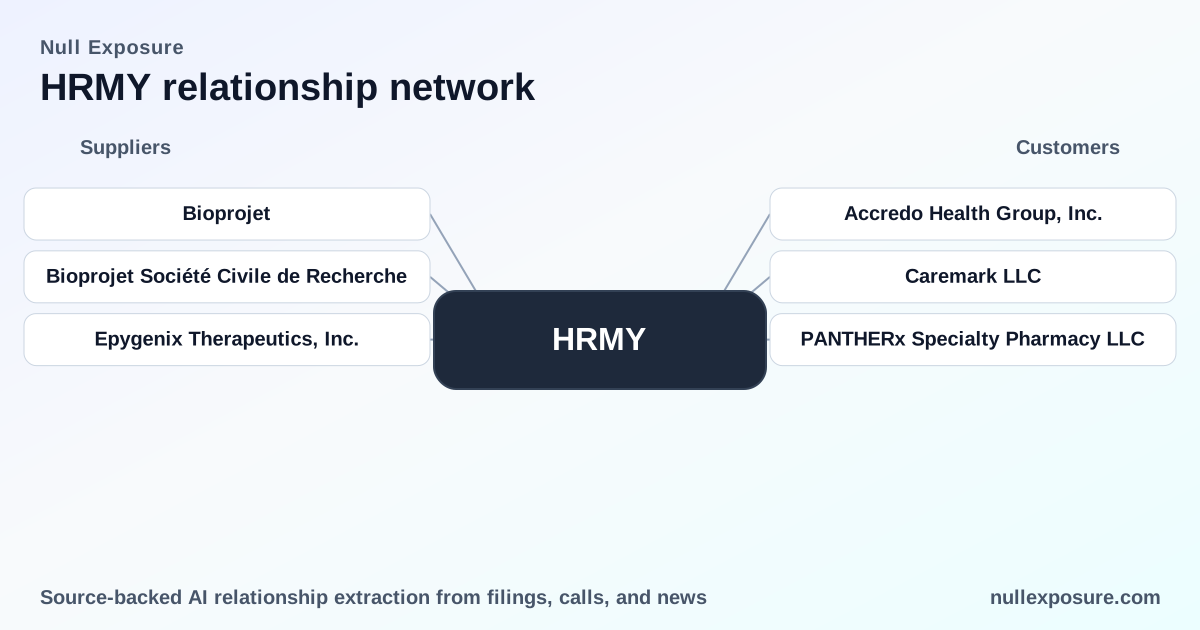
Harmony Biosciences operates as a commercial-stage specialty pharmaceutical company that monetizes primarily through sales of WAKIX (pitolisant) and related formulations while augmenting revenue and future optionality through in‑licenses, sublicenses and targeted acquisitions of development-stage assets. Harmony recognizes upfront license fees and milestone expenditures as R&D charges, pays tiered royalties to originators, relies on third‑party manufacturers and logistics partners for supply and distribution, and services debt through a multi‑year term‑loan facility. For investors and operators assessing counterparty risk, the company’s economics are driven by royalty obligations to licensors, concentrated manufacturing suppliers, and ongoing M&A/licensing spend tied to pipeline growth. Read the firm view and supplier map below; for a faster supplier-risk summary visit https://nullexposure.com/.
Executive snapshot: how Harmony makes money and where supplier risk sits
Harmony’s revenue base—$868m TTM—is dominated by WAKIX sales, with cost structure including royalties to licensors (Bioprojet), manufacturing and distribution costs paid to CDMOs and third‑party logistics providers, and periodic large license or milestone payments when acquiring or sublicensing assets. The company’s operating leverage and margin profile are sensitive to (1) royalty tiers under its Bioprojet license, (2) single‑source API and CDMO exposure, and (3) milestone-driven cash outflows for collaborators and acquisition targets. Harmony services long‑term debt (term loans maturing 2028) that introduces financing covenants and prepayment triggers tied to corporate actions. For a concise supplier-risk dashboard see https://nullexposure.com/.
What every disclosed relationship in the record actually means (short, sourced)
Bioprojet
Harmony holds exclusive U.S. commercialization rights to pitolisant and the WAKIX trademark under a long-standing license from Bioprojet; this license drives both royalty costs and product exclusivity for Harmony’s core commercial franchise. According to a Harmony press release and investor guidance (March 10, 2026), Harmony projects WAKIX revenue expansion and reiterates its exclusive U.S. development/manufacturing/commercial rights licensed from Bioprojet. (Source: Harmony press material reported on BioSpace, 10 March 2026.)
Bioprojet Société Civile de Recherche
Public investor communications reiterate that the company’s foundational license for pitolisant was executed with Bioprojet Société Civile de Recherche and continues to underpin product sales and royalty obligations; investor summaries tied to FY2026 guidance restate the exclusive U.S. license and the contractual royalty framework. (Source: InvestingNews coverage of Harmony FY2025/FY2026 guidance, published 10 March 2026.)
Bioprojet (sublicense for BP1.15205 referenced in SEC filing)
Harmony executed a sublicense with Bioprojet for an orexin‑2 receptor agonist (BP1.15205), granting exclusive U.S. and Latin American rights for development, manufacture and commercialization, with upfront fees, milestone payments and mid‑teens royalty rates on net sales. This sublicense was disclosed in Harmony’s regulatory filings and summarized in market commentary tied to the company’s 10‑K review. (Source: SEC 10‑K summary reported on TradingView, referencing Harmony’s April 2024 sublicense and FY2026 filings.)
Epygenix Therapeutics, Inc.
Harmony acquired Epygenix in April 2024, gaining exclusive rights to clemizole (EPX‑100) for Dravet and Lennox‑Gastaut syndromes; the deal expanded Harmony’s rare‑disease pipeline via an all‑stock/cash consideration and was recorded as an asset acquisition in FY2024 filings. (Source: Harmony acquisition disclosure summarized in TradingView’s SEC 10‑K report, referencing the April 2024 closing.)
Contracting posture, concentration and criticality — what the constraints signal
-
Licensing-first growth model. Harmony routinely uses exclusive licensing and sublicensing to secure commercial rights and pipeline assets; licensing is a core operating lever and a predictable cash sink (upfront fees, milestone schedules, and sales‑based royalties). Harmony capitalizes large license fees as IPR&D or expenses and carries multi‑year royalty obligations (explicit tiered royalties for pitolisant). This structure aligns commercial upside with third‑party IP holders and increases the persistence of royalty‑based COGS.
-
Long‑term financing and contractual commitments. The firm carries multi‑year term loans and manufacturing/office leases, creating obligations through at least 2028 that constrain strategic optionality and expose Harmony to covenant risk if operating performance weakens. Management acknowledges compliance with covenants as of recent filings, but debt amortization and potential prepayment triggers remain drivers for liquidity planning.
-
Single‑source manufacturing and distribution concentration. Harmony outsources critical manufacturing steps (raw intermediates, API and finished product) to specialized CDMOs and uses third‑party logistics for distribution; the firm discloses dependence on sole suppliers for the API and limited‑experience manufacturers for some inputs, making supply continuity a top operational risk and a material line item in cost of goods sold.
-
Materiality and regulatory criticality. Multiple constraints flagged as material or critical—manufacturing compliance (cGMP), reliance on third parties for clinical development (CROs, CMOs), and patent/licensing durability—mean a supply, regulatory or IP disruption would have outsized commercial impact.
-
Geographic footprint is North America‑centric but global in scope for assets. Licensing rights emphasize the United States and Latin America for new pitolisant formulations and BP1.15205; acquisitions and IP holdings carry global considerations, with select grant‑backs for Greater China. Foreign vendor relationships (Europe, Australia) create modest operational exposures.
Operational implications for investors and operators
-
Earnings sensitivity: Cost of goods sold will fluctuate with royalty cliff/tier movements and any supply chain disruptions; recognition of large license fees as R&D or IPR&D compresses near‑term profitability while increasing option value for pipeline assets.
-
Execution risk is concentrated in manufacturing and third‑party service management; the firm’s supply model requires active vendor oversight, contingency inventory (Harmony reports extended finished‑goods buffers) and potential secondary sourcing to derisk single‑source suppliers.
-
Balance sheet and covenant monitoring should be an investor priority; outstanding term loan principal and scheduled amortization through July 2028 create a refinancing or repayment profile that intersects with growth investments and milestone payments.
For a focused supplier exposure scorecard and to monitor changes in Harmony’s partner roster, visit https://nullexposure.com/.
Bottom line — investment and operational thesis
Harmony’s business is commercially proven on WAKIX and strategically built through licensing and targeted acquisitions that expand indications and long‑term revenue potential. The company’s strengths—strong gross margins on core product and a clear licensing engine—are balanced by concentrated manufacturing suppliers, material royalty obligations to Bioprojet, and a multi‑year debt service profile that increases the value of disciplined supply‑chain and IP management. Investors should underwrite upside to new indications and BP1.15205 commercialization against the counterparty and manufacturing concentration risks documented in filings; operators should prioritize supply‑chain diversification and rigorous vendor governance to protect revenue continuity.
For an up‑to‑date supplier risk brief and dialogue with our analyst team, go to https://nullexposure.com/.