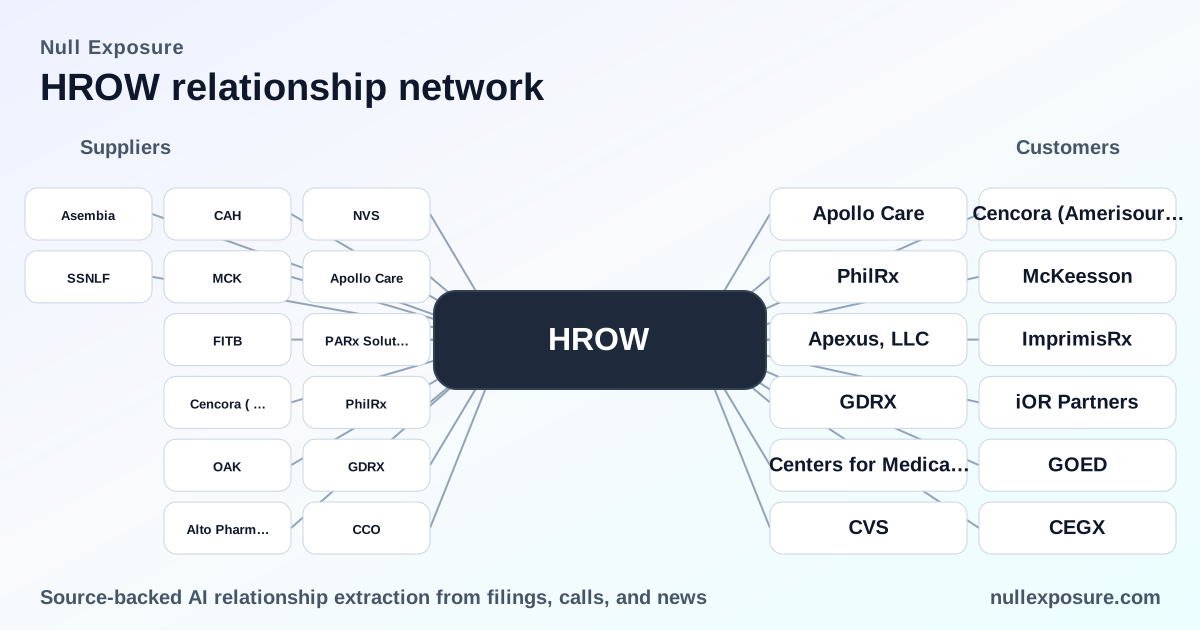
Harrow Health (HROW): supplier map and commercial posture investors need to know
Harrow Health is an ophthalmology-focused commercial-stage healthcare company that acquires exclusive U.S. commercial rights to branded ophthalmic products, licenses in late-stage assets, and monetizes through product sales distributed via specialty pharmacies and the three major pharmaceutical wholesalers. The company supplements sales with copay programs and patient-access partnerships while relying heavily on third‑party manufacturers and specialty distributors to deliver inventory. For investors evaluating supplier exposure, Harrow’s model is license-and-distribute, with material counterparty concentration and meaningful near-term financing maturities—factors that directly influence liquidity and operational risk (Revenue TTM: $250.0M). Learn more about Harrow supplier intelligence at https://nullexposure.com/.
Why supplier relationships matter to Harrow’s economics
Harrow operates as an asset-acquirer and licensor: it pays upfront/milestone consideration to acquire NDAs and product rights, then outsources manufacturing and distribution to third parties while owning the commercial economics. That operating model produces several structural characteristics:
- Contracting posture: a mix of long-term financial and real estate obligations and licensing/asset purchases rather than vertically integrated manufacturing. Long-dated leases and senior notes create durable fixed obligations that compress free cash flow available to fund distribution and marketing.
- Concentration and criticality: a small set of suppliers and wholesalers handle manufacturing and distribution for core products, making outages or quality issues potentially material to revenue.
- Maturity and refinancing risk: substantial debt principals are scheduled in the near term, requiring either refinancing or significant cash deployment.
- Licensing-led growth: Harrow routinely acquires exclusive U.S. commercial rights and licenses (Santen, Novaliq and others), shifting regulatory and manufacturing execution risk to third parties while keeping commercialization upside.
For a detailed vendor list and relationship notes see below — and if you want structured supplier scoring for investment due diligence, visit https://nullexposure.com/ for vendor-level exposure analysis.
Active relationships — what each supplier or partner does for Harrow
Below I list every relationship captured in the source feed with a concise plain-English summary and the original source reference.
-
Novartis (multiple entries) — Harrow acquired exclusive U.S. commercial rights to five FDA‑approved ophthalmic products from Novartis and paid milestone and one-time consideration as part of the NVS‑5 asset purchase; Novartis also agreed to supply the products during transition and assist with technology transfer. Sources: MMM‑Online and Pharmaceutical‑Technology reporting on the NVS‑5 acquisition and follow‑up (https://www.mmm-online.com/home/channel/the-wire/novartis-sells-u-s-rights-to-five-drugs-to-harrow-for-up-to-175m/; https://www.pharmaceutical-technology.com/news/harrow-novartis-ophthalmic-products/).
-
Apollo Care — Harrow partnered with Apollo Care to manage and deploy copay and patient-access programs supporting the commercial launch of VEVYE, integrating patient financial assistance into distribution workflows. Source: eyesoneyecare Glance coverage of VEVYE market access (https://glance.eyesoneyecare.com/stories/2024-01-03/harrow-prepares-to-launch-widespread-market-access-for-vevye/).
-
PARx Solutions — PARx provides a web-based prescriber technology stack (provided free to clinicians) used by Harrow for prescription routing and patient access for VEVYE. Source: eyesoneyecare Glance on VEVYE launch (https://glance.eyesoneyecare.com/stories/2024-01-03/harrow-prepares-to-launch-widespread-market-access-for-vevye/).
-
PhilRx — PhilRx is Harrow’s pharmacy partner and electronic prior authorization (PA) pathway; clinicians can route prescriptions through EMRs to PhilRx or retail pharmacies, supporting fast fulfillment of VEVYE. Source: eyesoneyecare Glance VEVYE availability story (https://glance.eyesoneyecare.com/stories/2024-01-11/vevye-is-officially-available-in-the-us/).
-
GoodRx — Harrow launched a strategic partnership with GoodRx to expand patient access and lower out‑of‑pocket costs for select branded products as part of an access initiative. Source: Glance coverage of Harrow access initiative (https://glance.eyesoneyecare.com/stories/2024-11-15/harrow-launches-initiative-for-expanded-access-price-cuts-of-branded-products/).
-
Besse Medical / Cencora — Harrow’s TRIESENCE product is available through major specialty distributors including Besse Medical / Cencora, enabling hospital and clinic fulfillment for injectables. Source: BioSpace press release on TRIESENCE reimbursement status (https://www.biospace.com/press-releases/harrow-announces-transitional-pass-through-reimbursement-status-for-triesence-triamcinolone-acetonide-injectable-suspension-40-mg-ml).
-
Cardinal Health / Cardinal Specialty / Metro Medical — Cardinal is named among the specialty distributors through which TRIESENCE and other products are orderable, supporting Harrow’s hospital/clinic channels. Source: BioSpace on TRIESENCE distribution (https://www.biospace.com/press-releases/harrow-announces-transitional-pass-through-reimbursement-status-for-triesence-triamcinolone-acetonide-injectable-suspension-40-mg-ml).
-
McKesson / McKesson Medical‑Surgical — McKesson is a primary wholesale distributor for Harrow’s branded products and part of the distribution triad that includes Cardinal and Cencora. Source: BioSpace and Glance articles referencing wholesale distribution (https://www.biospace.com/press-releases/harrow-announces-transitional-pass-through-reimbursement-status-for-triesence-triamcinolone-acetonide-injectable-suspension-40-mg-ml; https://glance.eyesoneyecare.com/stories/2024-01-11/vevye-is-officially-available-in-the-us/).
-
Fifth Third Bank, National Association — Harrow entered a commitment letter for a new revolving credit facility with Fifth Third Bank in conjunction with its 2025 financing and note offering. Source: GlobeNewswire release on 2025 senior notes and credit facility (https://www.globenewswire.com/news-release/2025/09/08/3146043/0/en/Harrow-Announces-Offering-of-250-0-Million-Senior-Unsecured-Notes-Due-2030.html).
-
Oaktree Fund Administration, LLC — Oaktree acted as administrative agent for Harrow’s prior secured facility; Harrow repaid its facility with Oaktree and had previously relied on Oaktree financing which matured in early 2026. Source: GlobeNewswire press material on note offering and debt repayment (https://www.globenewswire.com/news-release/2025/09/08/3146043/0/en/Harrow-Announces-Offering-of-250-0-Million-Senior-Unsecured-Notes-Due-2030.html).
-
Alto Pharmacy Powered by Fuze Health — Harrow added Alto Pharmacy (Fuze Health‑powered) as a specialty pharmacy partner to support VAFA program fulfillment, broadening specialty pharmacy coverage. Source: Harrow Q3 2025 financial results release (https://www.globenewswire.com/news-release/2025/11/10/3185049/0/en/Harrow-Announces-Third-Quarter-2025-Financial-Results.html).
-
Asembia — Harrow initiated a multi‑year partnership with Asembia to expand access to more than ten branded ophthalmic products across the U.S. as part of its access program. Source: Glance reporting on Harrow’s expanded access initiative (https://glance.eyesoneyecare.com/stories/2024-11-15/harrow-launches-initiative-for-expanded-access-price-cuts-of-branded-products/).
-
Cencora (AmerisourceBergen) — Cencora is listed as a wholesale distributor for VEVYE and other products, providing alternative distribution capacity along with McKesson and Cardinal. Source: Glance VEVYE availability article (https://glance.eyesoneyecare.com/stories/2024-01-11/vevye-is-officially-available-in-the-us/).
-
McKeesson (alternate spelling in sources) — The source feed contains a spelling variant; the role is the wholesale distribution function already noted under McKesson. Source: Glance VEVYE notice (https://glance.eyesoneyecare.com/stories/2024-01-11/vevye-is-officially-available-in-the-us/).
-
Samsung — Management referenced Samsung as a commercial partner supporting pre‑launch activities and preparation, indicating non‑pharma technology or device collaboration. Source: Q4 2025 earnings call transcript coverage (InsiderMonkey) (https://www.insidermonkey.com/blog/harrow-health-inc-nasdaqhrow-q4-2025-earnings-call-transcript-1708819/).
-
PhilRx / PARx / Apollo Care (additional mentions) — These three healthcare technology and pharmacy access partners are repeatedly cited across VEVYE launch and patient-access communications and work together for electronic PA, copay deployment and prescriber tooling. Sources: multiple Glance articles on VEVYE (https://glance.eyesoneyecare.com/stories/2024-01-03/harrow-prepares-to-launch-widespread-market-access-for-vevye/; https://glance.eyesoneyecare.com/stories/2024-01-11/vevye-is-officially-available-in-the-us/).
Investment implications — what to monitor next
- Supply chain and manufacturing risk are material and critical. Harrow does not vertically manufacture finished product and relies on third‑party contract manufacturers; failures or FDA inspection problems at those facilities would be immediately consequential.
- Distributor concentration is a single‑point risk. Sales flow through McKesson, Cardinal and Cencora; a distribution outage or security incident at a wholesaler would materially affect delivery.
- Debt maturity and refinancing risk are immediate. The company carried senior notes and Oaktree facilities with near‑term maturities — review financing covenants and refinancing progress closely (Oaktree and Fifth Third Bank references in company filings and press releases).
- Licensing and M&A drive capex and spend volatility. One‑time payments (Novartis payments and Santen acquisition) drive large cash outflows; investors should treat acquisition cadence as a recurring capital allocation lever.
- Geographic concentration is U.S.‑centric. Most finished products are made for and distributed in the U.S., concentrating regulatory and commercial risk domestically.
If you want a systematic risk score and supplier exposure dashboard for HROW, check the platform at https://nullexposure.com/ for a vendor-by-vendor risk matrix.
Bottom line
Harrow’s business is a licensing-and-commercialization model that converts acquired ophthalmic product rights into recurring sales through specialty distributors and pharmacy partners. That model delivers attractive gross margins but introduces concentrated supplier dependency and near‑term financing maturities that require active monitoring. For investors and operators, the priority checklist is manufacturing quality controls, distributor resilience, and the company’s refinancing execution. For deeper supplier intelligence and to track counterparty changes in real time, visit https://nullexposure.com/.