Heritage Insurance Holdings (HRTG): supplier relationships, reinsurance posture, and investor implications
Heritage Insurance Holdings underwrites coastal residential and selected commercial property & casualty risks and monetizes through insurance premiums, disciplined underwriting, reinsurance optimization, and investment income on its fixed-maturity portfolio. The company offsets catastrophe exposure through a layered reinsurance program (including quota-share, excess-of-loss towers, captive reinsurance and sponsored catastrophe bonds), collects ceding commissions, and is investing in modern policy/claims infrastructure to improve loss ratios and speed to settlement. For investors, the critical signals are Heritage’s heavy, recurring reinsurance spend, short-term contracting cadence, and strategic technology and captive relationships that compress volatility and operating cost. Learn more at https://nullexposure.com/.
How Heritage organizes suppliers: short contracts, big dollars, captive engineering
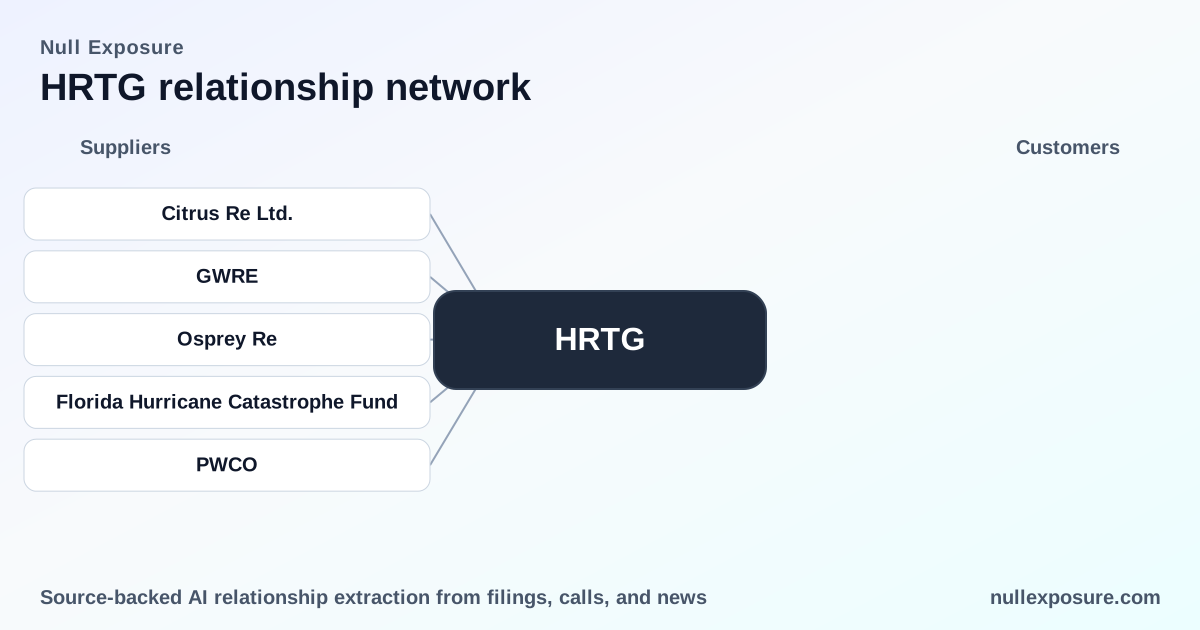
Heritage runs a classic property-insurer supplier model: reinsurance and claims/IT vendors are both strategic and material. The company buys the majority of its catastrophe protection on annual contracts that commence June 1 and are amortized over 12 months; this creates a predictable but recurring rate and capacity reset risk every renewal. Heritage supplements annual treaties with a Bermuda captive (Osprey Re) and sponsors catastrophe bonds (Citrus Re) to access capital markets and reduce immediate ceded-cost volatility.
Heritage also licenses core insurance software and analytics from third parties and has recently committed to Guidewire Cloud to modernize policy administration, underwriting and billing, a step that makes third‑party software both an operational dependency and a potential source of efficiency. The company’s distribution model remains agent-centric and regionally concentrated, and the Florida market exposure makes participation in the Florida Hurricane Catastrophe Fund (FHCF) a regulatory necessity and a contractually material counterparty relationship. Overall, Heritage shows high reinsurance spend scale (> $100m annually), short-term reinsurance posture, and critical third-party dependencies that require active governance.
Relationship-by-relationship: what investors need to know
Citrus Re Ltd. — sponsored catastrophe bonds support named‑storm cover
Heritage uses Citrus Re special-purpose vehicles to securitize named-storm protection across multiple states and terms; Artemis reported a targeted Citrus Re Series 2026-1 cat bond to provide multi-year indemnity-trigger protection from June 1, 2026 to May 31, 2029. Source: Artemis (March 10, 2026) — https://www.artemis.bm/news/heritage-returns-with-250m-target-for-new-citrus-re-2026-1-named-storm-cat-bond/.
Artemis also noted Heritage previously priced an upsized Citrus Re Series 2023-1 catastrophe bond at $235m, used to add reinsurance capacity in 2023. Source: Artemis (March 10, 2026) — https://www.artemis.bm/news/heritage-secures-citrus-re-2023-1-cat-bond-at-upsized-235m/.
Guidewire Cloud — core platform for policy/claims modernization
Heritage has implemented Guidewire Cloud as part of a strategic technology upgrade to modernize policy administration, underwriting and billing; press messaging describes full InsuranceSuite production on Guidewire Cloud following earlier ClaimCenter implementation. Source: BusinessWire via Markets.FinancialContent (Dec 10, 2025) — https://markets.financialcontent.com/wral/article/bizwire-2025-12-10-heritage-insurance-company-deploys-guidewire-to-modernize-policy-administration-underwriting-and-billing-operations.
Media analysis and equity commentary repeatedly cite Guidewire Cloud investments as a component of Heritage’s productivity and underwriting accuracy program. Source: Finviz / TradingView investor coverage (2026) — https://finviz.com/news/243513/heritage-insurance-skyrockets-136-ytd-time-to-buy-the-stock and https://www.tradingview.com/news/zacks:1aacc4015094b:0-heritage-insurance-stock-falls-3-6-ytd-time-to-buy-the-dip/.
Guidewire Software, Inc. / Guidewire (multiple entries) — implementation partner and ecosystem
Heritage engaged Guidewire PartnerConnect Consulting member PwC to lead the Guidewire implementation project, signaling reliance on the broader Guidewire partner ecosystem to realize cloud benefits. Source: BusinessWire via Markets.FinancialContent (Dec 10, 2025) — https://markets.financialcontent.com/wral/article/bizwire-2025-12-10-heritage-insurance-company-deploys-guidewire-to-modernize-policy-administration-underwriting-and-billing-operations.
Additional investor write-ups reference Guidewire as a visible technology investment that underpins Heritage’s underwriting and claims workflows. Source: Finviz coverage (2025–2026) — https://finviz.com/news/246497/heritage-insurance-skyrockets-136-ytd-time-to-buy-the-stock-revised and https://finviz.com/news/331343/heritage-insurance-stock-falls-36-ytd-time-to-buy-the-dip.
Osprey Re — captive reinsurer that smooths retention and collateral needs
Heritage uses Osprey Re, its Bermuda captive, to retain portions of reinsurance risk and to buy down retentions; Osprey also requires collateral management (letters of credit, trust accounts) and is an embedded component of Heritage’s reinsurance architecture. Source: Artemis (March 10, 2026) — https://www.artemis.bm/news/heritage-lifts-reinsurance-renewal-13-to-almost-2-5bn-with-only-slight-cost-increase/.
Florida Hurricane Catastrophe Fund (FHCF) — state‑mandated layer and concentration risk
Heritage participates in the FHCF (Heritage elected 90% participation for 2024), which is mandatory for Florida‑admitted business and therefore a material government counterparty in the reinsurance stack. Source: Artemis (2026 reporting on 2024 program) — https://www.artemis.bm/news/heritage-lifts-reinsurance-renewal-13-to-almost-2-5bn-with-only-slight-cost-increase/.
PwC — implementation lead for Guidewire deployment
PwC acted as the Guidewire PartnerConnect Consulting Global Strategic member that led Heritage’s Guidewire implementation, indicating Heritage’s reliance on a Tier‑one consulting partner to de-risk a large technology migration. Source: Markets.FinancialContent / BusinessWire (Dec 10, 2025) — https://markets.financialcontent.com/wral/article/bizwire-2025-12-10-heritage-insurance-company-deploys-guidewire-to-modernize-policy-administration-underwriting-and-billing-operations.
What the supplier map means for valuation and risk
- Short-term contracting posture raises renewal risk: Heritage’s core catastrophe treaties are annual with June 1 renewals and are amortized over 12 months, meaning a single commercial reinsurance cycle can materially change costs and required capital. This is a recurring earnings sensitivity that investors must price into forward multiples.
- Large, concentrated reinsurance spend is a stabilizer and risk: Ceded premiums exceeded $600m in 2024 and aggregate catastrophe limits purchased reached multi‑billion-dollar levels; that scale reduces balance‑sheet volatility but creates counterparty and collateral concentration exposures. Reinsurer credit and FHCF funding capacity are company-level material risks.
- Captive and capital‑markets tools lower net cost and increase optionality: Sponsoring Citrus Re bonds and using Osprey Re allow Heritage to transfer tail risk to capital markets and retain flexibility in retention sizing—this is a positive structural lever for long-term ROE if executed consistently.
- Technology modernization is now an earnings driver: The move to Guidewire Cloud, implemented with PwC, is intended to improve underwriting precision and claims efficiency; this reduces expense and combined-ratio exposure over time but increases short‑term implementation and vendor concentration risk.
- Operational criticality is high: IT, actuarial models and claims vendor networks are essential—Heritage flags cybersecurity, backup and third-party resilience as potential critical failure points. Investors should treat vendor governance as a catalyst or a risk factor depending on execution.
If you want a deeper supplier-level risk scorecard or to map contract expiries and renewal sensitivities for Heritage, start here: https://nullexposure.com/.
Conclusion — actionable investor checklist
Heritage’s business model centers on premium generation, active reinsurance optimization, and improving loss ratios via technology. For investors: (1) monitor the June 1 reinsurance renewal cycle and any changes to FHCF participation; (2) track execution of the Guidewire Cloud rollout and associated run‑rate savings; and (3) watch collateral and counterparty quality in the reinsurer panel and the captive (Osprey Re). Positive drivers are scale in reinsurance purchasing and use of catastrophe bonds; risks are renewal pricing, FHCF funding uncertainty, and third‑party operational failures.
For repository-level intelligence and to monitor supplier shifts across HRTG and peer insurers, visit https://nullexposure.com/.