Heron Therapeutics (HRTX): Supplier relationships that drive production and liquidity
Heron Therapeutics sells branded hospital and peri‑operative products—most notably ZYNRELEF and CINVANTI—and monetizes through direct commercial sales complemented by co‑promotion agreements and lender financing to support manufacturing scale and working capital. Heron’s operating model is built on a small number of contract manufacturers and a thin but commercialized product portfolio, with promotional partners used to extend reach into specialized clinical channels. For a focused supplier-risk view and ongoing monitoring, see https://nullexposure.com/.
How Heron contracts, pays and prioritizes partners — the operating posture in plain English
Heron runs a hybrid contracting posture: a mix of short‑term operational commitments (leases, rebates, distributor settlements) and longer‑dated commercial and financing arrangements. Its public disclosures show both short horizons—operating leases and purchase obligations due within 12–24 months—and multi‑year arrangements for manufacturing capacity and financing. Key operating signals:
- Contract mix: Short‑term operating leases and distributor/rebate settlements coexist with longer‑term manufacturing agreements and multi‑year credit facilities.
- Concentration: The company relies on a small number of contract manufacturers for critical components and finished product, creating supplier concentration risk that translates directly into production and revenue risk.
- Criticality: Several suppliers are described as sole or primary sources for specialized materials; loss of a single vendor could materially disrupt manufacturing.
- Global footprint: Heron sources materials and incurs manufacturing costs in Europe and elsewhere, exposing it to currency and trade policy risks.
- Spend scale: Purchase obligations and committed manufacturing payments are substantial (tens of millions), placing supplier spend squarely in the $10M–$100M band.
Those characteristics define where Heron is vulnerable and where operational management must focus procurement and contingency planning.
Supplier list and what each relationship means for investors
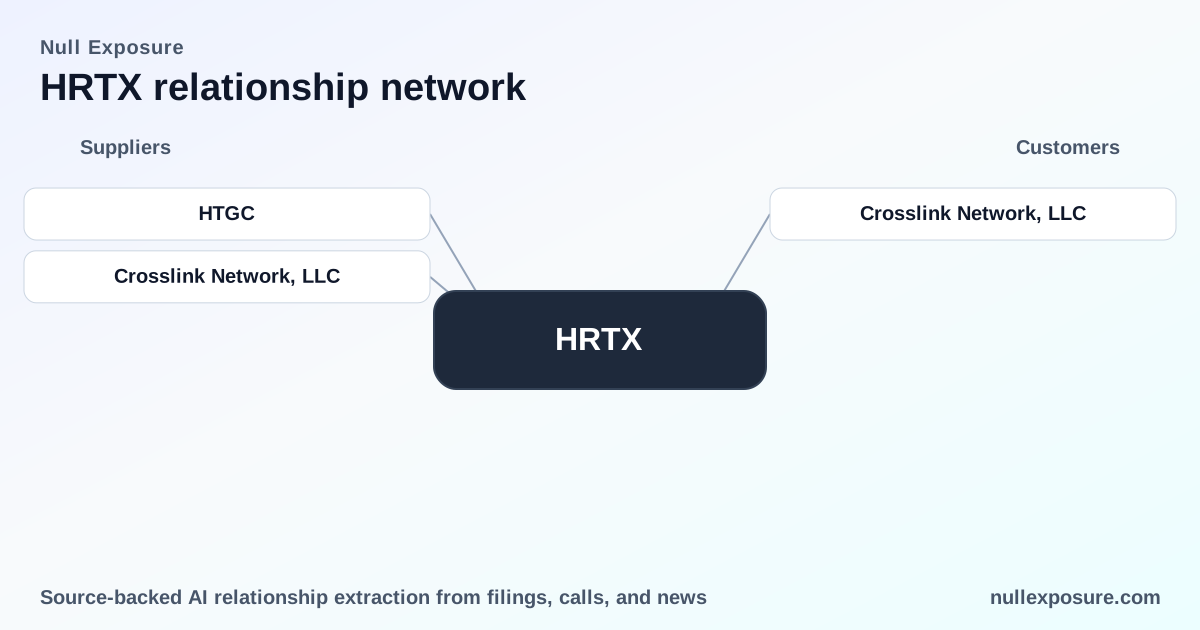
Hercules Capital, Inc. (HTGC)
Heron has multiple financing arrangements with Hercules: a working capital facility executed in August 2023 and a later credit restructuring announced in 2025 that converted or replaced prior debt with a new senior credit facility providing $110 million committed at closing and an additional $40 million in milestone tranches, with a 2030 maturity for the senior facility. According to a Latham & Watkins advisory on the August 2025 restructuring, the facility provides immediate committed capital and contingent tranche availability tied to milestones. (Source: Latham & Watkins news release covering Heron’s credit restructuring, 2025.)
Crosslink Network, LLC
Crosslink is a commercial promotion partner: Heron expanded the promotional effort for ZYNRELEF into the orthopedic surgery market through a co‑promotion agreement, and the company cites that arrangement as a driver of recent net‑revenue growth in its preliminary and final 2025 results. Press releases from GlobeNewswire and PR Newswire detail the co‑promotion and list ZYNRELEF as the largest contributor to Q4 revenue growth. (Sources: GlobeNewswire press releases on Heron financial results, January–February 2026; PR Newswire Heron 2024/2025 financial results release.)
What the constraint signals mean for suppliers and investors
Heron’s disclosures include constraint excerpts that are company‑level signals rather than itemized supplier judgments. Translate those signals into actionables:
- Contracting cadence is mixed but predictable. The presence of both short‑term operating leases and long‑term manufacturing and debt agreements signals a strategy that preserves flexibility for real estate and administrative costs while locking in manufacturing capacity and financing over multi‑year horizons. This reduces short‑run upkeep risk but concentrates execution risk in a few long‑term suppliers.
- Supplier concentration is a critical operational vulnerability. Multiple excerpts state that certain critical materials and components are sourced from single suppliers and that contract manufacturers are currently the sole resource for key components; this is an operational lever that can cause material revenue volatility if disrupted.
- Financial counterparties play a strategic role. Hercules’ facilities and the working capital arrangements introduce liquidity cushions tied to covenants and milestone triggers—useful for funding ramp but also a point of counterparty negotiation and covenant monitoring.
- Global sourcing exposes Heron to trade, currency and regulatory pressure. The company discloses Euro‑denominated manufacturing transactions and EMEA data‑transfer/regulatory considerations; operational continuity requires active currency and regulatory management.
- Spend concentration is meaningful. Purchase obligations of roughly $49.2 million (with the majority due within one year in the cited period) indicate near‑term cash commitments to manufacturing suppliers that investors should track against cash balances and financing availability.
Risk and opportunity — investor implications
Heron’s supplier relationships create a clear tradeoff: commercial upside from co‑promotion and scaled manufacturing versus execution risk from supplier concentration and near‑term payment obligations. Investors and operators should prioritize:
- Monitoring the milestone triggers that unlock additional Hercules capital, since those tranches materially affect liquidity options (source: Latham & Watkins advisory and company filings referencing the Working Capital Facility).
- Tracking ZYNRELEF co‑promotion performance with Crosslink as a revenue signal and as an indicator of commercial penetration into orthopedics (source: Heron press releases, FY2025–FY2026).
- Stress‑testing manufacturing continuity and supplier substitution timelines given single‑source components and long lead times for qualification under cGMP.
For live tracking and supplier‑risk scoring, visit https://nullexposure.com/ for a focused monitor and alerts.
Practical checklist for the next 12 months
- Confirm Hercules tranche milestones and covenant status ahead of near‑term maturities.
- Request audit evidence or management commentary on alternative manufacturers and dual‑sourcing plans for single‑supplier components.
- Review ZYNRELEF sales attribution: how much growth is cross‑channel co‑promotion versus base demand.
- Watch regulatory inspection calendars for contract manufacturers and any announcements of supply disruptions.
Conclusion — the bottom line for investors
Heron’s supplier map is lean and finance‑backed: promotional partners like Crosslink accelerate commercial reach while financiers like Hercules underwrite working capital and restructuring. That structure delivers upside if manufacturing scales smoothly and co‑promotion drives sustained demand, but it places outsized importance on a handful of contract manufacturers and on the performance‑based tranches of lending facilities. For active monitoring of these exact supplier relationships and to receive alerts when material supplier events occur, explore the platform at https://nullexposure.com/.