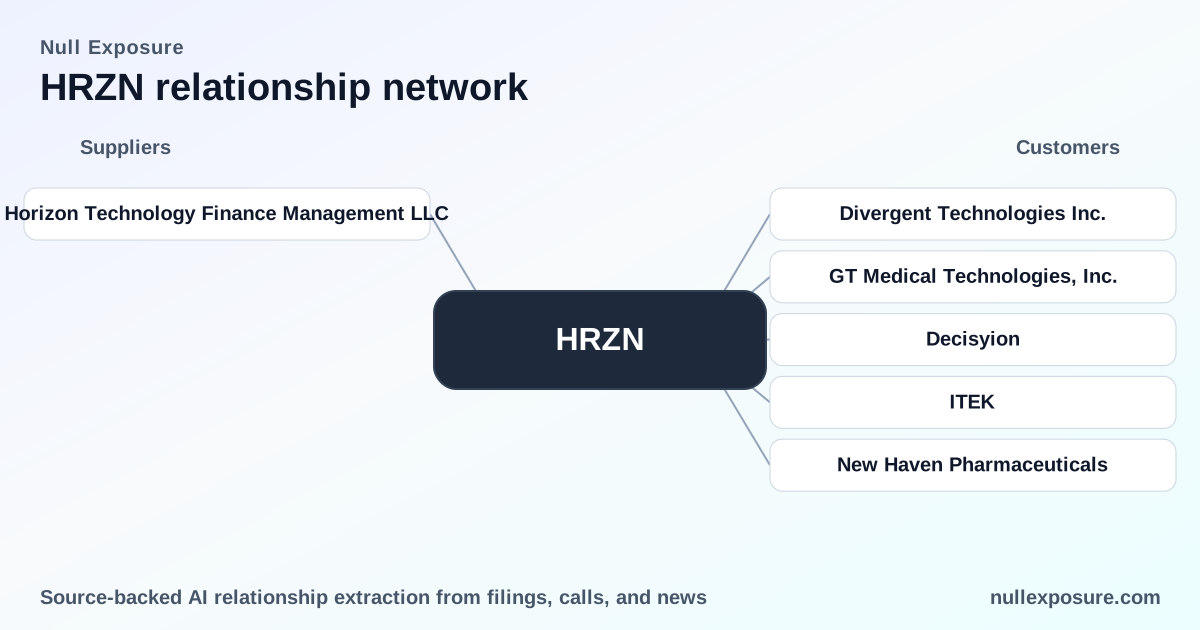
Horizon Technology Finance (HRZN): Advisor-led BDC with fee-driven economics and levered origination
Horizon Technology Finance operates as a business development company that provides secured debt and selective equity co-investments to growth-stage, venture-backed technology, life sciences and sustainability companies. The firm monetizes through interest income on loan portfolios, equity upside from co-investments, and fee-sharing with its external advisor—notably a usage-based base management fee and a two-part incentive fee that aligns pay to net investment income and realized capital gains. Access to leverage via multiple long-dated credit facilities and periodic equity issuance rounds out the capital stack and amplifies returns to shareholders.
For a concise supplier-risk briefing and ongoing supplier monitoring, visit https://nullexposure.com/.
The advisor relationship is the engine — and the principal operational dependency
Horizon is externally managed by Horizon Technology Finance Management LLC (the Advisor), an affiliate of Monroe Capital, which handles origination, underwriting, portfolio management and administrative services. The Advisor receives a base management fee (2.00% of gross assets, stepping to 1.60% above $250 million) plus a two-part incentive fee with a 1.75% quarterly hurdle and a 20% catch-up/realized gains component, creating a clear usage-based revenue link between asset growth, yield performance and advisor compensation. According to a March 10, 2026 news release on Yahoo Finance, HRZN is externally managed by Horizon Technology Finance Management LLC, an affiliate of Monroe Capital. (Yahoo Finance, March 10, 2026).
Company filings document the Investment Management Agreement effective June 30, 2023 and reapproved by the board on December 10, 2024, and explain the Advisor’s broad remit and material influence over investment selection, valuation designee responsibilities and day‑to‑day operations. That structure gives the Advisor substantial operational control and places key-person and concentration risk at the center of HRZN’s supplier profile.
Capital providers and funding counterparties that shape HRZN’s balance sheet
HRZN funds origination with a mix of long-term notes, securitizations and credit facilities. The firm uses a Key Facility (KeyBank), an NYL Facility (New York Life / NYL Noteholders), and a Nuveen Facility (Nuveen Noteholders), together with term notes (2026, 2027) and a 2022 Asset-Backed program. These arrangements are explicitly named in recent filings and amendments: the Key Facility was amended June 29, 2023 to increase commitments to $150 million (accordion to $300 million); the NYL Facility amendments extended certain maturities and investment periods in 2024; and the Nuveen Facility carries its own maturity and advance windows. These counterparties provide scale (hundreds of millions available), but also create maturities and covenant timelines that drive refinancing risk. (Company filings and facility amendments, 2023–2024).
Securitizations and note issuances are an ongoing part of the funding mix—HRZN has utilized asset-backed notes and convertible notes in past financings—meaning the firm’s liquidity profile depends on both capital market access and lender willingness to extend or renew commitments.
How contract types and governance features inform supplier posture
HRZN’s contracting posture blends usage-based economics, long-term credit commitments, short-term governance renewals and framework equity programs:
- Usage-based: The Advisor’s base and incentive fees are tied to gross assets and net investment income, creating a recurring operating expense that scales with the portfolio (company filings describing fee mechanics).
- Long-term funding: Credit facilities and notes contain maturities through 2029–2033 for various instruments; amendments extend availability periods and reset pricing (facility disclosures, 2023–2024).
- Framework equity programs: ATM (equity distribution) agreements permit opportunistic sales—current program authorizes up to $150 million—giving management a repeatable channel to raise equity when market windows open.
- Short-term renewals: The Investment Management Agreement requires annual board reapproval, introducing a recurring governance checkpoint that is operationally short-term even as the management relationship is strategically core.
Combined, these contract types produce a supplier profile where advisor services are critical and usage-fee driven, while funding relationships introduce longer-term refinancing and covenant risk.
Risk and materiality signals investors should prioritize
- Critical dependency on the Advisor: The Advisor sources, underwrites and manages investments; loss of senior personnel or the agreement itself would materially disrupt origination and portfolio oversight. (Investment Management Agreement and risk disclosures).
- Valuation complexity: Level 3 investments are a critical audit focus; fair-value judgments rely on significant unobservable inputs and third‑party valuation support, increasing governance and audit risk.
- Refinancing exposure: Large credit facilities and note maturities concentrate refinance timelines—if markets tighten, funding costs and access could materially affect origination and distributions.
- Fee alignment effects: The incentive fee design—particularly the catch-up and inclusion of accrued (non-cash) income—creates incentives that can influence timing of income recognition and portfolio structuring.
These are company-level constraints and risk drivers derived from the Investment Management Agreement, credit facility terms and public disclosures (company filings 2023–2025).
The single supplier entry in the results: Horizon Technology Finance Management LLC
Horizon Technology Finance Management LLC is HRZN’s external advisor and administrator; it manages day‑to‑day operations, originates and services investments, and receives a base management fee plus incentive fees under the Investment Management Agreement. This relationship is the operational center of gravity for HRZN. (Yahoo Finance press release, March 10, 2026; company filings describing the Investment Management Agreement, June 30, 2023; board reapproval December 10, 2024).
What this means for investors and operators
- Investment thesis hinge: HRZN’s return profile is driven by the Advisor’s ability to originate higher‑yield private credit opportunities and to manage leverage efficiently; operational reliance on the Advisor is a double-edged sword—it concentrates origination skill but concentrates risk.
- Capital structure vigilance: Monitor facility amendment language, available accordion capacity and upcoming maturities—these determine near‑term liquidity flexibility and sensitivity to credit markets.
- Fee transparency: Usage-based management and incentive fees are explicit sources of expense drag but also align advisor incentives with yield and realized gains; investors need to model both fee caps and deferral mechanisms into NAV sensitivity analyses.
- Operational oversight: Given valuation subjectivity and critical-person concentration, active governance and robust independent valuation processes are essential to mitigate downside surprise.
For a supplier-risk briefing tailored to institutional investors, and to track HRZN’s advisor and funding counterparties over time, visit https://nullexposure.com/ for updates and monitoring.
Final takeaways and recommended actions
- Primary supplier risk: the Advisor — central to origination, governance and execution. Investors should prioritize due diligence on advisor personnel, fee mechanics, and indemnities in the Investment Management Agreement.
- Funding is diversified but concentrated around a few large facilities and securitizations; watch maturities and amendment schedules.
- Operational controls and valuation governance matter materially given the prevalence of Level 3 investments and incentive-fee interplay.
To engage deeper with supplier analytics and receive alerts on HRZN’s counterparties and contract events, go to https://nullexposure.com/.