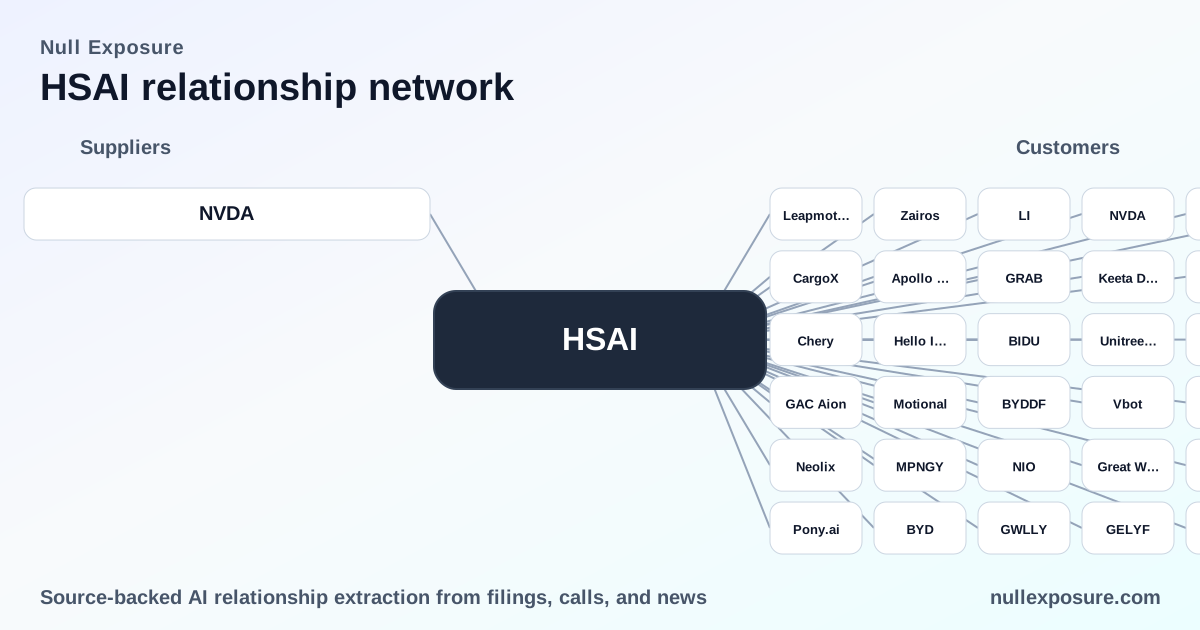
Hesai Group (HSAI): Supplier Profile, NVIDIA Tie-Up, and What Investors Should Know
Hesai Group develops, manufactures and sells three-dimensional LiDAR sensors and related perception products to automotive and adjacent markets, monetizing through device sales, integration programs with OEMs and platform partners, and scaled manufacturing. The company has converted strong unit economics—TTM revenue of $2.75 billion and gross profit of $1.14 billion—into a commercial platform that is now pushing volume scale while pursuing strategic partnerships with autonomous driving and sensing integrators.
Explore more supplier intelligence at https://nullexposure.com/ to see how these partnerships change competitive dynamics.
Why Hesai matters now: growth, margin profile, and strategic scale
Hesai is operating at the intersection of hardware scale and platform adoption. Financially, the company presents high growth (TTM revenue up 47.5% year-over-year in recent quarters), a healthy gross margin (approximately 41% TTM) and positive EBITDA ($339m), but valuation multiples reflect growth expectations (trailing P/E ~53.7 and EV/EBITDA ~42.6). Analyst coverage skews bullish: 21 coverage recommendations with 4 Strong Buy and 17 Buy, and a consensus target price near $32.65.
These results position Hesai as a supplier that is shifting from niche, product-led revenue to platform-enabled volume sales. That transition requires execution across manufacturing ramp, customer integration, and supply continuity—factors investors must watch closely.
The NVIDIA partnership: what the market reported and why it matters
A March 2026 media report noted Hesai was selected as a LiDAR partner for NVIDIA’s DRIVE AGX Hyperion 10, a Level-4-ready autonomous architecture, while simultaneously announcing a plan to more than double annual LiDAR production capacity to over 4 million units in 2026 and expand into new applications like motion-capture systems. According to Simply Wall St (reported March 10, 2026), this is a strategic placement into an OEM-level autonomy stack that drives both volume and validation.
This relationship is material because NVIDIA’s platform is a high-profile anchor customer for perception hardware, and the production-scale announcement signals a move from bespoke orders toward mass-market supply; both factors directly influence revenue runway and fixed-cost absorption. (Source: Simply Wall St, March 10, 2026.)
Supplier relationships — the complete inventory investors need to read
Hesai’s publicly reported supplier/partner relationships in our coverage set currently include the following:
- NVIDIA (NVDA): Hesai was chosen as a LiDAR partner for NVIDIA’s DRIVE AGX Hyperion 10 Level 4-ready architecture, and Hesai announced plans to expand annual production capacity to over 4 million units in 2026 while branching into lidar-based motion capture applications. (Source: Simply Wall St, March 10, 2026.)
This list reflects the relationships captured in the latest coverage window; investors should treat disclosure-driven partner announcements as high-conviction signals for volume trajectories and integration complexity.
What the NVIDIA tie-up implies for business model constraints and operating posture
The company-level operational signals investors must internalize are:
- Contracting posture: Hesai is operating as a hardware supplier that requires deep technical integration with platform partners and OEMs, which creates a contracting mix of multi-stage qualification programs followed by supply contracts that emphasize volume, quality, and SLAs.
- Concentration and customer mix: Rapid customer wins with platform leaders increase revenue visibility but concentrate downside risk if a major partner changes strategy or procurement terms.
- Criticality: LiDAR is a mission-critical sensing component for Level 3–4 autonomy stacks; winning placement with a platform like NVIDIA elevates Hesai from optional vendor to a potentially strategic supplier for system integrators.
- Maturity of operations: Financials (positive EBITDA, gross margin >40%) indicate industrial maturity, but the company’s valuation embeds further growth expectations; execution against the announced capacity ramp is the immediate operational test.
These are company-level signals derived from the firm’s reported scale and partnership announcements—not assigned to any single partner unless explicitly stated.
Risks that investors must price in
Hesai’s commercial pathway is attractive but contains execution and market risks that will determine whether current multiples are justified:
- Execution risk on the manufacturing ramp: The announced plan to exceed 4 million units in 2026 requires supply-chain resilience and capacity utilization to deliver accretive unit economics.
- Customer concentration risk: Large integration wins accelerate revenue but increase sensitivity to contract renewals and pricing dynamics.
- Valuation sensitivity: High P/E and EV/EBITDA multiples price in significant growth; missed shipments or slower-than-expected platform adoption will compress margins and multiples quickly.
A focused due diligence agenda should verify contract lengths, binding offtake terms, and inventory commitments behind large-scale production plans.
Explore supplier risk and partner exposure for your portfolio at https://nullexposure.com/ — use it to prioritize diligence and scenario planning.
Tactical takeaways for investors and operators
- Positive structural signal: Placement with NVIDIA and the production scale announcement are clear operational inflection points that shift Hesai closer to mass-market supply dynamics.
- Operational priorities: Confirm manufacturing timelines, quality-control metrics, and customer qualification milestones to validate revenue cadence and margin assumptions.
- Valuation discipline: The company’s growth is real, but multiples assume flawless execution; stress-test scenarios for capacity slippage and contract timing.
For operators evaluating Hesai as a supplier partner, the company’s scale and platform ties are attractive—contract terms should prioritize supply security, performance SLAs, and clear escalation paths for system integration issues.
Dive deeper into partner exposures and operational risk frameworks at https://nullexposure.com/ to align investment and procurement decisions.
Conclusion: position, monitor, and validate
Hesai’s combination of high-margin LiDAR products, a reported strategic placement with NVIDIA’s DRIVE AGX Hyperion 10, and an aggressive capacity expansion plan make it one of the most consequential hardware suppliers in the autonomy supply chain today. Investors should treat the NVIDIA announcement as a pivotal volume and credibility signal, but value the story only after validating execution on manufacturing scale, contract certainty, and customer diversification. Ultimately, HSAI is a growth hardware supplier where execution against scale is the principal driver of future returns.