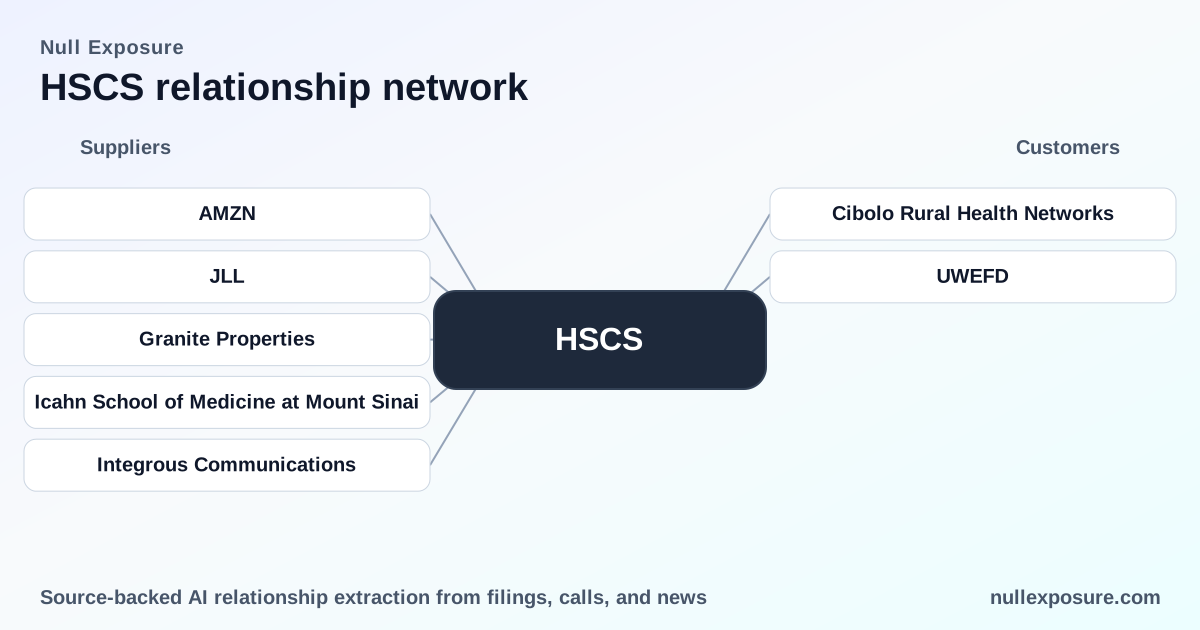
Heart Test Laboratories (HSCS): Supplier map and what it means for investors
Heart Test Laboratories develops the MyoVista wav ECG and cloud-based MyoVista Insights platform, monetizing through device sales, unit-based royalties and recurring cloud services. The company combines hardware manufacturing and licensed AI algorithms with cloud delivery, generating revenue from device units and subscription/usage flows while relying on third-party manufacturing, cloud infrastructure and academic licensees for core IP and algorithm performance.
For deeper supplier-risk due diligence and supplier maps like this, visit the Null Exposure homepage: https://nullexposure.com/
How Heart Test makes money — a short investor thesis
Heart Test sells a medical device (MyoVista wav ECG) and packages analytics via the MyoVista Insights cloud platform. Revenue drivers are device unit sales (with associated royalties to licensors) and platform usage, while margins are constrained by heavy R&D, outsourced manufacturing and recurring cloud costs; the company also funds operations through equity raises and short-term notes. The operating model blends hardware margins pressure with software/AI upside, but the business is materially dependent on third-party licenses and cloud infrastructure.
The relationships you need to know (each source cited)
HSC S’s public filings and press coverage list several external relationships that affect manufacturing, facilities, cloud delivery and investor communications. Below I summarize every relationship identified in the company’s supplier-scoped results.
Amazon Web Services (AWS)
MyoVista Insights is built as a cloud-native application running on AWS to lower cost and improve interoperability and cybersecurity. According to HeartSciences’ FY2025 business update and Q3 financial release (Markets FinancialContent, March 13, 2025), the company explicitly runs MyoVista Insights on AWS — https://markets.financialcontent.com/dailynews/article/gnwcq-2025-3-13-heartsciences-provides-business-update-and-reports-third-quarter-fiscal-2025-financial-results.
JLL (Jones Lang LaSalle)
JLL acted as tenant representative when HeartSciences signed a lease for its Southlake, TX office; the lease transaction was covered in a local business report (Dallas Innovates, FY2017). The article notes HeartSciences signed for 4,634 sq ft with JLL representing the tenant — https://dallasinnovates.com/heartsciences-putting-cardiac-testing-device-into-production/.
Granite Properties (GPI-MT, LP)
Granite Properties self-represented as landlord on the office lease for the Southlake facility; the same Dallas Innovates report documents the lease specifics (FY2017). The lease is also referenced in company filings as a long-term operating lease for the company’s headquarters — https://dallasinnovates.com/heartsciences-putting-cardiac-testing-device-into-production/.
Icahn School of Medicine at Mount Sinai
Heart Test licensed a low-ejection-fraction (LVEF ≤ 40) algorithm from Mount Sinai and completed pre-validation with Rutgers Robert Wood Johnson in February 2025, per the company’s FY2025 update. HeartSciences’ licensing and royalty obligations to Mount Sinai are a material part of the commercialization plan (Markets FinancialContent, March 13, 2025) — https://markets.financialcontent.com/dailynews/article/gnwcq-2025-3-13-heartsciences-provides-business-update-and-reports-third-quarter-fiscal-2025-financial-results.
Integrous Communications (investor relations)
Integrous Communications is listed as HeartSciences’ investor relations contact across multiple investor announcements and event notices in 2025 (Markets FinancialContent, May 8 and May 20, 2025; and March 13, 2025 releases). The firm coordinates investor webinars and presentation logistics (Markets FinancialContent press releases, May 8 & May 20, 2025; March 13, 2025) — see:
- Investor webinar notice (May 8, 2025) — https://markets.financialcontent.com/dailynews/article/gnwcq-2025-5-8-heartsciences-to-host-investor-webinar-and-q-and-a-on-wednesday-may-14-2025-featuring-ceo-andrew-simpson
- Conference presentation notice (May 20, 2025) — https://markets.financialcontent.com/dailynews/article/gnwcq-2025-5-20-heartsciences-ceo-andrew-simpson-to-present-at-emerging-growth-conference-82-on-wednesday-may-21-2025
- FY2025 business update (March 13, 2025) — https://markets.financialcontent.com/dailynews/article/gnwcq-2025-3-13-heartsciences-provides-business-update-and-reports-third-quarter-fiscal-2025-financial-results
What the contractual and structural signals tell operators and investors
The constraints extracted from Heart Test’s filings and press commentary paint a clear operating profile that investors must price.
-
Contracting posture — licensing-heavy and usage-linked economics. The company is a licensee of multiple algorithms (Mount Sinai and the University of Glasgow agreements); licensing agreements carry royalty obligations tied to unit sales and milestone commitments. The filings explicitly require low-single-digit royalties and minimum annual fees in places, which convert device sales into recurring outflows — this is a company-level signal anchored by the Mount Sinai and Glasgow license excerpts.
-
Concentration and criticality — single-source dependency for core IP and cloud. Heart Test’s algorith m portfolio and interpretive IP are critical to product differentiation: the filings state termination of licenses could prevent commercialization and that cloud availability is a critical link for diagnostic delivery. These are company-level risk signals; where a constraint references a specific licensor (Mount Sinai/Glasgow), attribute the licensing criticality directly to those agreements.
-
Maturity and term structure — mix of long-term facilities and short-term financing. The office lease is a multi-year, long-term operating lease (extended to 2028), while debt facilities and convertible notes have short-term or amendable maturities (Streeterville note with a March 2026 maturity, and other notes moved through amendments). This combination increases operational fixed-cost visibility (lease) while leaving capital structure fluid and potentially dilutive.
-
Commercial model and supplier roles — N-tier service and manufacturer reliance. The company uses third-party manufacturers and service providers for hardware, R&D and cloud operations, positioning those partners as service providers and manufacturers with materiality flagged as material/critical. The filings repeatedly emphasize that supplier disruptions can materially impair commercialization and regulatory readiness.
Investment implications — what to watch next
- Licensing expense converts growth into recurring royalty outflow. Any increase in unit sales will raise royalty cash requirements; investors should model royalty ladders and the capped $3.5M royalty scenario disclosed in filings when stress-testing free cash flow.
- Cloud dependency implies ongoing OpEx and uptime risk. With MyoVista Insights hosted on AWS, outages or price shifts alter margins and customer experience; AWS is a high-quality partner but cost and availability remain operational levers.
- Debt and short-term financing raise refinancing and dilution risk. Notes with near-term maturities and equity-based consideration for services indicate the company is financing growth with hybrid capital and equity-linked instruments.
- Regulatory and manufacturing execution are gating items. Third-party manufacturers must operate to QSR standards; failure to meet regulatory inspection requirements will delay market access and revenue recognition.
For a supplier-risk dashboard and tailored counterparty intelligence, visit our homepage: https://nullexposure.com/
Practical next steps for investors and operators
- Validate the scope and financial impact of royalty schedules with management and build scenarios for different adoption curves.
- Get granular uptime and SLAs for the AWS deployment and review cost forecasts for cloud compute and storage tied to MyoVista Insights.
- Review manufacturing QA records and audit readiness for QSR compliance; prioritize counterparties by criticality.
- Monitor short-term maturities and placement-agent arrangements for potential dilution or refinancing events.
Bottom line — what this relationship map implies
Heart Test’s value rests on a hybrid hardware-software model that is explicitly dependent on licensed algorithms and cloud delivery. That structure creates both leverage to recurring software economics and structural costs in the form of royalties, outsourced manufacturing, and cloud OpEx. Investors must price execution risk on licensing, regulatory compliance and near-term financing as the primary drivers of upside or downside.
Take action: review the supplier-specific summaries above and start your own supplier risk questionnaire at Null Exposure: https://nullexposure.com/
For hands-on due diligence support and expanded counterparty reports, head to https://nullexposure.com/ and request a tailored supplier assessment.