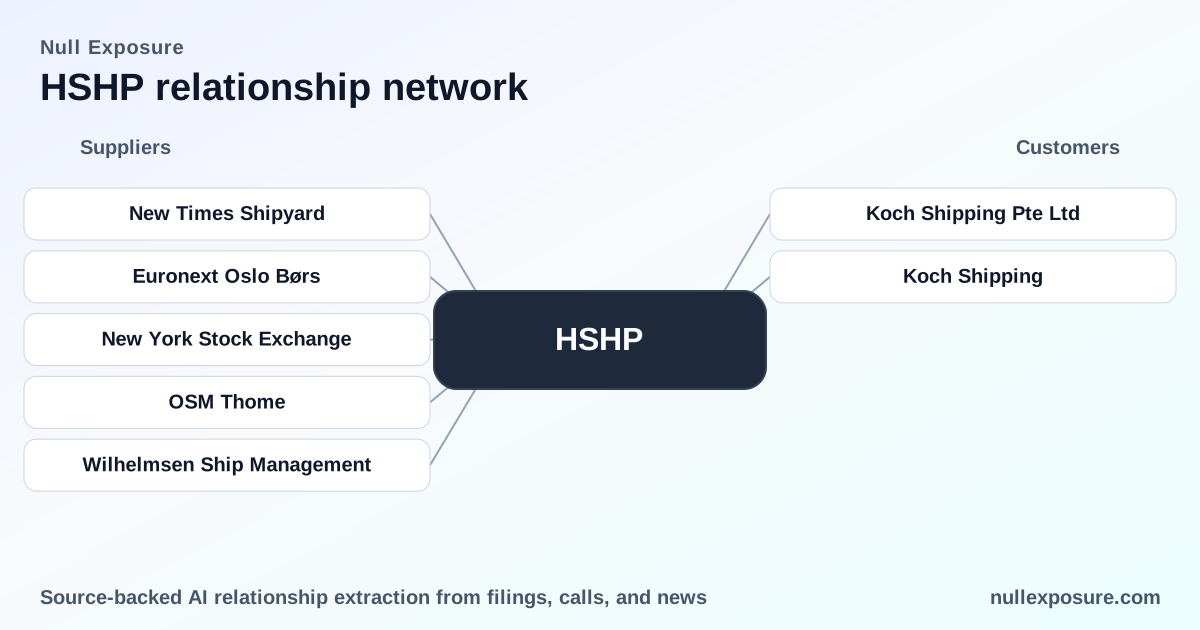
Himalaya Shipping Ltd. (HSHP): supplier map, operating posture, and investor implications
Himalaya Shipping Ltd. is a focused dry-bulk owner-operator that monetizes through asset ownership and time-charter revenue, with a fleet anchored by twelve 210,000 dwt LNG dual-fuel Newcastlemax newbuildings delivered between 2023 and 2024 and leased into multi-year fixtures. The company’s economics combine asset value appreciation and charter cashflows; trading and valuation metrics (market cap ~$599m, EV/EBITDA ~12.7) reflect an operator with strong recent cash generation and a capital-intense growth profile. For a concise supplier-risk and counterparty-readiness assessment, see Nillexposure’s supplier intelligence at https://nullexposure.com/.
How Himalaya’s supplier relationships drive economics and operational risk
Himalaya’s business model is straightforward: own large modern Newcastlemax vessels, secure long-dated charters with evergreen or rollover provisions, and outsource technical management to established third parties. This structure creates a relatively predictable revenue stream while concentrating execution risk in a few strategic relationships—shipyard(s) for newbuild delivery and a small set of technical managers for ongoing operations.
Company-level signals that shape the supplier-risk profile:
- Contracting posture: The newbuild program was executed through China’s New Times Shipyard with delivery schedules across 2023–2024 and time-charter commencements structured as 24-month contracts with evergreen characteristics, which implies a tilt toward medium-term revenue visibility rather than spot exposure. (Company notices and industry press, 2022–2026.)
- Concentration: The fleet expansion centers on a single newbuild class (12 Newcastlemax units), concentrating construction and specification risk with one primary shipyard relationship.
- Criticality: Dual-fuel LNG propulsion and modern Newcastlemax specifications are operationally critical to the company’s charter premium and regulatory positioning; continuity of technical management is therefore material.
- Maturity and cadence: Deliveries clustered in 2023–2024 place the fleet in a young, homogeneous state—beneficial for maintenance predictability but implying near-term capital servicing needs tied to the build program.
These company-level signals are reflected in the public filings and press coverage; for deeper, documented supplier exposures and event histories, Nillexposure’s supplier pages are the resource to bookmark: https://nullexposure.com/.
Who the suppliers and counterparties are (what matters to investors)
Below I list every supplier relationship surfaced in public reporting and press coverage, with a plain-English takeaway and a source for verification.
New Times Shipyard — builder of the Newcastlemax newbuilds
Himalaya contracted New Times Shipyard for a 12-vessel newbuild program of 210,000 dwt LNG dual-fuel Newcastlemax vessels, with successive deliveries and immediate commencement of charters as ships were handed over. This single-shipyard execution was central to fleet growth between 2023 and 2024. See the March 2026 delivery notices and earlier delivery coverage at VesselFinder and MarineLink (2026, 2022–2024): https://www.vesselfinder.com/news/25799-Himalaya-Shipping-Ltd-HSHIP--Delivery-of-Mount-Ita-and-commencement-of-charter and https://www.vesselfinder.com/news/27865-Himalaya-Shipping-Delivery-of-Mount-Denali-and-Commencement-of-Charter.
OSM Thome — technical manager for the fleet
Himalaya placed technical management of its newcastlemax fleet with OSM Thome, a recognized ship-management organization, which provides day-to-day operational oversight and crewing. That arrangement is documented in industry reporting that notes OSM Thome as a named technical manager for the fleet (Splash247, 2026): https://splash247.com/himalaya-shipping-seals-fresh-index-linked-deal-2/.
Wilhelmsen Ship Management — technical manager partner
Wilhelmsen Ship Management is also cited as a technical manager for the newbuild fleet, sharing operational responsibility and redundancy for maintenance and compliance. The presence of two established managers reduces single-provider operational concentration while keeping technical management external (Splash247, 2026): https://splash247.com/himalaya-shipping-seals-fresh-index-linked-deal-2/.
Euronext Oslo Børs — secondary trading venue and ex-distribution mechanics
Himalaya’s share trading is handled on multiple exchanges; company notices indicate shares on Euronext Oslo Børs went ex-dividend for a US$0.13 cash distribution on January 19, 2026, reflecting cross-list settlement mechanics and investor access across European venues (TradingView coverage, Jan 2026): https://www.tradingview.com/news/modular_finance:1994fe1dc2a78:0-himalaya-shipping-ltd-hshp-ex-cash-distribution-us-0-13-today-on-euronext/.
New York Stock Exchange — primary U.S. listing and settlement timing
The New York listing is the firm’s U.S. trading venue and the company announced the ex-cash distribution date on NYSE as January 20, 2026 due to U.S. settlement cycle changes, underscoring how corporate actions and cash distributions interact with listing mechanics (TradingView summary, Jan 2026): https://www.tradingview.com/news/modular_finance:1994fe1dc2a78:0-himalaya-shipping-ltd-hshp-ex-cash-distribution-us-0-13-today-on-euronext/.
What these relationships imply for risk and upside
- Operational stability vs. concentration risk: The use of two professional technical managers (OSM Thome and Wilhelmsen) gives Himalaya operational depth, reducing single-provider operational risk; however, the build program’s concentration at New Times Shipyard creates a construction counterparty concentration that investors must monitor for warranty, delivery timing, and cost variances.
- Revenue visibility and margin profile: Time-charter structures and the homogeneous, modern fleet support consistent cashflows and higher operating margins; public metrics show strong gross profit and an EV/EBITDA in the mid-teens. Himalaya’s forward earnings multiple (forward P/E ~8.2) suggests the market is pricing a near-term earnings uplift relative to trailing multiples.
- Liquidity and governance signals: Cross-listing and dividend mechanics on Euronext and NYSE improve liquidity and broaden investor access, while insider ownership (~44%) signals a concentrated sponsor base that both stabilizes control and can affect minority liquidity dynamics.
If you want a concise supplier-risk scorecard and counterparty monitoring plan based on these relationships, Nillexposure maintains a focused supplier intelligence feed at https://nullexposure.com/ that will map exposures to delivery milestones and operational covenants.
Investment takeaways and next steps
- Positive: Young, modern fleet with LNG dual-fuel capability under multi-year charters supports predictable cashflows and operational premiums. Market multiples (EV/EBITDA ~12.7; forward P/E ~8.2) leave room for re-rating if charter rolls sustain.
- Watchlist: Concentration at New Times Shipyard for the newbuild program, and the company’s capital servicing profile following heavy delivery waves, are the principal supply-side risks to monitor. Operational continuity hinges on the technical managers—OSM Thome and Wilhelmsen—performing to spec.
- Actionable next steps: Confirm charter roll schedules and counterparty credit quality, track any warranty or delivery claims tied to the shipyard, and watch cash-distribution mechanics around cross-listings for liquidity cues.
For a supplier-oriented due diligence package that maps contract timing, delivery milestones, and technical-management covenants, visit Nillexposure’s supplier intelligence hub: https://nullexposure.com/. For subscribing teams that need ongoing supplier monitoring tied to investor triggers, see https://nullexposure.com/ for plan options.
Himalaya’s model is an asset-backed, charter-driven shipping play where the supplier network—shipyard and technical managers—directly determines both near-term execution risk and the durability of the company’s revenue stream. Investors should weigh operational predictability against construction concentration when sizing exposure.