Host Hotels & Resorts (HST): supplier relationships that move cash and risk
Host Hotels & Resorts is a publicly traded REIT that owns premium hotel real estate and monetizes through rental economics, asset sales/acquisitions and revenue-sharing arrangements with major brand managers and franchisors. The company earns stable base management fees and usage-linked incentive fees, collects license/franchise fees tied to room and F&B revenue, and extracts value through cyclical capital deployment and portfolio rotation — all while funding growth largely with external capital due to REIT payout requirements. For counterparties and investors, the defining features are long contract tenors, revenue-linked fee mechanics, and a high concentration of economics with a handful of global brands.
For a centralized look at supplier exposures and contract posture, visit https://nullexposure.com/.
How Host runs its business with third parties — the operating model that matters
Host does not operate hotels directly. Instead, it owns the real estate and contracts third‑party managers and brand licensors to run day‑to‑day operations. That structure produces a predictable fee income profile but creates operational and counterparty dependency:
- Long-term contracting posture. Management and operating agreements typically have initial terms of 10–25 years with renewal options; ground leases can run up to 100 years. These are durable contracts that lock in operating relationships and capex responsibilities (Host funds substantial capital projects and approves major FF&E budgets). This is drawn from Host’s corporate disclosures in its 2024 filings (Form 10‑K, audited financial statements).
- Usage‑based economics. Managers receive base fees (generally 2–3% of gross revenues) and incentive fees tied to operating profit, while franchisors/licensees receive license fees (commonly ~5% of room revenue and 2% of F&B), which align Host’s returns to occupancy and RevPAR. This is described in the company’s management and license agreement summaries in its 2024 filings.
- Concentration and criticality. Host’s operating model is materially concentrated: approximately 60% of revenues are managed or franchised by Marriott, making a single brand relationship economically significant (Host’s 2024 Form 10‑K). Hotel operating costs and manager performance are critical to Host’s cashflow — hotel operating expenses account for the bulk of costs and managers control staffing, systems and guest data.
- Maturity and capital intensity. Host invests heavily in capex and resiliency — roughly hundreds of millions annually — and finances growth and debt service from capital markets and its credit facilities. Debt maturities, senior note issuances and a $1.5 billion revolver are highlighted in its disclosures and SEC filings.
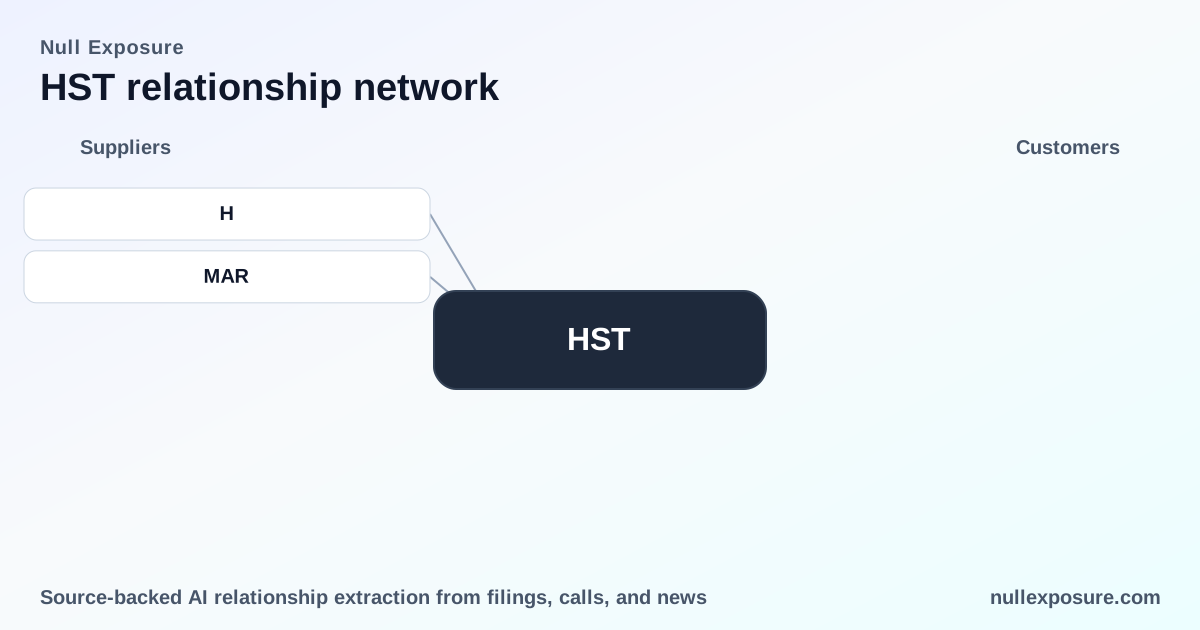
The direct supplier relationships in public mentions
Below I cover every relationship identified in the latest reported results and what each partner contributes to Host’s economics.
Hyatt — an operating partner in capital programs
Host reported working closely with Hyatt on transformational capital reinvestment programs as part of a broader $644 million portfolio reinvestment during 2025; Hyatt functions as a brand manager in those projects and is a counterparty in long‑term management arrangements. Source: REIT.com coverage of Host (March 10, 2026) citing company commentary on 2025 capital reinvestment (https://www.reit.com/news/articles/host-hotels--resorts-cfo-sees-multiple-tailwinds-supporting-sustained-growth-in-2026).
Marriott — the dominant brand partner and revenue driver
Host states that Marriott manages or franchises roughly 60% of its hotels by revenues, and Host executed “transformational capex reinvestment programs” with Marriott as part of the $644 million reinvestment in 2025; Marriott also receives license and franchise fees tied to room and F&B revenue. This relationship is material to Host’s top line and contains long tenors and usage‑based fees that directly align Host’s returns with Marriott’s system performance. Source: REIT.com article quoting Host (March 10, 2026) and Host’s 2024 Form 10‑K disclosures on management/franchise arrangements.
Why these relationships drive both upside and concentrated risk
The economics are straightforward: improvements and brand conversions catalyze RevPAR upside that flow to Host through higher base and incentive fees and higher asset valuations. Host’s 2025 capex program — and the explicit cooperation with Marriott and Hyatt — accelerates value creation when RevPAR recovers or outperforms peers. Source: Host’s public statements and 2024 disclosures as summarized in the March 2026 REIT.com coverage.
At the same time, the structure concentrates operational exposure:
- Single‑brand concentration (Marriott ~60%) amplifies counterparty risk and operational dependence — changes in Marriott’s loyalty or reservation economics translate into Host revenue swings (Host 2024 Form 10‑K).
- Operational control lies with managers. Because managers handle staffing, IT and guest data, Host is exposed to cybersecurity, labor and service‑quality risk that can materially affect hotel profitability and REIT qualification mechanics.
- Long maturities and debt covenants. Host’s capital plan and note issuances (Series K and L senior notes; $1.5B revolver and term loan structure) mean that liquidity and access to markets are central to executing capex and acquisition strategies.
Practical implications for investors and counterparties
For investors assessing HST supplier relationships, focus on three lenses:
- Contract mechanics: confirm initial term, renewal options, fee formulas (base %, incentive thresholds) and termination/performance remedies. Long tenors create stability but reduce flexibility.
- Concentration and contingency: quantify what 60% Marriott exposure means for revenue volatility and stress scenarios; model outcomes if RevPAR or loyalty economics change.
- Operational resilience: evaluate manager IT/security posture, insurance sub‑limits for natural disasters, and Host’s capital buffers for large remediation or resiliency projects (Host’s filings disclose insurance sub‑limits and material capex budgeting).
If you want a consolidated vendor-risk view and contract analytics for portfolios like Host’s, see the research tools and exposure reports at https://nullexposure.com/.
Quick checklist for counterparties and operators
- Confirm whether agreements are management, franchise or license, and how fees are calculated and paid.
- Map capex approval rights and who funds FF&E and resiliency investments.
- Validate data access, cybersecurity responsibilities, and who is liable for breaches affecting customer PII.
- Stress-test concentration: model a 10–20% RevPAR decline in Marriott‑managed hotels and its impact on Host’s distributions and covenant headroom.
Bottom line: durable cash flows, concentrated operational exposure
Host’s supplier relationships with Marriott and Hyatt reflect a repeatable monetization model — long term contracts, usage‑based fees, and brand lift from capex and conversions. Those same features create concentration and operational dependency that investors and counterparties must underwrite rigorously. For diligence on counterparties, contract clauses and scenario modeling tailored to REIT‑hotel structures, visit https://nullexposure.com/ for tools and vendor exposure analysis.