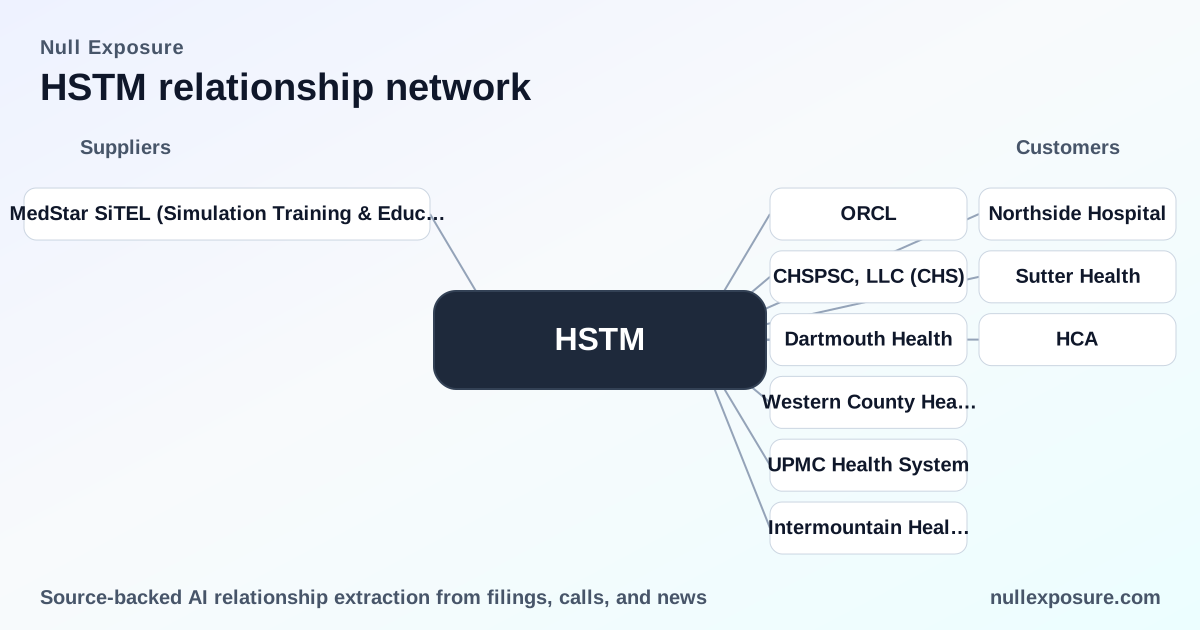
HealthStream (HSTM) — supplier relationships and what they mean for investors
HealthStream operates a healthcare workforce and education software platform that monetizes through subscription SaaS sales, licensed content and learning assets, professional services, and targeted acquisitions that expand clinical placement and continuing education offerings. With roughly $304 million in trailing revenue and a market capitalization near $622 million, the company balances recurring revenue with licensed content economics and modest M&A to grow addressable markets. For investors assessing supplier risk, HealthStream’s model is defined by long-term real estate and credit arrangements, extensive third‑party licensing and hosting, and concentrated operational dependency on security and data suppliers. Learn more at https://nullexposure.com/.
Quick take: the supplier posture in one paragraph
HealthStream runs a software-and-content business that both licenses intellectual property from third parties and licenses content and services to customers, while outsourcing critical infrastructure (hosting, archived data storage, conferencing systems) to third‑party providers. The company carries long-term lease commitments and a $50 million revolving credit facility that shapes procurement cadence and supplier selection, and it routinely makes small-to-mid M&A plays to acquire capability rather than large transformational purchases. These structural traits create a supplier profile that is license‑heavy, infrastructure‑dependent, and operationally sensitive to cybersecurity and third‑party availability. For additional supplier intelligence and comparative analysis, visit https://nullexposure.com/.
The recorded supplier relationships — what matters
HealthStream’s disclosed supplier relationships in the provided results are limited but instructive.
- MedStar SiTEL (Simulation Training & Education Lab): HealthStream co‑developed and co‑owns a virtual‑reality based clinical education pilot with MedStar SiTEL, indicating a collaborative innovation relationship that supports content and experiential learning offerings (FY2020). Source: HITConsultant report, January 15, 2020.
(That list represents each relationship surfaced in the reviewed results.)
How the company-level constraints shape supplier strategy
The company disclosures and constraint excerpts describe several company-level signals that define how HealthStream contracts with suppliers and manages vendor risk:
- Contracting posture — long-duration and mixed: HealthStream maintains multi-year non‑cancelable leases (weighted average remaining lease term ~6–7 years; lease obligations disclosed through 2029 and thereafter) and a revolving credit facility with availability up to $50 million maturing in October 2026, signaling capital and operational commitments that favor predictable, long-term supplier arrangements (company filings as of December 31, 2024).
- Licensing is core to product delivery: The company both licenses inbound technology and purchases/licences third‑party content for customer delivery, and also holds inbound licenses for IP used internally—so supplier relationships frequently sit inside licensing contracts with renewal and IP assignment implications (company disclosures).
- Service provider criticality and cybersecurity risk: HealthStream outsources hosting, archived data storage and conferencing services; its cybersecurity program aligns to NIST and HITRUST frameworks because service provider failures or breaches are identified as potentially material to operations and reputation (SEC filings discussing risk management).
- Spend profile and acquisition posture: Documented buybacks and acquisitions show both small bolt-on purchases ($1–10m) and utilization of larger financial facilities ($10–100m capacity); historical transactions include an asset acquisition of eeds (~$6.6m) and TCPS/The Clinical Hub combinations ($~1.3m cash plus earnouts), indicating a preference for targeted, lower‑to‑mid scale spend rather than headline M&A.
- Materiality mix — some supplier exposures are immaterial, others are material: The company states it is not dependent on any single third‑party license (an immateriality signal), but simultaneously flags that system downtime, subcontractor security lapses, or legal limits on data use could be material to revenue and costs. Investors should treat supplier risk as heterogeneous: many suppliers are routine and low-impact, while infrastructure and data suppliers are high‑impact.
What these constraints imply for operational and procurement teams
Operational leaders and sourcing teams should read HealthStream’s profile as a platform with concentrated operational dependencies and procurement levers that include licensing, hosting SLAs, and long-term facilities commitments.
- Negotiate robust SLAs, indemnities, and data use clauses with hosting and content licensors because cybersecurity and regulatory limits on data use are highlighted as material risks (SEC risk disclosures).
- Expect long lead times and covenant-driven financial controls when sourcing major capital items given the revolving facility structure and lease maturities.
- Design supplier due diligence to emphasize HITRUST/NIST alignment and subcontractor controls for any vendor touching PHI, archived data, or classroom‑to‑clinical systems.
For procurement benchmarking or to map supplier overlap across peers, see the platform at https://nullexposure.com/.
Relationship-level note: MedStar SiTEL
HealthStream’s public collaboration with MedStar SiTEL is a co‑development and co‑ownership arrangement for VR‑based clinical education piloting, demonstrating the company’s strategy to augment learning content through research partnerships and experiential technology (reported in FY2020). Source: HITConsultant, January 15, 2020.
Investor implications and next steps
- Risk profile: The most consequential supplier exposures are infrastructure and data‑centric (hosting, archived storage, conferencing) and regulatory/cybersecurity governance is a critical control that investors should monitor. HealthStream’s financial flexibility via a $50 million revolver and modest acquisition spend program limits the probability of forced, disruptive procurement pulls, but lease maturities and credit facility expirations create calendar risk that will influence supplier negotiation windows.
- Operational resilience: The company’s alignment to HITRUST and NIST in its cybersecurity program is a positive control signal; however, public filings specifically flag subcontractor-induced liability as a material risk — this should be tested in vendor audits and SOC/HITRUST reports.
- Value creation: Small bolt‑on buys for clinical placement management and content licensing help expand revenue per user without heavy capex; suppliers that enable fast integration and secure content delivery capture strategic value.
If you are evaluating supplier risk or preparing vendor diligence for HealthStream, review their filings and third‑party security attestations and compare against peers using consolidated supplier intelligence at https://nullexposure.com/. For customized supplier risk reports and exposure mapping, begin your analysis at https://nullexposure.com/.
Final recommendation: investors should treat HealthStream as a recurring revenue software and content business with concentrated infrastructure and licensing dependencies — underwrite cybersecurity and hosting resilience as primary sources of downside, and treat small M&A and licensing-led growth as the likely path to incremental upside.