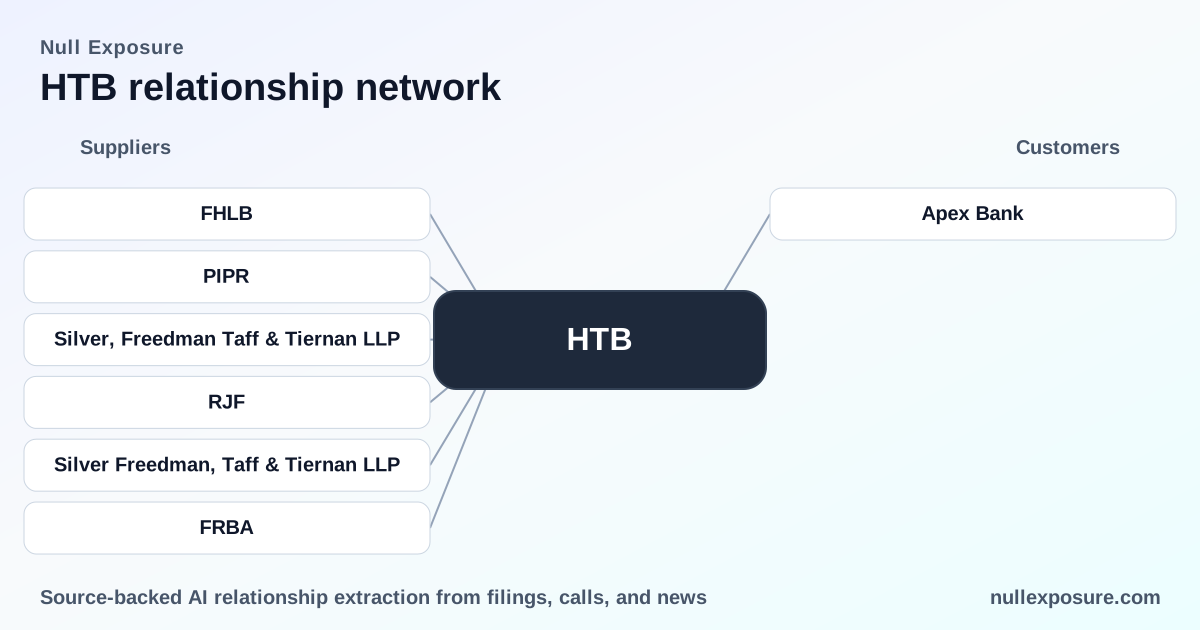
HomeTrust Bancshares (HTB): Supplier relationships that underpin funding, operations and deal execution
HomeTrust Bancshares operates as a regional bank holding company centered on retail and commercial lending, deposit gathering and fee income from servicing and transaction products. The company monetizes by capturing net interest margin on originated loans, generating gain-on-sale and servicing fees from loan dispositions, and collecting deposit and transactional revenue while leveraging wholesale funding lines when needed. Supplier relationships for HomeTrust are therefore dual-purpose: they both supply critical funding and underpin core processing and legal/financial execution for M&A and branch transactions. For a concise supplier risk snapshot and relationship map, visit https://nullexposure.com/.
How HTB structures its supplier exposure — one narrative, not a table
HomeTrust’s supplier posture blends long-term strategic contracts (core processing, leases, deferred compensation) with short-term liquidity arrangements (revolving lines, FRB/FHLB advances and brokered deposits). The company documents a formal vendor risk-management program and continuous monitoring for third-party cyber risk, demonstrating an institutional approach to outsourcing but also highlighting concentration and operational criticality: several vendors perform “critical processing functions.” Contract terms show a mix of tenors — leases with weighted-average remaining terms in the high single digits of years and borrowings that are demonstrably short-term — and spend signals span from sub-$100k transactional items to hundreds of millions of dollars in outstanding advances and brokered deposits.
- Key operating constraints: long-term core relationships, short-term liquidity facilities, geographical concentration in the Southeast U.S., and a vendor ecosystem treated as materially consequential to operations.
- Risk posture: vendor disruptions or security incidents are classified as potentially material; management actively negotiates multiyear renewals for core contracts and pays consulting fees to do so.
For a full supplier intelligence platform that surfaces these relationships for investors and operators, see https://nullexposure.com/.
The relationships that matter — direct from filings and press
Below are each of the supplier relationships disclosed in the public record for HTB, presented in plain English with concise sourcing.
FHLB (Federal Home Loan Bank of Atlanta)
HomeTrust pledges qualifying one-to-four family loans, HELOCs, commercial real estate loans and its FHLB of Atlanta stock as collateral to secure outstanding FHLB advances, which HTB uses to match funding duration and support residential lending. This collateralization and membership structure is documented in HTB’s 2024 Form 10‑K. (Source: HTB 2024 Form 10‑K)
FRB (Federal Reserve Bank advances)
HTB uses FRB advances as part of its borrowing mix and pledges commercial construction loans, indirect auto loans and municipal leases as collateral against outstanding FRB advances, reflecting active short-term borrowing in its funding stack. This treatment is described in the company’s 2024 Form 10‑K. (Source: HTB 2024 Form 10‑K)
Piper Sandler & Co. (PIPR)
Piper Sandler served as HomeTrust’s financial advisor in the sale of Knoxville branches to Apex Bank, supporting the company’s branch rationalization and transaction execution. This engagement was reported in a March 2026 news release covering the Knoxville branch sale. (Source: March 2026 WGRV transaction announcement)
Silver, Freedman Taff & Tiernan LLP (legal counsel)
Silver, Freedman Taff & Tiernan LLP provided legal counsel to HomeTrust for the Knoxville branch divestiture, assisting with transaction documentation and regulatory matters tied to the branch sale. This role is noted in the same March 2026 transaction announcement. (Source: March 2026 WGRV transaction announcement)
Raymond James & Associates, Inc. (RJF)
Raymond James acted as financial advisor to HomeTrust in the February 2023 merger with Quantum Capital Corp., a strategic acquisition that expanded HTB’s Atlanta-area footprint. The February 13, 2023 GlobeNewswire press release details Raymond James’ advisory role in that transaction. (Source: GlobeNewswire press release, Feb 13, 2023)
Silver Freedman, Taff & Tiernan LLP (legal counsel in FY2023)
In the 2023 merger with Quantum, the firm Silver Freedman, Taff & Tiernan LLP again served as legal counsel to HomeTrust while Piper Sandler advised Quantum; the arrangement is disclosed in HTB’s public deal announcement. This confirms the firm’s repeated counsel role across HTB transactions. (Source: GlobeNewswire press release, Feb 13, 2023)
What the constraints tell investors about operating risk
HTB’s public disclosures produce a compact, actionable profile of supplier-related constraints:
- Contract maturity mix: The company holds both long-term contracts (weighted-average lease terms in the 8–9 year range and multiyear core processing agreements) and numerous short-term funding arrangements (revolving credit lines, brokered deposits and short-term FRB advances). This signals a deliberate pairing of durable vendor commitments with flexible funding instruments — a standard bank operating model but one that requires active liquidity management. (Company-level signal from Form 10‑K excerpts)
- Service-provider criticality: HTB explicitly classifies third-party providers that perform critical processing functions as material to operations, and the company has invested in continuous vendor monitoring and annual tabletop exercises for business continuity and security. Vendor failure or cyber incident is a material operational risk. (Company-level signal from Form 10‑K)
- Geographic concentration: Lending and branch operations are concentrated in five Southeastern states (North Carolina, South Carolina, Tennessee, Virginia, Georgia), which focuses both credit risk and vendor/regional exposure. (Company-level signal)
- Spend and funding scale: Public notes show revolving lines of credit with unused capacity in the low hundreds of millions and brokered deposits totaling $387.1 million at year‑end, while FRB advances are material on the balance sheet — indicating high-dollar counterparty exposure in HTB’s funding stack. (Company-level signal)
- Renewal activity: Management paid a $3.0 million consulting fee in December 2024 to negotiate a multiyear renewal of the bank’s largest core IT processing contract, signaling active investment in maintaining long-term processing continuity. (Company-level signal)
These constraints collectively describe a bank that balances operational outsourcing and wholesale funding with active vendor governance and periodic M&A/branch rationalization.
For a navigable view of HTB’s supplier map and to compare these signals across peers, visit https://nullexposure.com/.
Investment implications and recommended next steps
HomeTrust’s supplier profile is consistent with a regional bank that manages growth through acquisitions and branch portfolio adjustments while relying on external funding sources and critical third-party processing. Key investment takeaways:
- Positive: diversified advisory and legal relationships support M&A and divestiture execution; active vendor monitoring and multiyear contract negotiation demonstrate governance discipline.
- Watch: high-dollar short-term borrowings and brokered deposits increase liquidity sensitivity to interest-rate cycles; vendor concentration on core processing functions creates outsized operational risk if a provider fails.
- Actionable next steps for investors and operators: assess HTB’s maturity ladder and liquidity cushions, review vendor contingency plans for core processing, and monitor future contract renewals and any changes in FHLB/FRB advance utilization.
For deeper supplier intelligence, scenario analysis and peer benchmarking on HTB, go to https://nullexposure.com/.
Bottom line: HomeTrust runs a classic regional banking model where supplier relationships are both enablers of growth and levers of operational risk; active governance and capital/funding discipline will determine whether these relationships remain a net positive for shareholders.