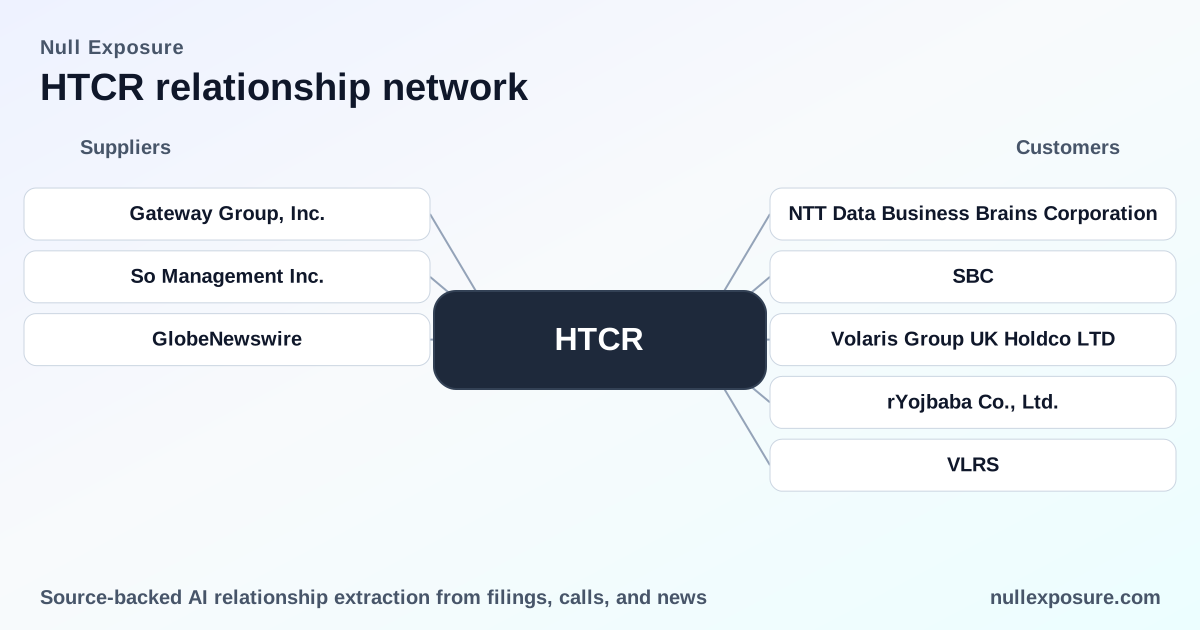
HeartCore Enterprises (HTCR) — supplier relationships that shape execution risk and operating leverage
HeartCore Enterprises is a Tokyo‑based software and IPO‑consulting services firm that monetizes through professional services, recurring software and hosting arrangements, and transaction fees tied to IPO advisory and related client implementations. Revenue is driven by services and software delivery, while cost structure is concentrated on third‑party hosting, outsourcing and short‑term financing that compress margins; investors evaluate HTCR through the dual lens of client concentration in services and vendor dependence for infrastructure. For a deeper look at how these supplier linkages affect valuation and operational risk visit https://nullexposure.com/.
What investors need to know about HeartCore’s commercial footprint
HeartCore operates as a services‑led software company: it sells implementation and advisory services alongside software hosted on third‑party infrastructure. The business model blends predictable recurring revenues (prepaid subscriptions and hosting) with lumpy professional fees and occasional financings, which creates volatility in margins and working capital. Corporate filings and press releases show repeated use of short‑term premium financing, factoring lines and a mix of long‑term property leases — a hybrid contracting posture that amplifies working capital sensitivity.
Constraints that define the supplier profile and operating risk
HeartCore’s supplier and contract profile sends clear signals about how the company runs:
- Contracting posture: A mix of long‑term leases (office and equipment) and multiple short‑term financings (insurance premium financing, factoring) signals stable fixed‑cost commitments paired with frequent tactical financing to manage cash needs. This structure increases operational leverage during revenue downturns.
- Concentration and geography: Core operations and most vendor relationships are APAC‑centric (Japan, Vietnam) with a smaller North American footprint; this regional concentration reduces diversification and exposes the company to Japan‑specific real estate and labor dynamics.
- Criticality and materiality: Third‑party data hosting and external data feeds are material and critical to delivery of HeartCore’s software; interruptions at providers like Amazon or IBM would directly affect revenue and client retention.
- Maturity and spend patterns: Outsourcing and professional fees fall largely in the sub‑$1m to $1–10m bands; the supplier base looks mid‑market, which suits rapid scaling but limits bargaining power against large providers. These constraints are company‑level signals drawn from HeartCore’s own disclosures and should frame any supplier‑relationship diligence.
All supplier and partner mentions in the collected records
Below is a concise, record‑level walkthrough of each relationship entry cited in the company‑level results. Each item is drawn from the referenced press release or news post.
-
Gateway Group, Inc. — GlobeNewswire press release naming investor relations contacts. According to the GlobeNewswire release dated February 24, 2026, Gateway Group, Inc. is listed as HeartCore’s investor relations contact (Matt Glover and John Yi) for the announced $2.0 million share repurchase program. Source: GlobeNewswire press release, Feb 24, 2026 (https://www.globenewswire.com/news-release/2026/02/24/3243598/0/en/HeartCore-Authorizes-2-0-Million-Share-Repurchase-Program-as-Part-of-Disciplined-Capital-Allocation-Strategy.html).
-
Gateway Group, Inc. — QuiverQuant summary of the repurchase announcement. A QuiverQuant news post captures the same investor relations attribution and summarizes the company’s $2.0 million buyback authorization in FY2026. Source: QuiverQuant, Feb 2026 (https://www.quiverquant.com/news/HeartCore+Enterprises,+Inc.+Authorizes+$2+Million+Share+Repurchase+Program+to+Enhance+Long-Term+Shareholder+Value).
-
So Management Inc. — coverage of an IPO client fee/referral payment. A news item on whatech reports HeartCore generated $5.64 million in net sales after paying a $3.36 million referral fee to So Management Inc. for sourcing a lead, reflecting significant referral/outsource cost in FY2024 revenue. Source: whatech market report on SBC Medical Group IPO, FY2024 (https://www.whatech.com/og/markets-research/it/887943-heartcore-s-go-ipo-client-sbc-medical-group-begins-trading-on-the-nasdaq-stock-exchange.html).
-
Gateway Group, Inc. — GlobeNewswire FY2025 quarterly results release. The Company’s Q3/FY2025 financial results filed on November 18, 2025 list Gateway Group as investor relations contact John Yi and Steven Shinmachi. This indicates consistent use of the same IR vendor/contact across major disclosures. Source: GlobeNewswire, Nov 18, 2025 (https://www.globenewswire.com/news-release/2025/11/18/3190036/0/en/HeartCore-Reports-Financial-Results-for-Third-Quarter-and-Nine-Months-Ended-September-30-2025.html).
-
Gateway Group, Inc. — Futunn summary of preliminary FY2025 results. A Futunn news post reporting preliminary FY2025 results again cites Gateway Group as the investor relations contact (Matt Glover and John Yi), reinforcing the vendor’s role in external communications for FY2026 disclosure cadence. Source: Futunn news post, early 2026 (https://news.futunn.com/en/post/68846540/heartcore-announces-preliminary-fiscal-year-2025-financial-results).
-
Gateway Group, Inc. — GlobeNewswire preliminary FY2025 results release. In a February 11, 2026 GlobeNewswire release, Gateway Group is the named investor relations contact for HeartCore’s preliminary FY2025 financials, consistent with other public filings. Source: GlobeNewswire, Feb 11, 2026 (https://www.globenewswire.com/news-release/2026/02/11/3236276/0/en/heartcore-announces-preliminary-fiscal-year-2025-financial-results.html).
-
Gateway Group, Inc. — GlobeNewswire German language release of the repurchase program. A German edition of the Feb 24, 2026 GlobeNewswire press release repeats Gateway Group as investor relations contact (Matt Glover and John Yi), showing multi‑market distribution of corporate announcements. Source: GlobeNewswire DE, Feb 24, 2026 (https://www.globenewswire.com/de/news-release/2026/02/24/3243598/0/en/HeartCore-Authorizes-2-0-Million-Share-Repurchase-Program-as-Part-of-Disciplined-Capital-Allocation-Strategy.html).
-
Gateway Group, Inc. — GlobeNewswire clarification on stockholder one‑time payment (Oct 29, 2025). The October 29, 2025 GlobeNewswire notice on a one‑time payment to stockholders lists Gateway Group (John Yi and Steven Shinmachi) as investor relations contacts, underscoring the same IR arrangement across governance and capital actions in FY2025. Source: GlobeNewswire, Oct 29, 2025 (https://www.globenewswire.com/news-release/2025/10/29/3176444/0/en/HeartCore-Clarifies-Form-of-One-Time-Payment-to-Stockholders.html).
-
GlobeNewswire — QuiverQuant syndication of the full GlobeNewswire release. QuiverQuant republished GlobeNewswire’s full Feb 24, 2026 release announcing the $2.0 million repurchase program and noting the company is an “IPO consulting services company based in Tokyo,” confirming the public messaging reach. Source: QuiverQuant republishing GlobeNewswire, Feb 24, 2026 (https://www.quiverquant.com/news/HeartCore+Enterprises,+Inc.+Authorizes+$2+Million+Share+Repurchase+Program+to+Enhance+Long-Term+Shareholder+Value).
How these relationships change the investment calculus
The record shows two distinct supplier patterns: an investor‑relations vendor (Gateway Group) that handles disclosure distribution and a set of services/referral relationships that materially impact margins (So Management and other service providers referenced in filings). The IR relationship increases market access and consistency of messaging; the referral/service payments (illustrated by the So Management item) are directly dilutive to margins when large relative to fees collected.
Visit https://nullexposure.com/ for comparable supplier analysis and to benchmark HTCR against peer supplier profiles.
Practical investor and operator takeaways
- Risk: vendor‑dependent delivery. HeartCore relies on third‑party hosting and external data; these are material and critical to operations and thus a first‑order risk for revenue delivery and customer retention.
- Working capital sensitivity. Frequent short‑term financings (insurance premium finance, factoring) combined with lumpy service revenue create rollover risk during revenue slowdowns.
- Governance of external communications. Repeated use of Gateway Group for investor relations centralizes disclosure control but concentrates dependency for market communications.
For investors and procurement leads assessing HTCR, prioritize diligence on hosting SLAs, referral fee economics, and the terms of the factoring/insurance financings. To start that diligence and access structured supplier intelligence, go to https://nullexposure.com/.
Bottom line: HeartCore’s supplier footprint is typical of a services‑heavy software firm — moderate spend bands, heavy reliance on third‑party infrastructure, and concentrated IR/disclosure support — which creates both scalability upside and execution risk that must be priced into any investment.