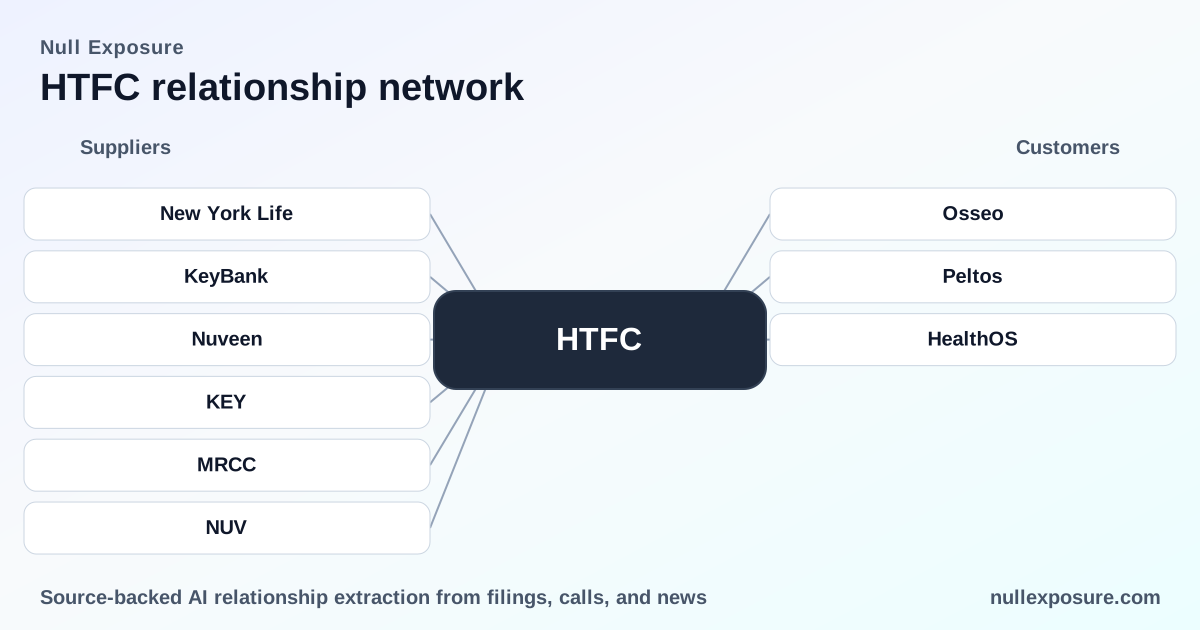
HTFC supplier relationships: where liquidity, fees and counterparties converge
HTFC operates as a manager‑run lending vehicle that generates returns from direct debt investments in private technology and related companies, funds those investments with a mix of unsecured notes and credit facilities, and pays an external advisor a usage‑based fee (base management fee plus incentive fee). In practice HTFC monetizes through interest and fee income on its loan portfolio, incremental upside from equity kickers, and leverage-driven spread capture while remitting base and performance fees to its Advisor. If you are evaluating HTFC as a counterparty or partner, focus on its credit lines, advisor economics, and counterparty concentration — these drive liquidity, refinancing risk and incentive alignment.
For an at‑a‑glance service that aggregates these signals, see https://nullexposure.com/.
Why the funding stack matters to operators and investors
HTFC’s supplier footprint is dominated by lenders and an external manager that performs most day‑to‑day functions. That structure creates two simultaneous dynamics: (1) funding concentration and refinancing cadence driven by a small number of large credit facilities and public note maturities; and (2) operational concentration because the Advisor supplies sourcing, underwriting, valuation and admin services for the firm. Both dynamics shape where counterparty diligence should focus — covenant terms, maturity ladders, incentive fee mechanics and the Advisor’s operational resilience.
Counterparty snapshots you need on your checklist
Below are the relationships identified in HTFC’s recent disclosures, summarized for research and counterparty risk review.
New York Life
HTFC had $181 million outstanding on a $250 million New York Life credit facility as reported in the company’s 2025 Q4 earnings call; that facility is an active source of committed funding for the company. (Source: 2025Q4 earnings call, htfc-2025q4-earnings-call, first reported March 7, 2026.)
KeyBank
Management stated in the 2025 Q4 call that there were no borrowings outstanding under the $150 million KeyBank credit facility at that time, although the facility remains available as committed capacity. (Source: 2025Q4 earnings call, htfc-2025q4-earnings-call, March 2026.)
Nuveen
HTFC strengthened capacity by increasing the commitment under its senior secured Nuveen facility to $200 million, and reporting outstanding advances on that facility in public remarks. That facility is a meaningful source of secured leverage for portfolio growth. (Source: news transcript summary on InsiderMonkey linking to the FY2026 commentary, March 2026.)
Monroe Capital
Monroe Capital — the parent of HTFC’s Advisor entity — will continue to provide ongoing support to the post‑merger company, a structural operational backstop for the Advisor relationship. (Source: 2025Q4 earnings call, htfc-2025q4-earnings-call, March 2026.)
(Each of the four counterparties above is called out in HTFC’s filings and public call transcripts between the 2025 Q4 earnings release and FY2026 commentary.)
Contracting posture and business model constraints — what they imply
HTFC’s contract evidence shows a mixed maturity profile and layered fee mechanics that are critical to model when evaluating counterparty risk.
- Short‑term operational contracts: The Investment Management Agreement and certain administrative arrangements are effectively short‑term from an enforcement perspective — the advisor agreement is reapproved annually and can be terminated on roughly 60 days’ notice, which creates potential near‑term operational fragility if changes occur. (Company‑level signal: short‑term contract posture.)
- Long‑dated financing relationships: By contrast, HTFC’s funding is anchored by multi‑year credit facilities and public notes with maturities stretching into 2027–2033, and discrete repayment dates on the 2026 and 2027 notes. Those long‑term debt exposures create refinancing and interest‑rate sensitivity concentrated around discrete windows. (Company‑level signal; where facility names are explicit, corresponding maturities and advance windows are documented in the filings.)
- Usage‑based economics: The Advisor is compensated largely by a base fee tied to gross assets (2.0% pa, stepping to 1.6% over $250m) and a performance‑style incentive fee, with look‑back and deferral mechanics. That structure aligns the Advisor to asset growth but also creates an incentive to use leverage to increase fee base. (Company‑level signal: usage‑based fee model.)
- Licensing and branding: HTFC holds a non‑exclusive license to use the “Horizon Technology Finance” service mark while the Investment Management Agreement is in effect, a modest operational dependency on the Advisor for branding. (Company‑level signal: licensing arrangement.)
- Geography and supplier concentration: Operations and counterparties are primarily North American, and large spend bands are concentrated (multiple relationships >$100M), which magnifies the impact of any single lender or funding disruption. (Company‑level signal: geography = NA; spend concentration evident.)
Key operational and counterparty risks to monitor
- Refinancing risk clustered around credit facility and note maturities. Large facilities and public notes create discrete dates where HTFC must renew, repay or refinance — monitor covenant schedules and available capacity.
- Advisor dependency. HTFC outsources sourcing, valuation and day‑to‑day operations to its Advisor; the Advisor’s ability to retain key personnel and to operate systems is functionally critical to asset performance. Operational failure at the Advisor is a high‑impact, company‑level risk.
- Fee incentives can compound leverage appetite. The base and incentive fee mechanics encourage growth in gross assets and can reward leverage‑driven NAV expansion; quantify incentive fee sensitivity under different interest‑rate scenarios.
- Counterparty concentration. A small set of large lenders (KeyBank, New York Life, Nuveen) supplies most committed capacity; a material change with one of these providers would materially affect liquidity.
- Active vs terminated instruments. Some legacy instruments have been repaid (e.g., 2019 Asset‑Backed Notes were repaid in full), but the financing mix remains active and evolving — track both active facilities and terminated obligations when modeling cash‑flow stress.
For a concise dashboard that collates these contract, maturity and counterparty signals into a single view for diligence or operations planning, visit https://nullexposure.com/.
Practical next steps for investors and ops teams
- Confirm the current outstanding balances and available capacity under each named facility (NYL, KeyBank, Nuveen) and the associated covenant thresholds. Public call excerpts give helpful starting points but require live confirmation.
- Stress the incentive‑fee mechanics in your downside NAV scenarios to see how advisor economics change in adverse markets.
- Build contingency playbooks for an Advisor resignation event (60‑day termination window) and for the near‑term note maturities in 2026–2027.
For access to the consolidated relationship map and signal scoring used to prioritize counterparty diligence, go to https://nullexposure.com/.
Bottom line: HTFC’s model is straightforward in economics—interest income plus advisor fees amplified by leverage—but its counterparty risk profile is concentrated and driven by a small set of large lenders and a single external Advisor. Effective investor or operator diligence should prioritize refinancing windows, covenant headroom, and the Advisor’s operational stability.