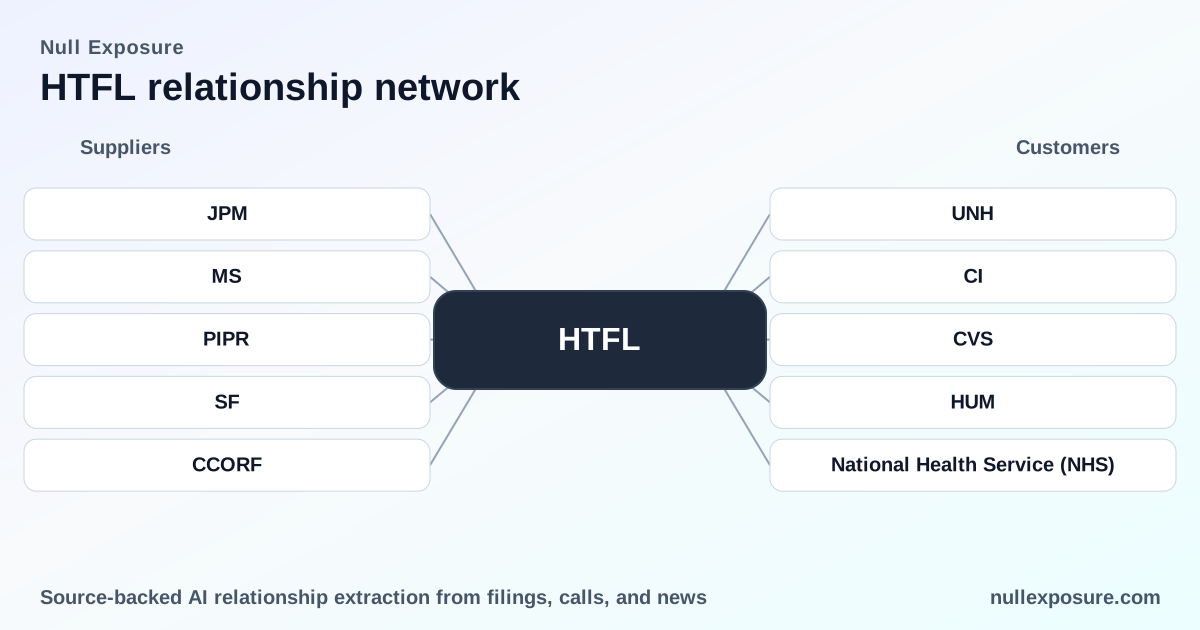
HeartFlow (HTFL): What the underwriter roster tells counterparties about capital access and supplier posture
HeartFlow operates a clinical software and diagnostic service business that sells non-invasive coronary artery disease analysis to health systems, imaging centers and payers. The company monetizes by converting clinical imaging into reimbursed diagnostic outputs and recurring commercial contracts; recent market activity shows the firm is actively using public capital markets to fund growth while operating at a loss as it scales. Investors and vendor managers should evaluate HeartFlow as a growth-stage medical‑technology supplier with meaningful revenue but ongoing operating losses and reliance on capital markets for liquidity.
For a concise supplier-risk briefing and ongoing exposure monitoring, visit https://nullexposure.com/.
The practical takeaway up front
HeartFlow’s completed upsized IPO and full exercise of the underwriters’ option signal strong capital-market access and a willingness to use external financing to fund commercial expansion. That dynamic changes how counterparties think about payment terms, contract length and dispute leverage: a company raising public capital trades some operational flexibility for improved balance-sheet runway. According to company filings through 2025-09-30, TTM revenue stood at $161.9M with gross profit of $122.4M but a negative operating profile, underscoring the logic of using equity to fund growth rather than purely internal cash flow.
What the bank roster reveals about the financing event
The roster of banks on the deal is not random: top-tier book-runners plus regional co-managers indicate an institutional-capital markets strategy and broad distribution to institutional investors. The GlobeNewswire announcement of the closing specifically names the managers and confirms the upsized IPO and full exercise of the underwriters’ option, which underscores demand for the offering and the reach of the syndicate in placing new stock.
Visit https://nullexposure.com/ for a tailored supplier relationship report if you need deeper countersigning and contractual exposure analysis.
Relationship roll call — who’s on record and what that means
J.P. Morgan
J.P. Morgan acted as a joint book-running manager on HeartFlow’s upsized initial public offering, positioning the bank as a primary distributor of the equity issuance and a central facilitator of HeartFlow’s capital raise. According to a GlobeNewswire press release in August 2025, J.P. Morgan was named alongside other lead banks for the offering.
Morgan Stanley
Morgan Stanley served as a joint book-running manager for the offering, indicating top-tier institutional placement support and market-making muscle behind the transaction. The GlobeNewswire release announcing the closing in August 2025 lists Morgan Stanley as a book-runner.
Piper Sandler
Piper Sandler functioned as the third joint book-running manager, completing the primary syndicate responsible for constructing the order book and allocating shares to institutional clients. The same August 2025 GlobeNewswire announcement cites Piper Sandler’s role.
Stifel
Stifel participated as a co-manager on the deal, contributing regional distribution and institutional relationships to the syndicate’s broader reach, per the August 2025 GlobeNewswire closing notice.
Canaccord Genuity
Canaccord Genuity acted as a co-manager on the offering, supplying additional placement and investor access particularly among specialty and healthcare-focused accounts, as described in the August 2025 GlobeNewswire announcement.
How these relationships translate into supplier posture and negotiating dynamics
- Contracting posture: HeartFlow’s use of an upsized IPO shows a preference for equity capital to fund expansion rather than debt or a purely cash-conservative posture. That implies counterparties should expect the company to prioritize growth investments and commercial expansion over aggressive renegotiation of supplier prices in the near term.
- Concentration: The publicly disclosed relationships here are financing partners, not vendors that supply core clinical services or IT; they do not introduce single-vendor operational concentration risk for HeartFlow’s clinical operations. For counterparties, concentration risk should be assessed across HeartFlow’s clinical supply chain and reimbursement partners, not the underwriting syndicate.
- Criticality: Access to capital markets increases HeartFlow’s runway and reduces short-term counterparty default risk tied to liquidity, but operational criticality remains with hospitals and imaging providers that deliver data and administer reimbursed procedures.
- Maturity and scale: With TTM revenue of $161.9M and a market capitalization around $1.79B, HeartFlow is a scaling public company: large enough to be a commercially attractive counterparty, but still operating at a loss (operating margin TTM -32.6%), so vendors should expect negotiation around cash preservation and performance-based contracting.
No supplier-specific constraints were captured in the reviewed relationship records; this absence is a company-level signal that the disclosed materials focused on the financing transaction rather than ongoing contractual restrictions or operational caveats.
Practical risk checklist for investors and vendor managers
- Confirm contract length and termination provisions: growth-stage public companies often trade flexibility for expanded commercial reach, so long-term contracts with favorable early-termination penalties protect suppliers.
- Monitor receivable exposure: despite improved capital access, operating losses mean attention to DSO and payment cadence remains necessary.
- Review concentration of revenue sources: verify which health systems and payers make up HeartFlow’s top accounts; financial sponsors and underwriters do not substitute for stable commercial revenues.
- Reassess pricing and performance clauses tied to deployment scale: rapid growth targets can strain implementation teams and affect claims and warranty exposure.
Final recommendation and next steps
HeartFlow’s successful upsized offering—book‑run by J.P. Morgan, Morgan Stanley and Piper Sandler with co-managers Stifel and Canaccord Genuity—enhances its balance sheet and reduces immediate liquidity risk for counterparties while keeping the company in a high-growth, negative‑margin operating mode. For vendor due diligence: prioritize contract clarity on payment terms, service-level expectations and termination remedies; for investors: track revenue conversion and margin progress against the current public-market valuation.
For a vendor-specific exposure briefing or to request a tailored counterparty risk memo, go to https://nullexposure.com/.
To commission a supplier-vetting report that integrates contractual terms and capital-market signals, start here: https://nullexposure.com/.