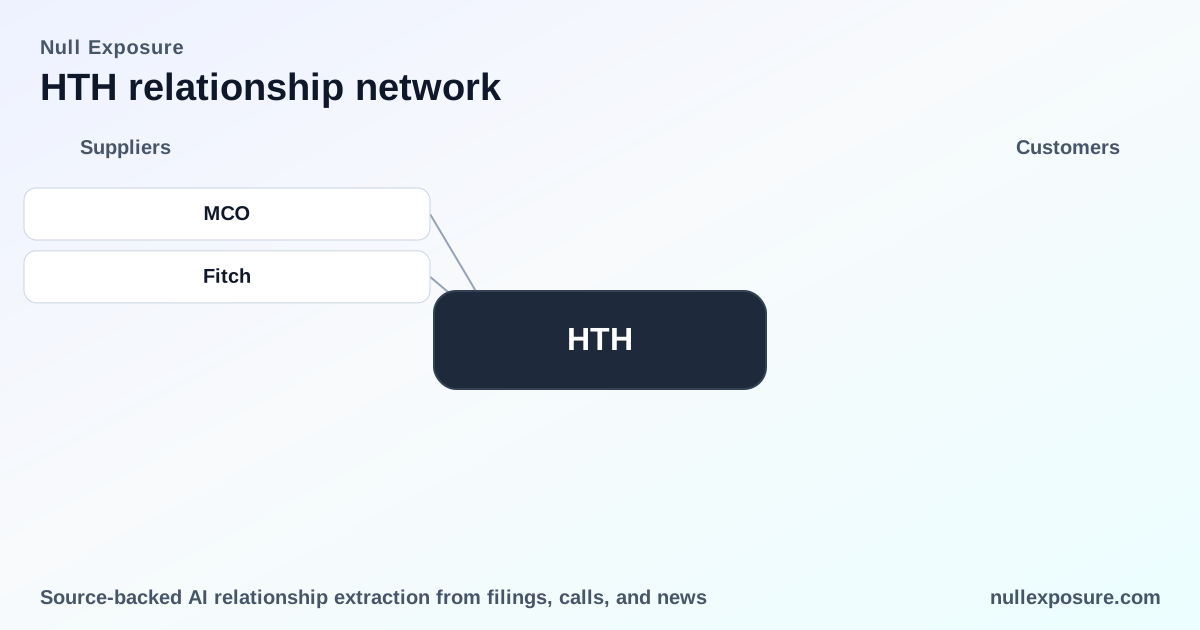
Hilltop Holdings (HTH): Supplier relationships, funding posture, and what operators should know
Hilltop Holdings operates as a diversified financial conglomerate concentrated in regional banking, mortgage origination and broker‑dealer services; it monetizes through net interest income, mortgage origination fees and spread trading/brokerage commissions, while leveraging securitized and short‑term funding facilities to manage liquidity. For investors and counterparties evaluating supplier exposure, Hilltop’s operating model blends long‑duration contractual commitments and heavy short‑term funding reliance, creating a distinctive counterparty risk profile that matters for vendor contracting and credit decisioning. Learn more at https://nullexposure.com/.
How Hilltop makes money and why suppliers care
Hilltop’s revenue mix is anchored in core banking spreads and fee income from mortgage origination and securities services; the banking segment funds itself with a mix of deposits, short‑term repurchase agreements and committed credit facilities, while PrimeLending (mortgage origination) uses warehouse lines that are critical to loan production. The company’s public metrics — roughly $1.27B revenue TTM, a return on equity of ~7.8%, and a price‑to‑book near 0.95 — reflect a low‑growth, yield‑sensitive franchise where cost and counterparty stability directly impact margins.
The supplier and counterparty landscape in plain English
Hilltop’s public disclosures and risk sections reveal a supplier ecosystem that includes large bank counterparties, clearinghouses, vendor service providers for IT and security, and property lessors. Two external credit rating relationships were picked up in recent news flow: Moody’s and Fitch have affirmed investment‑grade assessments (BBB+/Baa2) with a stable outlook, which supports access to capital markets and underpins the company’s ability to refinance medium‑term debt. According to a March 10, 2026 news report on Bitget, both Moody’s and Fitch coverage cites those ratings for FY2026.
For an operator evaluating contractual exposure, the disclosure set signals:
- A mix of long‑term contractual obligations (subordinated notes maturing in 2030 and 2035; long office leases) that create duration risk.
- Substantial short‑term funding activity (commercial paper, repo, federal funds, FHLB borrowings and warehouse lines) that results in daily funding sensitivity.
- Vendor concentration on critical IT, data and security services, with subscriptions to threat intelligence and vendor oversight governed by a vendor risk management (VRM) framework.
These are company‑level signals drawn from the firm’s regulatory and annual disclosures.
Discover how this profile maps to supplier risk frameworks at https://nullexposure.com/.
All external relationships surfaced in the results
Below are the relationships surfaced in the coverage, each with a concise, plain‑English summary and source reference.
-
Moody’s — Hilltop holds an investment‑grade rating from Moody’s at Baa2 (stable outlook), a rating cited as supporting the company’s favorable capital market access for FY2026; this appeared in a news item dated March 10, 2026. Source: Bitget news report (March 10, 2026) citing Moody’s commentary on FY2026.
-
Fitch — Fitch has likewise affirmed an investment‑grade rating of BBB+ (stable outlook) for Hilltop for FY2026, cited in the same March 10, 2026 news piece that referenced both agencies’ views on the company’s credit profile. Source: Bitget news report (March 10, 2026) citing Fitch’s FY2026 assessment.
What the contractual evidence means for partners and vendors
Hilltop’s disclosures include a clear blend of contract types and spend profiles that shape supplier strategy:
-
Long‑term commitments are material and institutional. The company discloses subordinated notes maturing in 2030 and 2035 and long‑term office leases (129‑month commitments), signaling that certain supplier relationships are embedded and will persist through multi‑year implementations. Treat these as strategic engagements where integration and exit costs are meaningful. Evidence is drawn from the company’s December 31, 2024 consolidated disclosures.
-
Short‑term funding dominates day‑to‑day liquidity management. The firm regularly uses commercial paper, repo and short bank borrowings (CP notes with weighted average remaining life of days to months, and repurchase agreement maturities from overnight to 90+ days). This creates pricing and settlement sensitivity for suppliers that provide marginable services or are exposed to funded inventory. These points are described in the firm’s short‑term borrowings and repurchase agreement disclosures.
-
Subscription and framework relationships exist for critical IT/security. Hilltop subscribes to security alert services and maintains committed revolving credit lines across its broker‑dealer businesses (e.g., up to $200–$425M of committed facilities in various places), indicating ongoing vendor relationships for monitoring, compliance and liquidity support.
-
Relationship roles are dual: buyer and service consumer. Hilltop both purchases securities and services (banking and treasury purchases) and relies on third‑party service providers for core technology, clearing, and audit functions (PwC as auditor since 1998 is named). Vendor risk management governs high‑risk vendors and vendors hosting non‑public personal information.
-
Geography is primarily North American with global risk considerations. The business is concentrated in Texas and the U.S., but disclosures call out global macro and supply‑chain impacts as drivers of operating results.
Materiality and concentration: practical takeaways
-
Critical dependencies exist on internal subsidiaries and dividend flows. Hilltop relies heavily on dividends from its bank subsidiaries for corporate funding; regulators can restrict those payments, which elevates criticality for any supplier paid by the parent that is not upstream in the cash flow waterfall. This is flagged explicitly in the company’s governance disclosures.
-
Spend concentration includes large credit facilities and warehouse lines (> $100M). PrimeLending’s $1.2B warehouse capacity (with $812M drawn at year‑end 2024) and broker‑dealer committed credit arrangements put Hilltop squarely in the high‑spend band for key financial counterparties.
-
Risk management posture is mature and formalized. The VRM process and use of third‑party audit and security subscriptions indicate a structured vendor oversight program; counterparties that host sensitive data or provide mission‑critical services are treated with elevated governance.
For investors and operators: what to do next
- For counterparties negotiating contracts, price and covenant language should reflect both long‑term embedded obligations and short‑term funding volatility; require clear dispute and termination mechanics for liquidity stress events.
- For investors, monitor short‑term funding metrics and dividend flow restrictions; those are leading indicators of operational strain.
- For vendor managers, insist on proof of VRM coverage, business continuity testing and evidence of hedging or committed facilities that back warehouse lines.
Learn more about supplier risk signals for financial firms at https://nullexposure.com/.
Hilltop is a fundamentally conservative, funding‑sensitive financial holding company with significant embedded contractual duration and a formal vendor governance program; for counterparty negotiations and investor diligence, the combination of investment‑grade external ratings and high short‑term funding activity requires contract design that protects against funding squeezes and subsidiary dividend constraints.