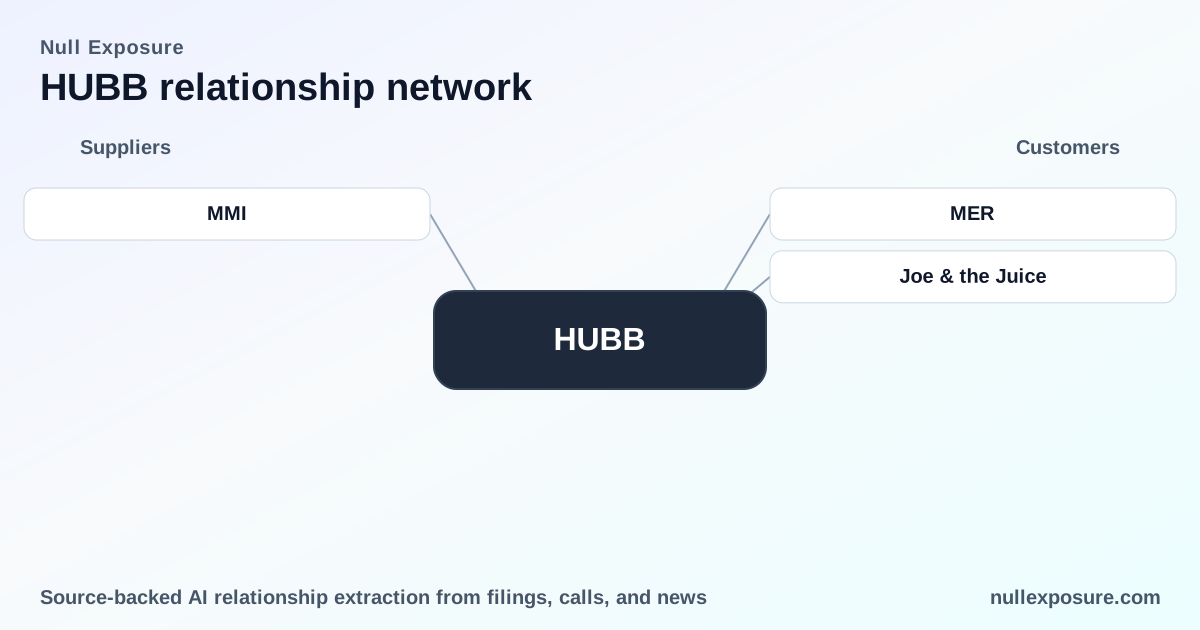
Hubbell Inc (HUBB): Supplier-focused investment thesis and relationship review
Hubbell Inc designs, manufactures and sells electrical and electronic products across commercial, industrial and residential markets, monetizing through direct product sales, aftermarket parts and platform-based recurring revenues tied to replacement cycles and infrastructure spending. For suppliers and operators evaluating a relationship with Hubbell, the company presents as a large, financially stable industrial buyer with diversified procurement needs and solid margins — understanding its contracting posture, supplier concentration signals and specific third‑party interactions is the priority.
For an actionable supplier-risk framework and to benchmark Hubbell against peer procurement profiles, see Null Exposure for tailored due diligence and supplier monitoring tools: https://nullexposure.com/
How Hubbell makes money and why suppliers should care
Hubbell’s revenue base is concentrated in electrical equipment and parts, with TTM revenue of $5.84 billion, an operating margin near 19.1%, and consistent profitability (TTM EPS $16.54). The business model drives predictable, recurring demand for components, finished goods and aftermarket services across construction and utility cycles. For suppliers, that translates into:
- Large, repeat purchase volumes when products are in a standard bill of materials.
- Margin pressure sensitivity because Hubbell can pass raw-material cost increases into product prices to a degree, but still expects cost discipline from vendors.
- Procurement scale — the company’s size and institutional shareholder base (over 100% institutional holdings reported) give it bargaining leverage on price and contract terms.
These characteristics make Hubbell an attractive counterparty for stable demand, while also requiring suppliers to be competitive on price, lead times and quality.
Contracting posture, concentration and criticality — what the public signals say
The public constraints available present a clear company-level signal: Hubbell is not materially dependent on any single supplier for raw materials used in manufacturing. That is a meaningful indicator of procurement strategy and supply chain resilience: the firm maintains diversified sourcing and is not concentrated on one vendor for primary feedstocks.
From a business-model perspective:
- Contracting posture: centralized procurement with leverage due to scale — suppliers should expect contract negotiations that emphasize price stability, quality metrics and contingency clauses.
- Concentration: low single-supplier concentration reduces supplier bargaining power for specialized vendors, but suppliers providing unique or certified components retain premium negotiating leverage.
- Criticality and maturity: mature industrial products and replacement-driven demand make key component suppliers strategically important, even if not single-source; invest in certifications and continuity planning to capture that value.
Financial health and implications for supplier credit
Hubbell’s market capitalization stands near $25.1 billion with EBITDA around $1.41 billion, a trailing P/E of ~28.6 and forward P/E ~24.0. These metrics point to an investment-grade profile relative to industrial peers and imply solid counterparty credit for suppliers. Payment behavior and procurement terms will reflect that credit profile, but suppliers should still underwrite exposure over long manufacturing cycles and large order backlogs.
Explicit relationship coverage: what the public reporting records
Hubbell’s public relationship reporting in the sample set is narrow; the results include one third‑party interaction that is relevant for supplier and asset-risk context.
Marcus & Millichap (MMI) — real estate intermediary for a Hubbell-associated asset
A YieldPro report from February 2026 notes that Marcus & Millichap’s Manhattan office exclusively marketed a property on behalf of the seller, identified as HUBB NYC, and procured a private investor buyer. The reference is transactional and real-estate specific rather than procurement-related, but it is relevant to understanding non-core asset dispositions and local entity structures that could affect regional operations or real estate liabilities. Source: YieldPro, February 2026 — https://yieldpro.com/2026/02/304-bleecker-street/
(That is the only named relationship in the public results set provided.)
What the relationship signal means for suppliers and investors
The Marcus & Millichap item is not a supplier contract; rather, it signals active portfolio management at a local-entity level (HUBB NYC). For suppliers, this matters because divestitures and property sales can change local warehousing, logistics partners and regional demand patterns, creating transition windows where procurement requirements or invoicing entities change. Investors should treat this as a governance and capital-allocation datapoint: Hubbell can monetize non-core real estate as part of balance-sheet optimization without impairing core supply relationships.
Mid-read action: if you are benchmarking supplier exposure or vendor-credit limits, run a governance check on entity-level buyers and confirm invoicing/legal entity fields with Hubbell procurement: https://nullexposure.com/
Practical supplier risk checklist driven by Hubbell’s profile
Suppliers should prioritize:
- Contract clauses that address continuity of supply and changes in regional ownership or warehousing after asset sales.
- Certification and quality documentation to convert niche component status into higher bargaining power.
- Flexible logistics and SKU management to align with Hubbell’s diversified sourcing posture.
These steps align with the company-level signal that single-supplier dependency is immaterial, but operational disruptions or local entity changes can still cause concentrated risk windows.
Key takeaways and investor guidance
- Hubbell is a financially robust, margin-oriented industrial buyer with diversified supplier exposure — a favorable counterparty for well-capitalized vendors who can meet scale and quality demands.
- Publicly available relationship data in this set is limited to a property transaction marketed by Marcus & Millichap, indicating selective non-core asset monetization but not altering core procurement dynamics.
- Company-level constraint data flags low single-supplier dependency, which is a direct signal that procurement concentration is low; suppliers with unique capabilities remain strategically valuable.
For monitoring supplier counterparty risk and capturing procurement shifts tied to entity-level transactions, consider integrating continuous intelligence into vendor management: https://nullexposure.com/
Hubbell’s operating model rewards reliable, scale-capable suppliers and penalizes those unable to meet cost/quality expectations. Use the signals above to refine credit underwriting, contractual protections and growth capture strategies when engaging with Hubbell.