Hub Cyber Security (HUBC): advisory network, capital partners, and what suppliers tell investors
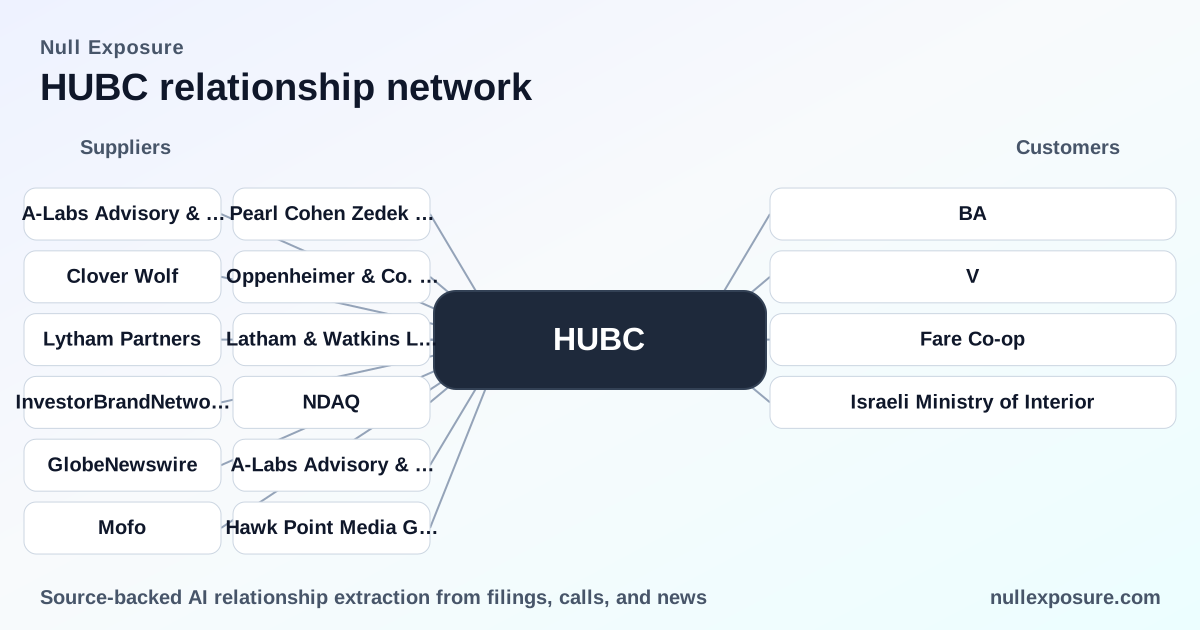
Hub Cyber Security sells Confidential Computing security software and services out of Tel Aviv and monetizes through enterprise licenses, services for regulated customers (banks, critical infrastructure), and strategic inorganic moves — IPO/de‑SPAC financing and targeted acquisitions to expand product depth. Revenue comes from product and services contracts; capital and communications partners undergird deal execution and market access. For a concise supplier-relationship map and ongoing signals, see NullExposure’s coverage at https://nullexposure.com/.
Why the advisor and investor map matters for an early-stage security vendor
HUBC is a small-cap, loss-making security vendor that relies on external advisors and placement agents to execute financing and strategic transactions. That contracting posture — heavy reliance on legal, financial and investor‑relations intermediaries — is a structural feature, not a transitory footnote. Public filings and press releases show repeated use of major law firms, boutique placement agents, and IR/PR firms to complete de‑SPAC deals, raise PIPE capital, manage communications, and support integration after acquisitions. Given negative EBITDA and a market capitalization under $1m in the disclosed snapshot, the company’s ability to access capital and manage perception is a critical determinant of execution. Learn more via NullExposure’s homepage: https://nullexposure.com/.
The operating model signals investors should read into
- Contracting posture: HUBC outsources deal execution and investor communications to external specialists, indicating a lean internal corporate-development and investor-relations function.
- Concentration and funding sensitivity: Public reporting documents show reliance on a small number of placement and PIPE investors for material financings, creating elevated financing concentration risk.
- Criticality to customers versus maturity: HUBC sells mission‑critical cyber solutions, but its financial profile (negative margins and steep EPS loss) signals early commercial maturity and dependence on capital markets to scale.
- Maturity and transition events: The company has executed a de‑SPAC business combination, pursued acquisitions (BlackSwan) and corporate housekeeping (reverse share split) — consistent with a company in transition from private start‑up to public execution mode.
These are company‑level signals rather than assertions tied to any single external firm.
Who HUBC is working with — relationship summaries and sources
Below are every relationship identified in the public results for HUBC, with a one‑to‑two sentence plain‑English summary and the original reporting source.
-
Pearl Cohen Zedek Latzer Baratz — Identified as one of HUBC’s legal advisors during the de‑SPAC process. According to SPACInsider coverage of the Mount Rainier business combination (reported in FY2023), Pearl Cohen served alongside Latham & Watkins on legal matters. (SPACInsider, FY2023)
-
Oppenheimer & Co. Inc. — Named as a financial advisor to HUBC for the de‑SPAC execution and related financing activities. SPACInsider lists Oppenheimer among the financial advisors to HUB in its Mount Rainier transaction coverage (FY2023). (SPACInsider, FY2023)
-
Latham & Watkins LLP — Served as a principal legal advisor on HUBC’s de‑SPAC business combination; the firm also publicized the advisory relationship in a client news post. Latham’s advisory role on the Mount Rainier combination is documented in the firm’s March coverage (reported FY2023). (Latham & Watkins LLP press release, FY2023)
-
The Nasdaq Stock Market LLC (Nasdaq) — Nasdaq is the exchange on which HUBC’s ordinary shares trade and the venue referenced for the company’s 1‑for‑15 reverse share split effective January 16, 2026; trading resumed on a split‑adjusted basis under the symbol HUBC. (QuiverQuant citing Nasdaq notice, FY2026)
-
A‑Labs Advisory & Finance Ltd. (ALabs) — Identified as a financial advisor and the sole placement agent for the PIPE; ALabs also provided an irrevocable $10 million commitment on terms matching a separate investor, indicating a role beyond pure advisory services. This is reported in SPACInsider and Calcalistech coverage of the transaction (FY2023). (SPACInsider and Calcalistech, FY2023)
-
Hawk Point Media Group, LLC (HPM) — Retained via an IR agency relationship to provide press releases, editorial insights and digital media production for HUBC, indicating outsourced communications and media production. This is disclosed in a FinancialContent/Accwire piece describing IR activity (FY2025). (FinancialContent / AccwireCQ, FY2025)
-
Clover Wolf — A hedge fund investor that withdrew from a scheduled investment as part of the merger timeline, a withdrawal that prompted a postponed completion date; the development was reported in Israeli tech coverage. (Calcalistech, FY2023)
-
Lytham Partners — Functions as HUBC’s investor relations contact in multiple press releases and filings; Lytham’s named representative (Ben Shamsian) appears across FY2025–FY2026 releases and acquisition announcements. (GlobeNewswire and other press releases, FY2025–FY2026)
-
InvestorBrandNetwork (IBN) — A wire service used to distribute press material about HUBC’s acquisition of BlackSwan Technologies, indicating paid or arranged press distribution channels for corporate announcements. (GlobeNewswire/InvestorBrandNetwork release, FY2025)
-
GlobeNewswire — Platform used to publish HUBC’s corporate releases, including CEO letters and acquisition announcements; the channel is cited in press distributions during FY2025–FY2026. (GlobeNewswire press releases summarized via QuiverQuant, FY2026)
-
Mofo — Identified as a family‑office investor (headed by Moshe Schlisser) and linked to notable individual investor activity in press reporting; listed among other private investors in coverage of financing arrangements. (Calcalistech, FY2023)
Investment implications: execution risk, funding vector, and reputational plumbing
HUBC’s supplier/partner map shows a company that leverages external specialists for three functions critical to public‑company survival: financing (ALabs, Oppenheimer), legal governance (Latham, Pearl Cohen), and investor communications (Lytham, GlobeNewswire, HPM). That configuration reduces fixed overhead but increases execution risk if external partners cannot deliver capital or credible market messaging. Key risk vectors:
- Financing concentration: reliance on a small set of investors and placement agents to fill PIPE commitments increases funding tail‑risk.
- Reputational dependence: use of wire services and IR firms for messaging requires disciplined disclosure management given prior investor withdrawals.
- Operational leverage: negative EBITDA and steep EPS loss mean the company’s runway depends on continued access to capital markets.
For institutional due diligence, verify the cadence of PIPE closings, contractual terms with placement agents, and any lock‑ups or fee structures disclosed in deal filings. For a focused supplier relationship review, see NullExposure’s dossier at https://nullexposure.com/.
What to watch next (and a final read)
- Track subsequent PIPE funding completions and any changes to placement agent commitments.
- Monitor integration milestones for the BlackSwan acquisition and customer wins among regulated financial institutions.
- Watch Nasdaq filings for governance disclosures (related‑party arrangements, fees to advisors) and any further corporate actions (reverse splits, additional financings).
Bottom line: HUBC is an early‑stage cybersecurity vendor with strategic advisory relationships that are critical to its capital and communications strategy; that external network reduces internal fixed costs but concentrates execution risk around a small set of intermediaries. For continued coverage and supplier‑relationship intelligence, visit https://nullexposure.com/.
If you want a tailored supplier‑risk brief or a one‑page relationship map for presentation decks, request a custom report via NullExposure: https://nullexposure.com/.