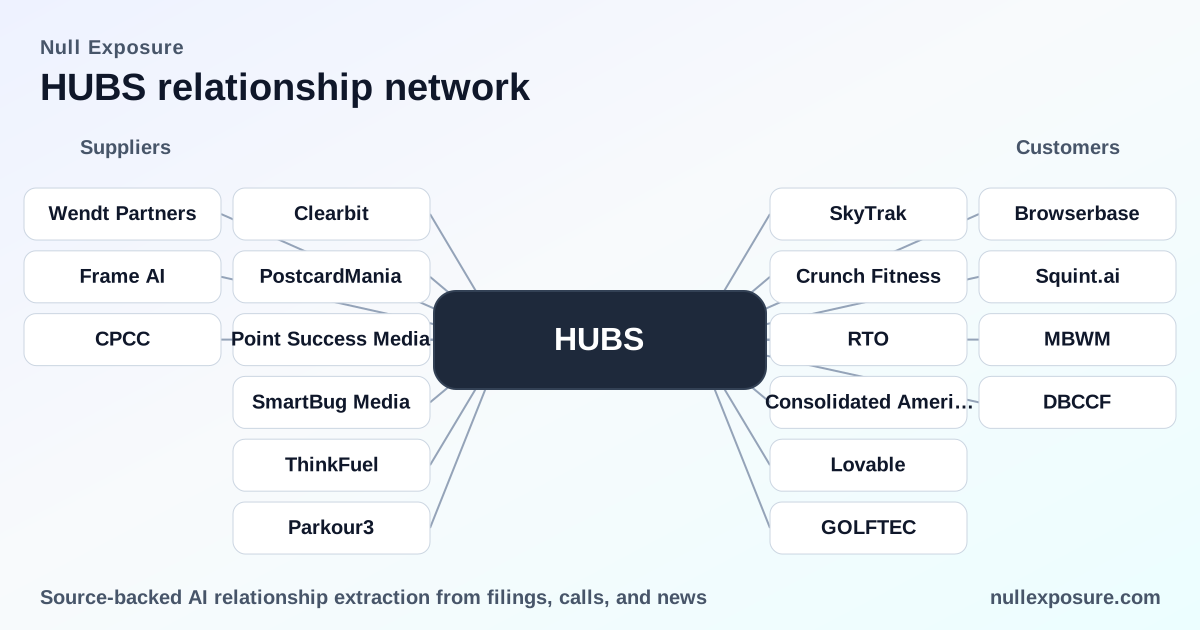
HubSpot’s supplier map: what investors and operators need to know about HUBS’ external ties
HubSpot operates a cloud-native CRM and marketing platform and monetizes primarily through recurring subscription revenue for its Hubs (marketing, sales, service, CMS, and operations), incremental paid add‑ons and AI-enhanced features, and an expanding partner and integration ecosystem that drives upsell and services revenue. The company leverages acquisitions and third‑party integrations to accelerate product capability (notably in data and AI) while maintaining enterprise-grade finance arrangements to underwrite growth and working capital. For a concise vendor and supplier risk scan, see more at the NullExposure homepage: https://nullexposure.com/.
How HubSpot’s contracting posture and vendor profile shape execution
HubSpot’s public disclosures and the supplier signals in market reporting convey a mature contracting posture with a mix of strategic, long‑term arrangements and a broad partner base that supports go‑to‑market scale. Management disclosed a five‑year revolving credit facility with Bank of America for up to $500 million entered on February 10, 2026, which the company categorized as a material definitive agreement — a financing backbone that reduces liquidity strain as HubSpot integrates acquisitions and funds R&D. The company also discloses use of a third‑party registered payment facilitator for payments processing and publishes future minimum vendor commitments (disclosed total: $494,730 as of December 31, 2025). Separately, an automated classification signal flagged a high spend band; treat that as a company‑level model signal rather than a single counterparty figure. Together these items indicate capitalized growth with explicit operational vendor relationships and financial backstops.
Supplier and partner roll call — what each relationship contributes
Clearbit
HubSpot acquired Clearbit to augment B2B marketing intelligence and fold richer enrichment into HubSpot AI, strengthening customer data and targeting capabilities. Multiple industry writeups in March 2026, including TradingView and Finviz, cite the acquisition as accelerating HubSpot’s data-driven vision (TradingView / Finviz, March 2026).
PostcardMania
PostcardMania announced a beta for a PCM Integrations direct‑mail connector that triggers physical mail from HubSpot CRM events, effectively turning CRM workflows into automated offline touches; the initiative was reported in February 2026 by Sahm Capital (Sahm Capital, February 2026).
Point Success Media (SmartBug Media rebrand)
Agency ecosystem moves such as SmartBug Media’s rebrand to Point Success Media illustrate how HubSpot partners are repositioning services around HubSpot’s platform and lower‑entry offerings, signaling continued partner channel evolution (SimplyWall.St coverage, March 2026).
SmartBug Media
SmartBug Media’s strategic repositioning (reported alongside the Point Success Media narrative) underscores the role agencies play in driving HubSpot adoption, professional services, and implementation revenue for customers moving across Hub tiers (SimplyWall.St, March 2026).
ThinkFuel
ThinkFuel enters the HubSpot partner narrative through acquisition activity (Parkour3’s purchase), highlighting consolidation among agencies that service HubSpot customers and the platform’s centrality in agency portfolios (SimplyWall.St, March 2026).
Parkour3
Parkour3’s acquisition of ThinkFuel reflects partner consolidation around HubSpot — an ecosystem signal that specialist agencies are scaling via M&A to capture HubSpot‑centric services demand (SimplyWall.St, March 2026).
Wendt Partners
Wendt Partners has been recognized as a top HubSpot partner for manufacturing companies, indicating verticalized partner strength that supports HubSpot’s penetration into manufacturing and industrial segments (Finviz writeup, March 2026).
Frame AI
The acquisition of Frame AI accelerated HubSpot’s conversation intelligence and unified handling of structured and unstructured customer data, improving the company’s ability to deliver AI‑driven insights across the buyer journey (TradingView, March 2026).
Stripe
HubSpot leverages Stripe Tax for checkout tax calculations, embedding Stripe into transaction flows to handle tax logic at point of sale — a payment and tax service relationship noted in Martech coverage from June 2025 (MarTech, June 2025).
What these relationships imply for investors and operators
- Strategic acquisitions (Clearbit, Frame AI) are tactical moves to own key data and AI capabilities rather than relying solely on third‑party enrichment providers; that reduces time‑to‑market for features and increases integration control, but also raises integration and retention execution risk.
- Channel and agency consolidation (SmartBug, Point Success Media, Parkour3, ThinkFuel, Wendt Partners) strengthens go‑to‑market reach and professional services revenue, creating customer stickiness through certified partners that implement and expand Hub usage.
- Operational integrations (PostcardMania, Stripe) show practical expansion of the platform into offline orchestration and payments/tax flows, diversifying utility for customers and increasing the number of critical service interactions HubSpot depends on at runtime.
- Financial posture: the five‑year, up‑to‑$500 million revolving credit facility with Bank of America (effective Feb 10, 2026) is a material financing arrangement that supports M&A, op‑ex cadence, and partner investments — a positive signal for execution flexibility.
For a deeper supplier risk and concentration scorecard tailored to your portfolio, visit https://nullexposure.com/ and request a scoped review.
Constraints and how they shape supplier risk assessment
- Contract type: HubSpot’s five‑year Revolving Credit Agreement (entered February 10, 2026 with Bank of America as administrative agent) establishes long‑term financial capacity and is explicitly disclosed as material in company filings.
- Materiality: The revolving credit filing was treated as a material definitive agreement, indicating board‑level awareness and disclosure thresholds have been met.
- Service provider posture: HubSpot confirms engagement of a third‑party registered payment facilitator, which is relevant for payment flow reliability and compliance oversight.
- Spend signals: The company disclosed future minimum vendor commitments totaling $494,730 as of December 31, 2025; classification tooling also surfaced a high spend‑band signal — treat these as company‑level inputs to vendor concentration analysis rather than counterparty‑specific assertions.
These constraints indicate a mixture of strategic, long‑dated financial arrangements and a dispersed, partner‑centric supplier base rather than a single, concentrated supplier dependency.
Investor takeaway and next actions
- Key positive: Acquisitions (Clearbit, Frame AI) and deep partner relationships materially increase HubSpot’s product defensibility and platform utility, supporting recurring revenue and upsell.
- Key risk: Integration execution and the operational reliability of multiple third‑party services (payments, tax, direct mail, agency implementers) are mission‑critical and deserve focused vendor management and contingency planning.
- Actionable step: For investors assessing counterparty concentration and operational dependency, commission a vendor exposure review that maps revenue touchpoints to supplier SLAs and financial backstops.
To start a supplier risk engagement or request a custom vendor exposure brief for HubSpot, visit https://nullexposure.com/. For portfolio teams seeking an expedited supplier scan focused on AI and payment flows, see our research page at https://nullexposure.com/ for immediate intake and pricing.