Humana Inc. (HUM): Supplier relationships and what they mean for investors
Humana is a vertically integrated health insurer that monetizes by collecting premiums (commercial, Medicare Advantage, and government programs), managing risk through capitation and reinsurance, and extracting margin via care management, pharmacy rebates, and administrative efficiencies. Revenue is driven by membership scale and network control; cash and liquidity are secured through a mix of short-term commercial paper and multi-year credit facilities while longer-term funding is provided by senior and subordinated note issuances. For investors and operators evaluating supplier counterparty exposure, the mix of short-term liquidity tools, long-term capital markets activity, and high-dollar provider and vendor relationships defines Humana’s operating leverage and supply-chain risk. Learn more at NullExposure.
How Humana contracts and captures value
Humana runs a hybrid contracting model. The company pays fixed monthly capitation to providers on some lines (subscription-style revenue outflows), maintains significant short-term liquidity tools (commercial paper, revolving credit), and issues long-duration debt for capital structure optimization. That structure enables predictable payments to providers while giving Humana flexibility to manage interest-rate exposure through swaps and to access markets for large financings. This combination is why provider network performance and capital markets execution are both strategically critical to Humana’s operating model.
- For a complete supplier intelligence picture and tailored risk scoring, visit NullExposure.
Who the suppliers and counterparties are (what the data shows)
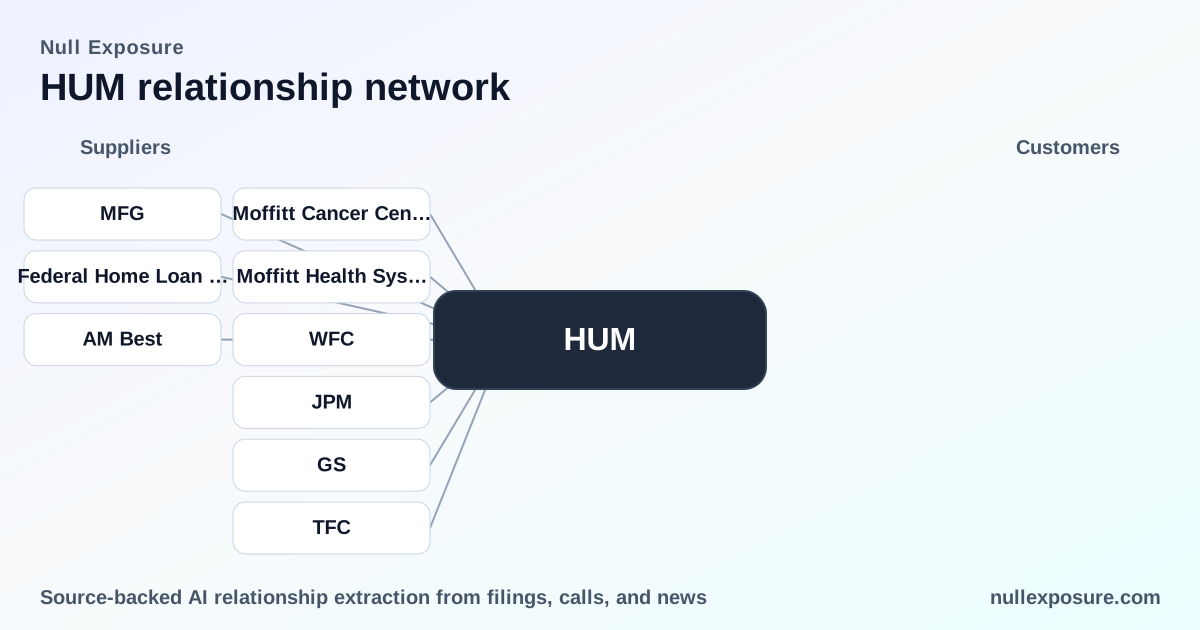
Below are the relationships surfaced in the latest results, each described in plain English with source references.
Moffitt Cancer Center
Humana announced that Moffitt Cancer Center (Florida) will be out-of-network for Humana Medicare Advantage members effective July 1, 2026, affecting network adequacy and member access in that market. Source: Humana news release, March 10, 2026 — https://news.humana.com/news/articles/humana-statement-on-our-contract-with-moffitt-health-system
Moffitt Health System
The related Moffitt Health System (the health system arm) will likewise be out-of-network for Humana Medicare Advantage members as of July 1, 2026, indicating a termination of network access rather than a new partnership. Source: Humana news release, March 10, 2026 — https://news.humana.com/news/articles/humana-statement-on-our-contract-with-moffitt-health-system
Wells Fargo Securities, LLC (WFC)
Wells Fargo acted as an active joint book-running manager on Humana’s $1.0 billion junior subordinated notes offering, indicating its role in distribution and execution of Humana’s capital markets transactions. Source: AIJourn reporting on the notes offering, March 2026 — https://aijourn.com/humana-completes-aggregate-1-0-billion-fixed-to-fixed-rate-junior-subordinated-notes-offering/
J.P. Morgan Securities LLC (JPM)
J.P. Morgan served as an active joint book-running manager on the same junior subordinated notes deal, supporting placement and underwriting capabilities for Humana’s subordinated issuance. Source: AIJourn notes offering coverage, March 2026 — https://aijourn.com/humana-completes-aggregate-1-0-billion-fixed-to-fixed-rate-junior-subordinated-notes-offering/
Goldman Sachs & Co. LLC (GS)
Goldman Sachs was also an active joint book-running manager on the junior subordinated notes sale, reflecting the typical syndicate mix Humana uses for large fixed-income issuance. Source: AIJourn notes offering coverage, March 2026 — https://aijourn.com/humana-completes-aggregate-1-0-billion-fixed-to-fixed-rate-junior-subordinated-notes-offering/
Truist Securities, Inc. (TFC)
Truist joined the syndicate as an active joint book-running manager for Humana’s junior subordinated offering, reinforcing the syndicate’s diversity across regional and national banks. Source: AIJourn notes offering coverage, March 2026 — https://aijourn.com/humana-completes-aggregate-1-0-billion-fixed-to-fixed-rate-junior-subordinated-notes-offering/
Mizuho Securities USA LLC (MFG)
Mizuho Securities participated as an active joint book-running manager on the subordinated notes, showing Humana’s use of global banks for distribution reach. Source: AIJourn notes offering coverage, March 2026 — https://aijourn.com/humana-completes-aggregate-1-0-billion-fixed-to-fixed-rate-junior-subordinated-notes-offering/
Federal Home Loan Bank of Cincinnati
Humana’s liquidity access includes short-term borrowings from the Federal Home Loan Bank of Cincinnati via its insurance subsidiary, supplementing commercial paper, credit facilities, and subsidiary dividends as liquidity sources. Source: AIJourn summary of AM Best commentary, March 2026 — https://aijourn.com/am-best-assigns-issue-credit-rating-to-humana-inc-s-new-junior-subordinated-notes/
AM Best
Rating agency AM Best assigned a Long-Term Issue Credit Rating of “bbb-” to Humana’s $1 billion 6.625% junior subordinated notes due 2056, providing an independent assessment that affects cost of capital and investor appetite for subordinated paper. Source: AIJourn report relaying AM Best’s assignment, March 2026 — https://aijourn.com/am-best-assigns-issue-credit-rating-to-humana-inc-s-new-junior-subordinated-notes/
Constraints and what they reveal about Humana’s operating model
The supplied constraint signals should be read as company-level characteristics that shape supplier risk and procurement strategy:
- Contracting posture: Humana operates with a mix of short-term liquidity and commercial arrangements (commercial paper, 364-day credit agreement) alongside multi-year credit agreements and long-dated bonds. This creates a dual exposure: short-term funding rollover risk, plus long-term interest-rate and refinancing risk.
- Commercial models: The presence of capitation (subscription-style) contracts means Humana locks in monthly payments to providers, shifting utilization risk and requiring tight provider management to protect margins.
- Counterparty mix and concentration: Counterparties span very large financial institutions, government entities (Medicare/treasury exposure), and individual brokers/providers, implying diversified counterparties but concentrated operational dependence on providers and large banks for financing and derivative hedging.
- Criticality and materiality: Provider performance, IT/service vendors, and claim processing are described as material or critical to operations; failures here would materially impact service delivery and financials.
- Maturity and lifecycle: Relationships range from short-term operational facilities to multi-year provider and lease arrangements, requiring different governance and contingency playbooks.
- Spend profile: Multiple signals point to large spend relationships (>$100M) — capitation pools, commercial paper activity, and borrowing capacity — meaning supplier disputes or payment timing issues could have meaningful financial consequences.
These signals justify active oversight of provider network performance and stress-testing financing pathways under adverse scenarios.
Investment implications and recommended vigilance
Humana’s model gives investors a stable premium-based revenue engine, but supplier and capital-market relationships are active levers of risk and return. Key takeaways:
- Network disruptions (like the Moffitt separation) are operationally significant for local market access and could pressure membership retention or claims patterns.
- Capital markets access (the recent junior subordinated notes and large syndicated bank facilities) shows Humana can execute large financings, but the assigned “bbb-” to subordinated paper highlights cost sensitivities at lower tiers of capital.
- Liquidity layering (commercial paper, FHLB access, revolving lines) reduces single-point-of-failure risk, but the firm remains exposed to short-term rollovers and SOFR spread variability.
For executive teams and investors focused on counterparty concentration, supplier performance, and capital structure optimization, NullExposure provides actionable supplier intelligence and scenario modeling. Explore strategic supplier dashboards at NullExposure.
Bottom line: where to look next
Humana’s supplier picture is a study in balance: large-scale capital markets relationships and bank syndicates support strategic financing, while provider contracting and capitation expose the company to operational concentration and network risk. Active monitoring of provider network changes, liquidity metrics, and ratings movements on subordinated obligations will be the most efficient way to surface material counterparty risk early.
For tailored intelligence on Humana’s supplier exposure and contract-level risk scoring, start with NullExposure. If you want a quick briefing or vendor-specific risk map, visit NullExposure and request a supplier risk snapshot.