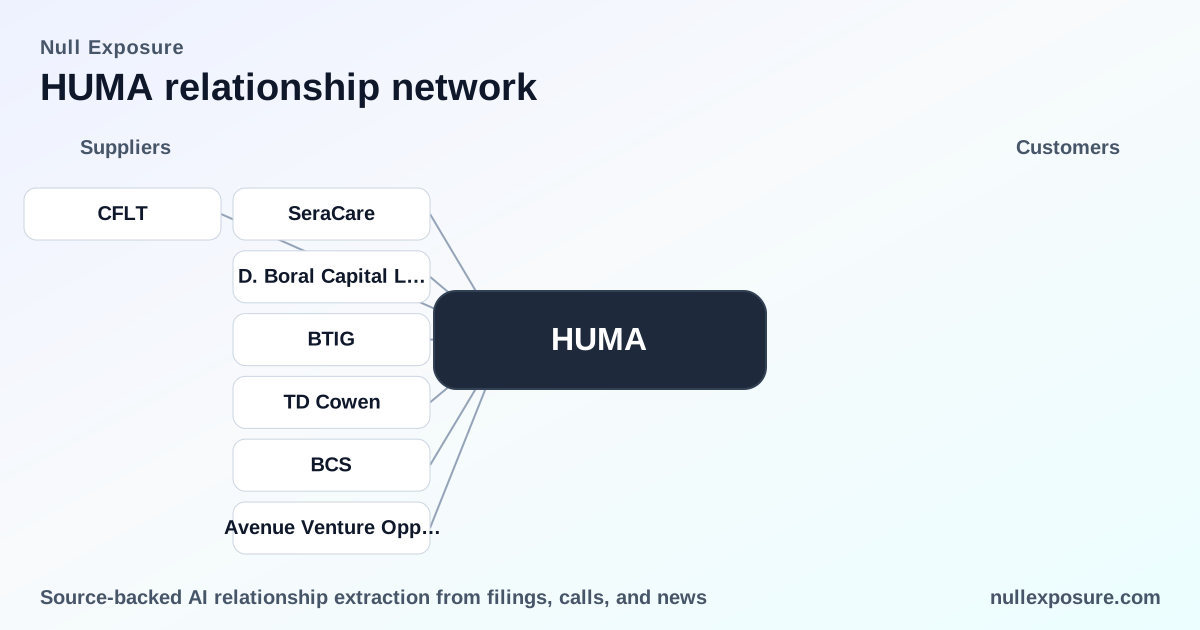
Humacyte (HUMA): Supplier and Capital Partner Map for Investors
Humacyte operates a vertically integrated regenerative-medicine platform that develops off‑the‑shelf human acellular vessels (HAVs) and related products. The company monetizes through commercial sales of Symvess and clinical-stage product development, while funding growth via equity offerings, structured revenue‑interest financings and credit facilities that finance scale‑up of manufacturing and trials. For investors and operators evaluating supplier relationships, Humacyte’s value proposition depends as much on its intellectual‑property licenses and sole‑source inputs as on its recent capital partners that provided liquidity for near‑term execution. For a concise vendor and financing footprint, see Nillexposure’s supplier intelligence at https://nullexposure.com/.
What matters for investment and operations: a short thesis
Humacyte’s business is manufacturing‑intensive and license‑driven: core economics will flow from commercial adoption of HAV products, but delivery hinges on a handful of critical suppliers, long‑dated licenses, and periodic capital raises. Supply concentration and long‑term contracting are structural exposures, while diversified financing relationships provide immediate runway. Active investors should value Humacyte as a commercial‑stage biotech with operational leverage to manufacturing inputs and contractual covenants that influence cash flexibility and product availability.
- Explore deeper supplier intelligence and risk scoring at https://nullexposure.com/ for operational due diligence.
How Humacyte’s contracting posture and business model read to investors
Humacyte combines several contract types across its value chain: long‑term leases and supply agreements, licensing arrangements with major research institutions, framework master services for clinical work, and short‑term service contracts for CROs and logistics. Company filings show prolonged lease commitments through 2033 and license agreements with Yale and Duke that are worldwide and, in some cases, exclusive; these create both defensibility and counterparty obligations that affect commercialization timelines. Spend profiles range from sub‑$100k maintenance fees to tens of millions in non‑cancellable purchase commitments, reflecting a maturity mix: established manufacturing commitments alongside ongoing clinical‑stage spend. Overall concentration is material: the 10‑K identifies sole‑source suppliers for critical inputs and license dependence that would be material if terminated.
Supplier and capital relationships — the full list (brief, sourced)
Below are every relationship captured in the public disclosures and press coverage; each entry includes a plain‑English summary and a concise source reference.
-
SeraCare — Humacyte relies on SeraCare as a sole‑source supplier of human plasma, with an agreement that places most plasma purchases with SeraCare and that automatically extends annually unless properly terminated. This supply arrangement is identified as material to manufacturing. (Humacyte 2024 Form 10‑K, FY2024)
-
Confluent — Confluent supplies the polymer mesh used in Humacyte’s manufacturing and is described as a sole‑source vendor with contractual obligations to establish redundant manufacturing at volume thresholds. The mesh supply agreement includes price‑adjustment mechanics tied to raw material cost changes. (Humacyte 2024 Form 10‑K, FY2024)
-
D. Boral Capital LLC — D. Boral acted as exclusive placement agent on an oversubscribed equity unit offering that raised proceeds via common stock and warrants, handling distribution of 28,436,018 units at $2.11 per unit in a 2025 transaction. This placement supported near‑term liquidity. (CityBuzz and Newswire reports, FY2025 coverage)
-
BTIG — BTIG served as a joint bookrunner on a capital raise alongside TD Cowen and Barclays, participating in syndication and investor allocation for Humacyte’s offering activity in 2025. (Market coverage of Humacyte offering, March 2025)
-
TD Cowen — TD Cowen acted as a joint bookrunner for Humacyte’s 2025 offering, supporting underwriting and distribution functions in the transaction. (Market coverage of Humacyte offering, March 2025)
-
Barclays (BCS) — Barclays was a joint bookrunner on the same 2025 equity offering, handling institutional placement and market execution alongside BTIG and TD Cowen. (Market coverage of Humacyte offering, March 2025)
-
Avenue Venture Opportunities Fund II, L.P. (Avenue Capital Group) — Avenue provided a credit facility up to $77.5 million, delivering structured debt financing to support commercial scale-up and general corporate uses; the facility supplements equity capital and revenue‑interest financings already on Humacyte’s balance sheet. (GlobeNewswire press release, Dec 16, 2025)
Operational constraints and strategic implications
Humacyte’s public disclosures reveal several company‑level signals that drive supplier risk and commercial execution:
-
Contracting posture: The company uses a mix of long‑term contracts (facility leases through 2033; multi‑year license terms) and framework agreements (master services with Frenova) to lock in capacity and clinical support. This posture signals an emphasis on stability of supply and service continuity.
-
Concentration and criticality: The filing explicitly states sole‑source suppliers for human plasma and polymer mesh, which are critical to manufacturing; these relationships are flagged as material and could delay commercialization if disrupted.
-
Maturity of relationships: Licensing arrangements with Yale and Duke are long‑standing and worldwide, providing IP barriers but also operational obligations (milestones, diligence reporting) that Humacyte must satisfy to retain rights.
-
Spend scale: Commitments and purchase orders span sub‑$100k maintenance fees to $10–100m non‑cancellable purchase commitments, reflecting both R&D‑level vendor spend and material manufacturing outlays.
-
Financing posture: Humacyte balances equity placements with majority‑backed credit (Avenue) and revenue‑interest structures; this reduces immediate dilution while imposing covenants and potential repurchase clauses that affect cash management.
-
For a supplier risk scorecard and supplier concentration model, visit https://nullexposure.com/ to see how these signals map to operational risk.
Investment implications and risk checklist
-
Upside: Proprietary licenses and a commercial manufacturing footprint create an addressable revenue path if product adoption accelerates. Capital partners in 2025–2026 increased runway, enabling commercialization investment.
-
Downside: Sole‑source inputs and license termination clauses are material operational risks; any supplier disruption or license dispute could materially delay sales. Structured financings and restricted cash arrangements also add covenant complexity.
Closing recommendation
For investors and procurement teams, the priority is clear: validate continuity plans for SeraCare and Confluent supplies, and understand covenant mechanics for non‑dilutive and credit financings. Operational diligence should focus on supplier redundancy for plasma and mesh, and on milestone calendars tied to Yale and Duke licenses. For a deeper supplier risk assessment and contract‑level visibility, review the Nillexposure supplier dashboard at https://nullexposure.com/.
If you want a tailored supplier‑risk brief or portfolio mapping for HUMA, start here: https://nullexposure.com/.