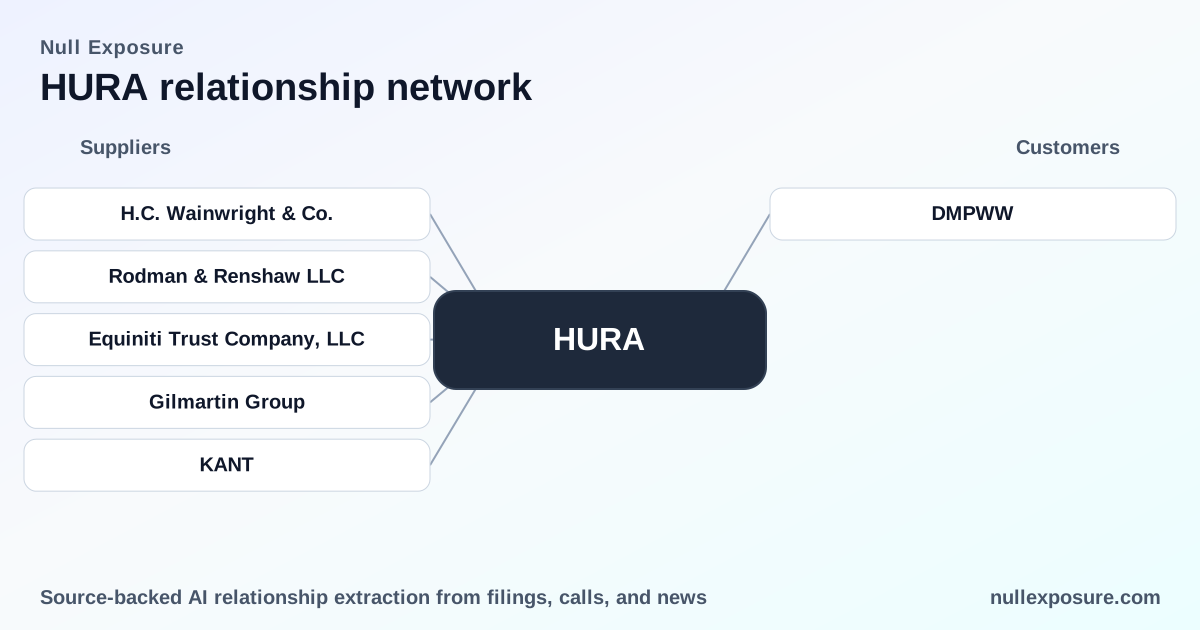
TuHURA Biosciences (HURA): supplier relationships, contracts and what investors should price in
TuHURA Biosciences is a clinical-stage immunotherapy developer that monetizes through a mix of licensed intellectual property, milestone/royalty-bearing partnerships, and capital markets financings while it advances IFx candidates toward regulatory filings. Revenue upside will depend on successful late-stage development and commercialization; near-term value is driven by licensing arrangements, CDMO/CRO service relationships and recurring financing activity that dilutes or funds the runway.
Learn more about supplier risk and counterparties at https://nullexposure.com/
The operating posture investors need to understand
TuHURA runs as a small, R&D-heavy biotech that intentionally outsources execution. The company is both a licensee of foundational IP and a buyer of critical outsourced services—clinical operations, analytical testing, and biologics manufacturing are delivered by third parties while key patent rights come from research institutions. That mix creates a dual dependency: long-lived licensing obligations on one hand, and operationally critical, potentially single-source vendor relationships on the other.
- Contracting posture: Licensing relationships are structured as exclusive, long-term agreements with milestone and running royalty provisions; service relationships with CROs, CDMOs and auditors are predominantly active, fee-for-service contracts.
- Concentration and criticality: Several contract excerpts flag sole- or limited-source suppliers for reagents and CDMO capacity, making manufacturing and trial execution critical points of failure.
- Maturity: Licensing agreements extend for decades (patent-term based) while service contracts are shorter-term and operational—this produces a stable IP base but a fluid, execution-sensitive supply chain.
Supplier and partner relationships disclosed in recent reporting
Below I list each counterparty cited in the public coverage set, with a concise plain-English description and the original source.
H.C. Wainwright & Co.
H.C. Wainwright is acting as exclusive lead placement agent for TuHURA’s $15.6 million registered direct offering, providing capital markets execution and placement services for the financing. (PR Newswire / Yahoo Finance, March 10, 2026 — https://www.prnewswire.com/news-releases/tuhura-biosciences-inc-announces-15-6-million-registered-direct-offering-302636732.html; https://finance.yahoo.com/news/tuhura-biosciences-inc-announces-15-144900759.html)
Rodman & Renshaw LLC
Rodman & Renshaw serves as a co-placement agent on the same registered direct offering, complementing the lead placement role and helping syndicate the deal. (Yahoo Finance / PR Newswire, March 10, 2026 — https://finance.yahoo.com/news/tuhura-biosciences-inc-announces-15-144900759.html; https://www.prnewswire.com/news-releases/tuhura-biosciences-announces-15-6-million-registered-direct-offering-302636732.html)
Equiniti Trust Company, LLC
Equiniti is the rights agent managing the contingent value rights (CVRs) tied to the legacy Kintara acquisition; per the CVR agreement, Equiniti facilitated release of 1,539,958 shares of TuHURA common stock after contract milestones were met. (PR Newswire / Futunn news, March 10, 2026 — https://www.prnewswire.com/news-releases/tuhura-biosciences-announces-its-release-of-kintaras-contingent-value-right-cvr-as-kintaras-rem-001-meets-primary-safety-endpoint-achieving-contractual-milestone-302641610.html; https://news.futunn.com/en/post/66206140/tuhura-biosciences-announces-its-release-of-kintara-s-contingent-value)
Gilmartin Group
Gilmartin Group is listed as the investor relations contact for the financing announcement, performing IR and communications support for investor outreach. (Yahoo Finance, March 10, 2026 — https://finance.yahoo.com/news/tuhura-biosciences-inc-announces-15-144900759.html)
Kineta (KANT)
Kineta is an acquired target and counterparty in TuHURA’s M&A activity; TuHURA closed on Kineta’s assets (including KVA12123 anti‑VISTA program) with $15 million upfront consideration and prior exclusivity/option payments. This acquisition expanded TuHURA’s pipeline and added trial funding obligations. (FierceBiotech, March 2026 — https://www.fiercebiotech.com/biotech/kineta-sells-genentech-and-merck-deals-investor-ahead-tuhura-merger)
What the constraints reveal about the business model and procurement risk
The company disclosures collectively signal a predictable, risk-concentrated operating model:
- Licensing-first IP strategy: TuHURA holds exclusive licenses from academic institutions and is obligated to pay tiered royalties, upfront license fees and patent prosecution costs—a long-term fixed-cost layer that scales with revenue (company-level disclosure citing Moffitt and WVURC license terms).
- Third-party manufacturing is mission-critical: Multiple constraints emphasize reliance on CDMOs/CMOs and the regulatory sensitivity of cGMP compliance; manufacturing issues would materially delay or block commercialization (company-level evidence).
- Service-heavy, short-term execution relationships: CROs, auditors, consultants and IR firms supply core capabilities on short contracts and are the primary operating expense drivers; this model reduces fixed overhead but increases execution risk and vendor churn.
- Spend profile is heterogeneous: Contracts range from sub-$100k maintenance fees to multi‑million acquisition and clinical-funding commitments, producing a mixed spend ladder that requires both treasury flexibility and targeted vendor oversight.
- Geography: Operational assets, cash and facilities are US‑centric, but IP and regulatory exposure are global—meaning supply chain or regulatory shocks overseas can still materially impact outcomes.
Investment implications and a short checklist
TuHURA’s supplier and partner architecture creates concentrated upside if clinical programs succeed, and asymmetrical downside if manufacturing or pivotal trial support fails. Investors should monitor the following:
- Cash runway and the frequency of placement-agent activity (H.C. Wainwright / Rodman syndication events).
- CDMO/CMO audit findings, supply‑chain notices and any FDA inspection outcomes tied to active trials.
- Royalty and milestone obligations embedded in licensing agreements that will scale with future revenue.
- Contingent share or CVR mechanics that can dilute float when milestones (managed by Equiniti) are achieved.
Key takeaways:
- Capital markets relationships are active and being relied on to fund near-term operations.
- Manufacturing and CRO/CDMO execution are the single largest operational risk vectors.
- Licensing obligations create durable long-term cost commitments that will compress margins once products commercialize.
Visit https://nullexposure.com/ for a consolidated view of supplier signals and counterparties.
Actionable next steps for investors and operators
For investors: prioritize counterparties that handle TuHURA’s cGMP manufacturing and watch FDA or EMA communications closely; review placement agreements and warrant terms to model dilution scenarios. For operators and procurement leads: focus on de-risking single-source reagent suppliers, securing secondary CDMO capacity, and tightening milestone governance in license contracts.
Final recommendation: treat TuHURA as a high-beta, execution-sensitive biotech—the IP position supports upside, but supplier and manufacturing risk are gatekeepers to value. For deeper supplier signal monitoring and ongoing counterparty intelligence, see the coverage at https://nullexposure.com/ — it consolidates financing, CVR and supplier activity for investor decision-making.