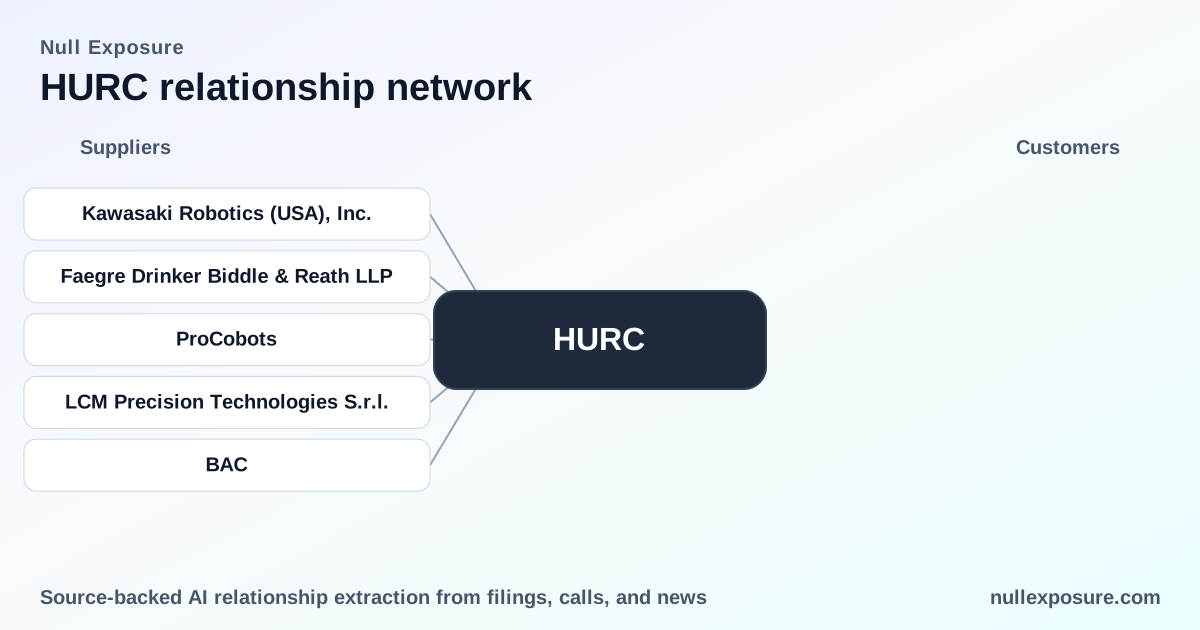
Hurco Companies Inc (HURC): supplier relationships, operating posture, and risks for investors
Hurco Companies designs, manufactures and sells computerized metal‑cutting machine tools and control systems and monetizes through OEM equipment sales, recurring parts and service, and strategic component sourcing across the U.S., Europe and Asia. Revenue is product‑led (machine sales) with margin leverage coming from proprietary controls, component sourcing from affiliated manufacturers, and aftermarket services. For investors evaluating supplier and counterparty exposure, Hurco combines concentrated manufacturing footprints, short‑dated hedging and credit arrangements, and a handful of commercially significant partners that shape delivery risk and working capital needs. Learn more about supplier intelligence and counterparty risk at the source: https://nullexposure.com/.
Quick take: the commercial model that matters to counterparties
Hurco sells capital equipment with embedded proprietary controls and outsources significant portions of manufacturing and control assembly to related and third‑party manufacturers, while retaining final assembly and distribution functions in Indianapolis and regional subsidiaries. This structure produces three investor‑relevant characteristics:
- Concentration of production in Taiwan and Italy increases operational leverage and supplier concentration risk.
- Cash‑flow sensitivity to order cadence and foreign exchange movements; Hurco actively uses short‑term forward contracts and regional credit lines to manage FX and liquidity.
- Supplier spend is meaningful — control systems and component purchases run at multi‑million dollar levels annually, making a small set of suppliers commercially critical.
Explore more supplier profiles and how they affect corporate finance decisions at https://nullexposure.com/.
Relationships: who Hurco works with and why each matters
Below I cover every relationship surfaced in public reporting and news for HURC, with concise plain‑English summaries and sourcing.
-
Kawasaki Robotics (USA), Inc. — Hurco has a strategic collaboration to integrate Kawasaki industrial robots into Hurco CNC control for turnkey machine‑tending solutions, enabling automated cells that pair Hurco machining centers with Kawasaki manipulators. This is a commercial partnership showcased in industry press in March 2026. Source: Automate.org coverage of the Kawasaki collaboration (March 2026).
-
Faegre Drinker Biddle & Reath LLP — Hurco engaged Faegre Drinker as legal counsel in the acquisition of Milltronics; the firm represented Hurco in the purchase, documenting deal counsel support for M&A activity disclosed in retrospective firm materials. Source: Faegre Drinker client matter description (original transaction context, referenced in firm materials).
-
ProCobots — Hurco demonstrated CNC machines integrated with ProCobots and other collaborative robotic systems to illustrate autonomous machining workflows, signaling active automation partnerships for showroom and product‑integration purposes. This activity was described in Hurco’s FY2025 results release. Source: Hurco FY2025 earnings release via GlobeNewswire (January 2025).
-
LCM Precision Technologies S.r.l. — LCM, an Italian manufacturer of electro‑mechanical components (direct‑drive spindles, swivel heads, torque tables), supplies critical five‑axis components and accessories to Hurco; Hurco’s European sales performance referenced electro‑mechanical components manufactured by LCM as a factor in FY2026 European revenue movements. Source: Hurco FY2025/FY2026 results notices on GlobeNewswire and The Globe and Mail (January 2026).
-
Bank of America, N.A. (BAC) — Hurco entered a secured revolving credit agreement with Bank of America effective January 5, 2026, providing a $20.0 million facility that is secured by substantially all personal property and contains customary covenants and events of default. This is both a liquidity provider and a counterparty for secured borrowing. Source: Hurco SEC filing summary reported on TradingView and embedded 10‑K disclosures (FY2026 filings, January 2026).
What the constraints say about Hurco’s operating posture
Public disclosures and reporting create a clear operating profile:
-
Contracting posture: mixed short‑ and long‑term commitments. Hurco uses short‑dated foreign exchange forwards (maturities from Nov 2025 through mid‑2026) alongside multi‑year leases (many 2–5 year facility leases) and credit agreements with defined scheduled maturities (credit agreements scheduled to mature Dec 31, 2026). That mix produces operational flexibility for hedging and working capital, but it also concentrates refinancing risk into discrete windows.
-
Supplier concentration and criticality are high. Manufacturing and control system production are concentrated in a small number of facilities and third‑party manufacturers, including Hurco’s own Taiwanese subsidiary and an affiliated contract manufacturer (Hurco Automation Ltd., 35% owned). Key components such as electro‑mechanical assemblies from LCM and control systems from HAL are material to production continuity.
-
Commercial maturity and stage: active relationships with some recent amendments. Hurco’s relationships are operationally active — credit facilities were renewed and restructured into a 2026 facility, leases remain in force, and integration pilots with robotics partners continue. Some earlier credit arrangements terminated as scheduled at year‑end 2025, reflecting normal lifecycle transitions of financing packages.
-
Counterparty profile leans toward large institutions for financial instruments. Hurco limits derivative counterparties to a major U.S. bank to minimize credit risk for FX forwards; separately it has a secured credit facility with Bank of America. This reduces credit counterparty dispersion but concentrates risk into a top‑tier banking relationship that also governs covenant dynamics.
-
Materiality is dual‑track: many commitments are immaterial individually but aggregate exposure is material. Filing language distinguishes many immaterial short‑term obligations, yet Hurco explicitly warns that prolonged supply disruptions or manufacturing interruptions at key facilities or vendors could have a material adverse effect on results. On the spend side, annual purchases of control systems and components run in the single‑digit to low‑double‑digit millions, placing some suppliers into a 10m–100m aggregated spend band over time.
Risk implications for investors and operators
-
Liquidity and covenant risk are concentrated around refinancing windows. The calendar of credit maturities and facility terminations compressed into late 2025/2026 elevates monitoring priority for covenant compliance and available borrowing capacity under the new $20M Bank of America facility.
-
Operational risk from supplier geography. Heavy production in Taiwan and manufacturing inputs from Italy create exposure to FX, tariffs and regional disruption — a strategic supplier failure would propagate quickly into order fulfillment and margins.
-
Vendor integration is a strategic differentiator. Automation partnerships (Kawasaki, ProCobots) and LCM spindles underpin product differentiation; successful integration supports higher ASPs and aftermarket service revenue.
How to act on this profile
- For credit investors: monitor liquidity metrics and covenant testing through FY2026 and track forward contract notional exposure denominated in NTD, EUR and GBP.
- For strategic acquirers or OEM partners: control‑system sourcing (HAL) and LCM electro‑mechanicals are the two most operationally sensitive supplier relationships to model into synergies or transition plans.
- For active operators: prioritize contingency planning for Taiwan/Italy manufacturing continuity and maintain visibility into Bank of America facility covenants.
Want deeper counterparty maps and supplier risk scoring for Hurco? Visit https://nullexposure.com/ to request a tailored profile.
Conclusion and next step: Hurco’s business is product‑centric with concentrated manufacturing and a small number of materially important supplier relationships; that combination creates opportunities for margin expansion through automation integration but requires active monitoring of liquidity, FX hedging and supplier continuity. For a more detailed supplier risk pack and alerts on covenant events, start here: https://nullexposure.com/.