HUYA Inc.: Supplier relationships that reshape monetization, one game at a time
HUYA operates China-focused live game streaming platforms and monetizes through advertising, subscriptions, virtual gifting and increasingly through game publishing and co-publishing partnerships that convert audience reach into product revenue. The company reported trailing revenue of approximately $6.26 billion with negative EBITDA (~$106 million) and is pursuing revenue diversification via co-published titles and marquee event distribution to counter slow ad growth and improve unit economics. For investors and operators this means assessing HUYA as both a platform and an emerging content publisher — a dual role that changes supplier dynamics and counterparty exposure.
Explore supplier intelligence and relationship mapping at https://nullexposure.com/ for a deeper vendor risk view.
What the recent supplier signals show about HUYA’s ecosystem
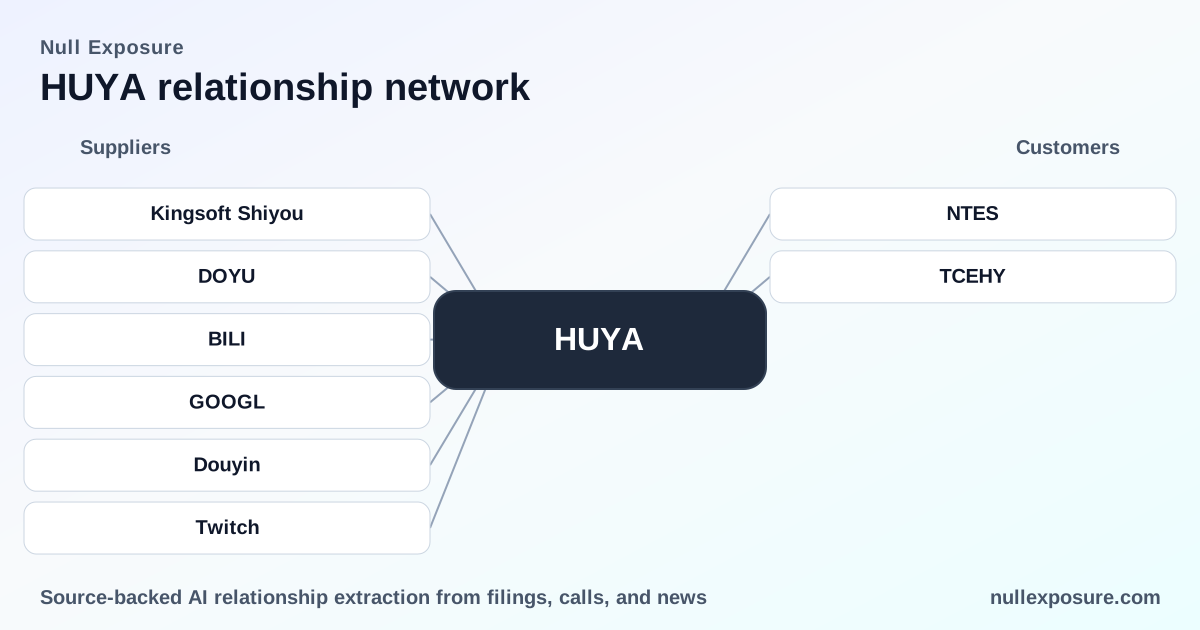
HUYA’s disclosed relationships fall into two functional buckets: game co-publishing (content creation partners) and event distribution/streaming partners (platform peers and international channels). Below are the relationships surfaced in recent reporting, with concise plain-English context and source notes.
Kingsoft Shiyou — co-publishing partner for Goose Goose Duck Mobile
HUYA co-published the mobile title Goose Goose Duck Mobile with Kingsoft Shiyou; the game launched in mainland China on January 7, 2026 and posted a strong initial performance according to HUYA’s announcement and market write-ups. This is an explicit example of HUYA translating platform reach into direct product revenue through co-publishing. (HUYA press release reported on Yahoo Finance, Jan 2026; market commentary on Ad-hoc-News, Mar 2026.)
Douyu — domestic simultaneous broadcaster for an international tournament
HUYA carried the Grand Finals of the D-aan Manor global invitational concurrently with Douyu, indicating cooperation and competition with a primary domestic streaming rival for large esports events and audience capture. (Event coverage reported by Futunn, Mar 2026.)
Bilibili — peer broadcaster in domestic multi-platform event distribution
Bilibili was a co-broadcaster of the same Grand Finals, showing HUYA’s reliance on multi-platform event dissemination to maximize reach rather than exclusive channel control. (Event coverage reported by Futunn, Mar 2026.)
YouTube — international distribution outlet for the tournament
The Grand Finals were also distributed internationally via YouTube, demonstrating HUYA’s content and events access to global channels for incremental audience monetization beyond China. (Event coverage reported by Futunn, Mar 2026.)
Douyin — domestic short-form and live partner in event reach
Douyin carried the Grand Finals alongside HUYA, reflecting cross-format distribution (short form + live) that amplifies discoverability and funneling back to HUYA’s ecosystem. (Event coverage reported by Futunn, Mar 2026.)
Twitch — international live streaming complement
Twitch distributed the tournament internationally, reinforcing that HUYA participates in event-level partnerships that extend beyond its owned platform footprint to capture viewership across Western streaming networks. (Event coverage reported by Futunn, Mar 2026.)
How these relationships change HUYA’s operating model and constraints
There are no explicit contractual constraint excerpts surfaced in the relationship signals. At the company level, the relationship mix implies several operational characteristics:
- Contracting posture: HUYA is operating as a hybrid platform/publisher that negotiates both co-publishing deals (revenue-share and product-level risk) and distribution partnerships (rights and syndication agreements). This requires flexible contracting terms and revenue-sharing models tied to engagement and in-game monetization.
- Concentration: HUYA’s business remains content-and-talent concentrated — marquee streamers and breakout games drive disproportionate revenue — but co-publishing deals like the one with Kingsoft Shiyou are deliberate moves to reduce single-revenue reliance on ads and gifts.
- Criticality: Partnerships that secure exclusive or early access to games and live events are critical to audience retention and monetization; loss or deterioration of those relationships would directly pressure revenue per user.
- Maturity: Core streaming operations are mature and competitive, while game co-publishing initiatives are early-stage strategic experiments intended to diversify revenue and improve margins over the medium term.
Key company signal: no explicit constraints were published with these relationship records, but the combination of negative EBITDA and active co-publishing indicates HUYA is reallocating capital toward content assets to drive top-line growth and higher-margin revenue streams.
Investment implications and material risks
HUYA’s pivot is strategically sensible but execution-sensitive. Investors and operators should weigh:
- Revenue diversification upside: Co-publishing gives HUYA a path to capture product sales and in-game spend — a structural lift to lifetime value if titles scale.
- Execution and timing risk: Early-stage publishing investments require marketing spend and product hit-rate; negative EBITDA (~$106M) means capital allocation is tight and outcomes need to be demonstrably accretive. (HUYA company financials through Sep 2025.)
- Competitive and distribution risk: The multi-platform broadcast landscape (Douyu, Bilibili, Douyin, Twitch, YouTube) reduces exclusivity and compresses per-user monetization potential for any single platform, creating pressure on pricing and ad yields. (Event distribution reported by Futunn, Mar 2026.)
- Regulatory and market risk in China: Platform and game approvals, content restrictions, and user monetization rules remain material operational constraints that investors must monitor continuously.
Analyst coverage is constructive overall (consensus target price near $4.00, with a mix of buy and hold ratings), but the market cap (~$773M) and forward valuation indicate the market prices in execution risk alongside growth optionality.
Recommendations for investors and operators
- Track co-publishing cadence and metrics: prioritize monitoring user acquisition costs, in-game monetization, and retention curves for titles like Goose Goose Duck Mobile to judge whether publishing materially improves LTV/CAC dynamics.
- Audit distribution economics across partners: insist on granular rights and revenue-share transparency when event content is syndicated to Douyu, Bilibili, Douyin and international channels to ensure HUYA captures the intended monetization.
- Assess streamer concentration and contractual terms: quantify how much revenue depends on top streamers and what step-up costs HUYA faces to retain them versus replacing talent.
For a structured supplier-risk assessment and relationship mapping that supports these actions, visit https://nullexposure.com/ and review our analytical approach.
Final read — what matters going forward
HUYA is transitioning from a pure platform play into a hybrid operator that bets on owned and co-owned content to lift yield per user. The Kingsoft Shiyou co-publishing deal is the clearest example that HUYA is monetizing its audience beyond gifts and ads, while the multi-platform event distribution with peers and global channels shows pragmatic reach-maximization at the cost of exclusivity. Investors should treat HUYA as a growth-reliant turnaround where publishing success and effective syndication economics are the primary value drivers.
If you need a vendor-specific due diligence brief or live supplier-monitoring setup tailored to HUYA and its partners, get started at https://nullexposure.com/ — our platform maps relationships and translates them into investment and operational signals.