HVIIR supplier relationships: what investors need to know now
Hennessy Capital Investment Corp. VII Rights (HVIIR) is a SPAC vehicle that monetizes through a combination of trust-account capital and sponsor-led deal origination: it raises cash in an IPO, holds approximately $190 million in a trust invested in short-term U.S. government obligations, and generates fees and deferred underwriting economics that convert into manager/sponsor upside on closing a business combination. For investors and counterparties evaluating supplier relationships, the practical model is simple and capital-constrained: HVIIR buys time and optionality with short-term financial commitments while outsourcing the bulk of advisory, legal and administrative execution to third-party service providers. Learn more at https://nullexposure.com/.
High-level operating model and what it implies for suppliers
HVIIR’s operating posture is typical of sponsor-led SPACs: it is not an operating company today and its commercial value is concentrated in the trust account and the ability to execute a transaction before the SPAC deadline. That profile produces predictable supplier dynamics:
- Contracting posture: short-term and conditional. The trust-account rules require investments in U.S. treasury bills or qualifying money market funds with maturities of 185 days or less, and many vendor payments are month-to-month or contingent on consummation of a business combination. This makes HVIIR a short-term and performance-contingent counterparty for most suppliers.
- Counterparty mix and concentration. Suppliers range from individual contractors (executive officers on independent contractor agreements) to very large financial institutions (banks that hold trust deposits or serve as underwriters) and U.S. government obligations as the trust’s core asset. This mix implies low vendor diversification risk for treasury management but concentrated legal and advisory exposures during deal execution.
- Criticality and materiality. The trust account is material to HVIIR’s ability to execute a transaction; claims against the trust can reduce the per-share redemption amount and force liquidation. As a result, legal, underwriting and trustee relationships are critical to outcomes and receive heightened protection (waivers, indemnities, deferred fees).
- Maturity and spend profile. Relationships are a mix of low‑dollar operating commitments (monthly administrative fees) and large, transaction-level outlays (underwriting discounts, deferred fees and potential transaction costs). HVIIR recorded $12.66 million of offering-related transaction costs and holds ~$190 million of trust proceeds, so suppliers working on the deal side will interact with material budgets, while operational suppliers have modest recurring contracts.
How those constraints shape supplier risk and negotiation leverage
- Suppliers who require long, unsecured payment terms or large up-front capital should expect resistance; HVIIR’s cash is ring-fenced in the trust account and non-trust funds are limited.
- Firms that accept contingent or success-based compensation (deferred underwriting fees, deal-closing retainers) gain privileged access.
- Counterparties that can sign waivers with respect to the trust account increase their commercial attractiveness, but HVIIR cannot force every third party to accept such waivers, creating residual litigation risk.
Learn more about supplier exposure insights and how to evaluate counterparties at https://nullexposure.com/.
Named relationships investors should track
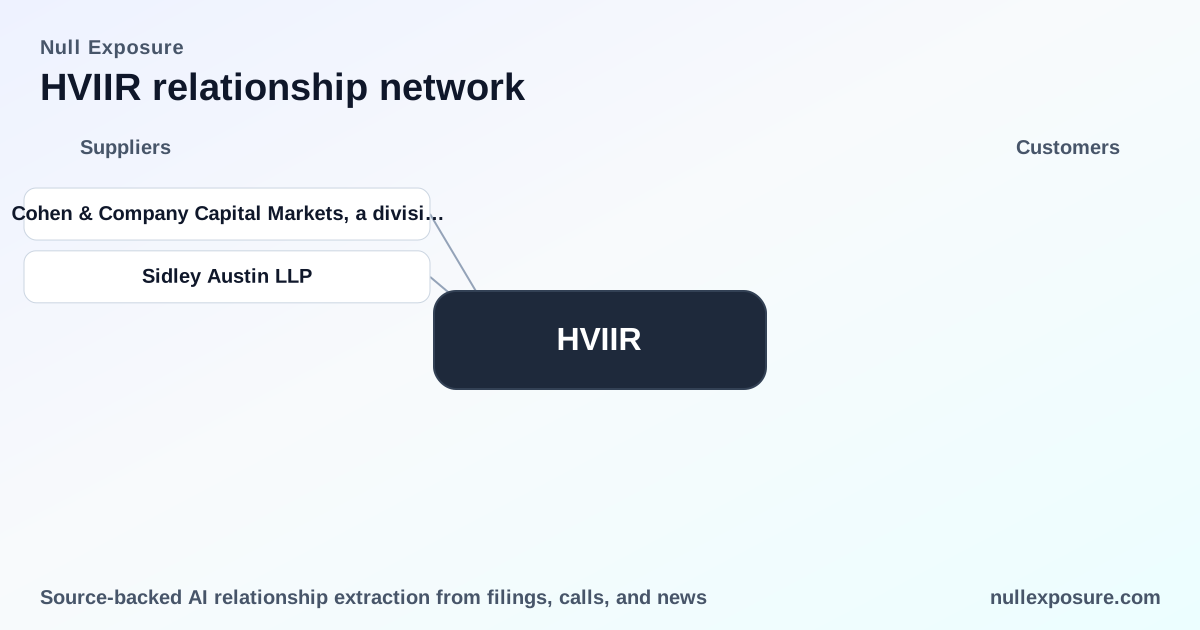
Cohen & Company Capital Markets — exclusive financial and capital markets advisor
Cohen & Company Capital Markets, a division of Cohen & Company Securities, LLC, is serving as exclusive financial advisor and lead capital markets advisor to Hennessy Capital Investment Corp. VII, positioning the firm as the principal underwriter/advisor on origination and structuring activities. This engagement is referenced in the public reporting on HVII’s IPO and subsequent underwriting documentation (Yahoo Finance, March 2026 — underwriting agreement and press coverage: https://finance.yahoo.com/news/one-nuclear-energy-become-public-110000799.html).
Sidley Austin LLP — legal advisor to the SPAC
Sidley Austin LLP is acting as legal advisor to HVII, supporting the IPO and formation documents and standing to receive deferred legal fees related to the offering; this legal role places Sidley at the center of disclosure, documentation and post‑closing indemnity negotiations (reported in the same Yahoo Finance coverage of HVII’s public filing activity in March 2026: https://finance.yahoo.com/news/one-nuclear-energy-become-public-110000799.html).
Relationship map: what each interaction means for your commercial decision
- Advisors and underwriters (Cohen & Company) are paid through a mixture of cash and deferred underwriting discounts that only vest if a business combination closes; the deferred economics align their incentives with successful deal completion but also expose them to trust-account redemption mechanics (public filings incorporated into the January 2025 underwriting agreement and press reporting).
- Legal counsel (Sidley Austin) receives deferred and contingent fees tied to closing; legal advisors carry the practical burden of ensuring disclosures and agreements reduce the risk of third‑party claims that could erode the trust account.
- Trustee and treasury counterparties (Odyssey Transfer and Trust Company and large U.S.-chartered banks) are operationally critical: trust-account rules force those funds into government obligations or qualified money market funds, limiting investment risk but also limiting liquidity and flexibility.
- Independent auditors and administrative service providers maintain active, month-to-month engagements that are necessary for exchange listing and regulatory compliance; these are active but modest in absolute spend.
Practical takeaways for investors and suppliers
- If you are an advisor or banker, structure compensation with a meaningful success component; deferred underwriting discounts and post-close fees are the commercial norm and connect your economics to the SPAC outcome.
- If you are a law firm or diligence provider, insist on precise indemnities and billing arrangements: legal exposure is a direct lever on trust account value and therefore on sponsor guarantees.
- If you are an operational vendor, accept short-term, month-to-month commercial terms and small recurring fees unless you can secure payment outside the trust account.
- Risk to monitor: potential claims against the trust account that could lower the per‑share redemption amount and force liquidation — these are company‑level constraints that make legal and trustee relationships the most strategically important.
Before you engage with HVII or similar SPACs, review counterparty protections and fee timing carefully. For a buyer’s checklist and supplier risk playbook, visit https://nullexposure.com/.
Conclusion — focus investment diligence where it matters
HVIIR is a capital‑rich SPAC in structure but capital‑constrained in practice: the trust account is both the balance-sheet and the single-source of transaction capacity. Underwriting and legal relationships (notably Cohen & Company and Sidley Austin) are the operational fulcrum of any successful business combination, while routine vendors are small, short-term payees. For investors and operators, the actionable signal is clear: prioritize counterparties whose economics are tied to deal completion and who accept trust-account constraints. Final diligence should validate deferred-fee mechanics, trustee controls and any outstanding indemnities that could impact the trust account. For ongoing supplier intelligence and to benchmark counterparty exposure across SPACs, go to https://nullexposure.com/.