Highview Merger Corp. (HVMC): What the supplier map tells investors about execution risk and sponsor alignment
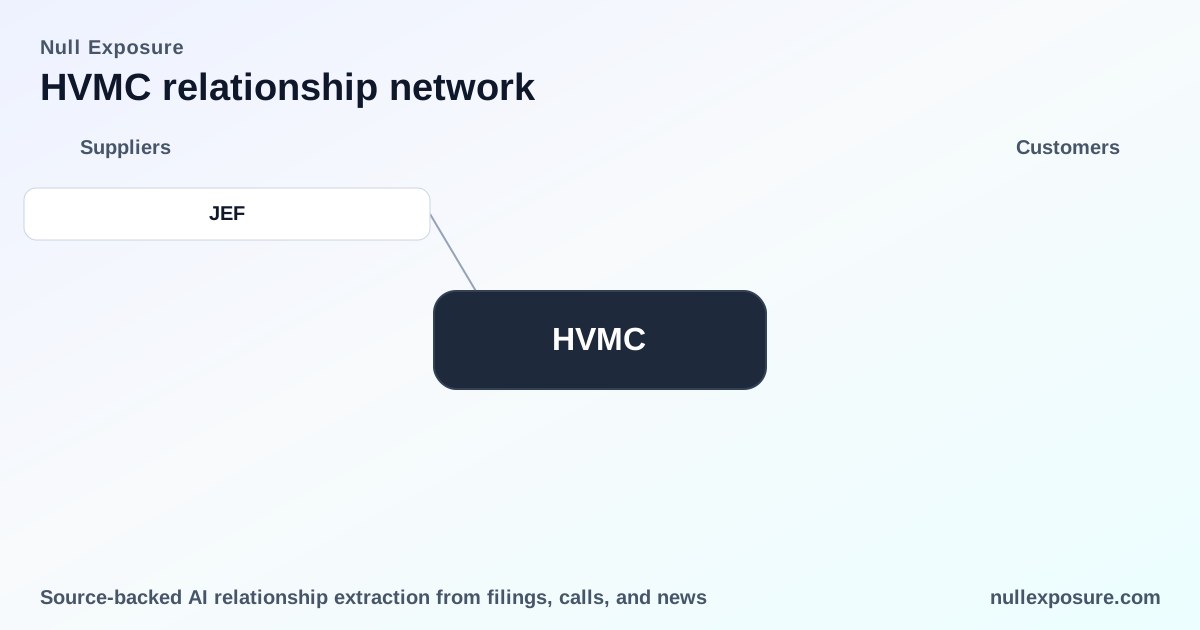
Highview Merger Corp. is a special purpose acquisition company that raises capital through a public listing to consummate a business combination with a high-growth technology target; it monetizes by capturing sponsor promote and transaction-related fees while enabling shareholder upside through the merged operating company’s growth. HVMC’s supplier relationships are narrow and transaction-focused, with the most material external dependency being its investment banking-led underwriting and syndication activity during deal execution. For an investor assessing execution risk, counterparty strength and fee alignment around that underwriting relationship are the critical lenses. Read more on supplier exposure and strategic signals at NullExposure.
Why bank-led supplier relationships matter for a SPAC thesis
A SPAC is a time-limited vehicle whose success depends on sourcing, negotiating, financing and closing a merger. The quality and configuration of external providers—underwriters, placement agents, legal and accounting firms—directly affect probability of closing, financing cost and post-transaction perception. For market participants, a concentrated provider set increases execution speed but raises counterparty concentration risk; a diversified provider set reduces single-point failure but can raise coordination costs. Track these supplier choices as proxies for sponsor sophistication and access to capital markets.
The supplier relationships on record for HVMC
- Jefferies LLC — Jefferies functioned as the sole book-running manager for HVMC’s transaction. According to a press release published on Yahoo Finance on March 10, 2026, Jefferies led the offering as the book runner, signaling the firm’s primary underwriting role for HVMC’s deal execution (Yahoo Finance, Mar 10, 2026: https://finance.yahoo.com/news/highview-merger-corp-announces-completion-200500084.html).
This is the full set of supplier relationships disclosed in the results returned for HVMC’s supplier profile.
What that single relationship means in practice
Jefferies acting as sole book-runner reveals three practical implications for investors:
- Execution centralization. A single lead underwriter reduces friction in pricing and syndication decisions, enabling faster deal completion and a more consistent investor story at pricing.
- Concentration risk. Relying predominantly on one underwriting partner elevates counterparty concentration; any reputational or capacity issues at that bank increase transaction execution risk for HVMC.
- Market signaling. The choice of Jefferies—an established mid-to-large investment bank with a strong technology practice—imparts positive credibility to the target and to the sponsor’s ability to place institutional demand.
Source: Yahoo Finance press release, March 10, 2026.
Operating-model and business-model signals investors should treat as firm-level constraints
Treat the following as company-level signals about HVMC’s operating posture rather than attributes tied to a single supplier entry.
- Contracting posture — Transactional and short-term. HVMC’s supplier engagements are structured around discrete deal events (underwriting, placement, legal diligence) rather than ongoing supplier services, which compresses supplier tenure and increases the premium on immediate execution capability.
- Concentration — High around key providers. The SPAC model naturally concentrates dependency on a few high-impact partners (lead underwriter, sponsor team, legal counsel), increasing single-counterparty exposure that investors must price into expected closing probability.
- Criticality — Very high for core providers. Underwriters and placement agents are critical to financing and placing the transaction; failure or withdrawal by a lead bank materially impairs the SPAC’s ability to close at acceptable economic terms.
- Maturity — Transaction-driven sophistication. Supplier relationships for SPACs are often shallow but sophisticated: they are mature in terms of market-standard documentation and fee structures but short in duration and highly performance-sensitive.
These constraints shape HVMC’s execution profile and should inform both risk assessment and valuation assumptions about probability-weighted closing outcomes.
For an expanded supplier map and deeper counterparty intelligence, visit NullExposure.
Practical checklist for investors and operators
Use this checklist to convert relationship facts into investment-relevant due diligence:
- Confirm lead underwriter capacity and appetite across comparable tech deals completed in the last 12 months.
- Review underwriting economics—fees, overallotment option size, any side arrangements—that affect sponsor alignment and net proceeds to the combined company.
- Monitor public signals from the lead bank (research coverage, trading desks) that influence aftermarket liquidity and investor appetite post-close.
- Stress-test closing scenarios where the lead underwriter reduces syndication support and estimate alternative financing costs or dilution.
Key risk: single-book-runner concentration increases closing fragility; key upside: a reputable underwriter with strong tech distribution materially raises the probability of a smooth placement and broader investor acceptance.
What to watch next and where HVMC’s supplier story goes from here
- Track additional supplier disclosures: legal counsel, accounting firms and any PIPE investors that will add financing depth. Those names will materially change the concentration and criticality picture.
- Watch for amendments to underwriting commitments and the appearance of co-managers; the transition from sole book-runner to a broader syndicate is a positive liquidity signal.
- Monitor Jefferies’ public communications and syndicate activity in the technology sector as a near-term proxy for distribution strength.
For continuing updates and a consolidated supplier view tailored to institutional diligence, visit NullExposure.
Bottom line: HVMC’s supplier profile is currently narrow and transaction-centric, with Jefferies’ sole book-running role as the dominant external dependency disclosed to date. Investors should price the trade-off between faster execution and higher counterparty concentration into both probability-of-close assumptions and post-transaction financing scenarios.