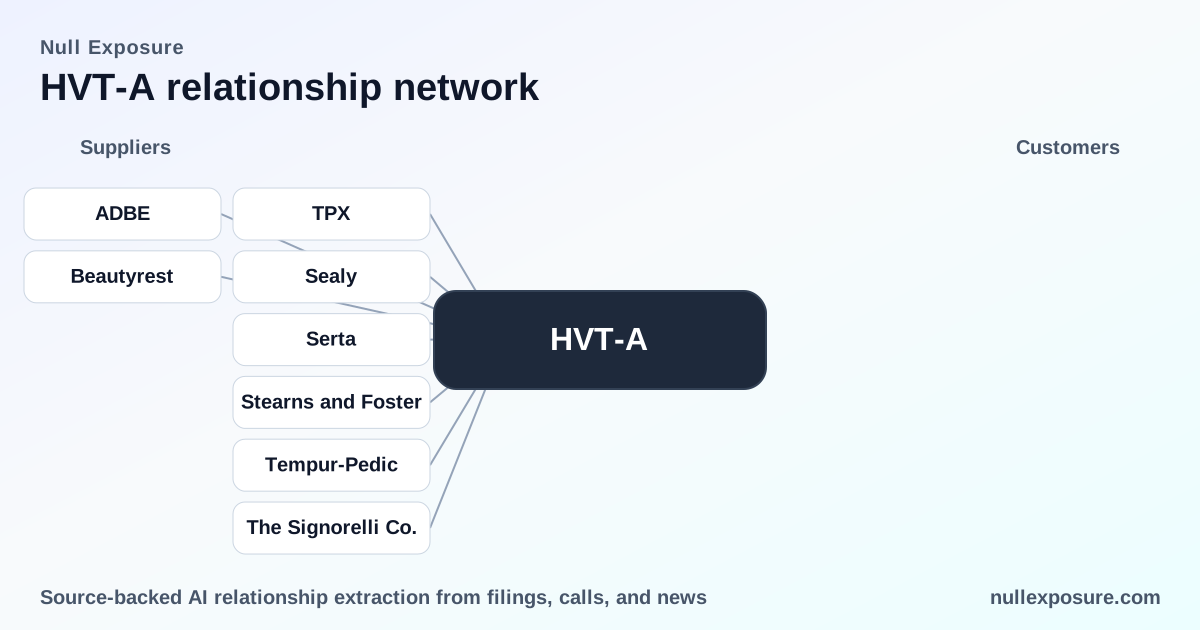
Haverty Furniture (HVT-A): Supplier map and operating constraints investors need to know
Haverty Furniture Companies operates as a specialty retailer of residential furniture and accessories, monetizing through retail sales across stores and distribution centers, supported by delivery and financing programs; the company posted roughly $759 million in trailing revenues and a market capitalization near $383 million (TTM). Haverty sources a substantial portion of product from third‑party manufacturers—both domestic and foreign—and captures margin through merchandising, inventory management, and store/distribution economics. For a concise view of supplier exposure and commercial posture, visit https://nullexposure.com/.
What drives Haverty’s supplier economics and commercial posture
Haverty’s operating model is capital‑intensive and supply‑dependent. The company maintains a large footprint of leased retail stores and distribution facilities, with operating lease liabilities of roughly $218 million as of December 31, 2024, and an $80 million revolving credit facility that provides working capital flexibility. A substantial share of merchandise is imported—about 58% of furniture purchases in 2024 were for goods not produced domestically—concentrating sourcing risk in Asia and Mexico for key product categories.
- Contracting posture: A mix of long‑term lease commitments for stores and distribution centers plus shorter annual arrangements for certain carrier services creates a hybrid contract profile with durable fixed occupancy costs and flexible logistics relationships.
- Concentration: The largest ten vendors accounted for roughly 41.3% of product purchases in 2024, signaling meaningful supplier concentration and bargaining implications.
- Criticality: Third‑party producers and transportation providers are operationally critical; Haverty relies on external manufacturing capacity and third‑party carriers for virtually all inbound and market deliveries.
- Maturity and stage: Supplier relationships are predominantly mature and active, with longstanding vendor networks but continued competition for manufacturers’ production capacity.
For deeper supplier risk analytics and tailored reports, see https://nullexposure.com/ — the homepage hosts granular supplier coverage for investors.
On‑the‑record supplier and partner relationships
Below are every relationship referenced in public items collected for HVT‑A. Each entry includes a plain‑English summary and the published source.
Tempur‑Pedic (Marketscreener, FY2026)
Haverty sells mattress lines that include Tempur‑Pedic, indicating a branded mattress assortment in stores and online; this was noted alongside an equity buyback announcement reported March 10, 2026 by MarketScreener. Source: MarketScreener (Mar 10, 2026).
Sealy (Marketscreener, FY2026)
Sealy products are listed among Haverty’s mattress offerings in the same Marketscreener piece, underscoring Haverty’s multi‑brand mattress strategy. Source: MarketScreener (Mar 10, 2026).
Sealy (SimplyWallSt, FY2017)
Historical company summaries from SimplyWallSt (FY2017) reiterate that Haverty has offered Sealy mattress lines, confirming this relationship persists in legacy merchandising descriptions. Source: SimplyWallSt (FY2017).
Serta (SimplyWallSt, FY2017)
SimplyWallSt’s company profile from FY2017 documents Serta as part of Haverty’s mattress lineup, reinforcing a consistent multi‑brand mattress assortment across periods. Source: SimplyWallSt (FY2017).
Stearns and Foster (SimplyWallSt, FY2017)
Stearns & Foster is cited in legacy merchandising descriptions as one of the mattress brands Haverty carries, supporting an emphasis on premium mattress SKUs. Source: SimplyWallSt (FY2017).
Tempur‑Pedic (SimplyWallSt, FY2017)
A separate FY2017 SimplyWallSt reference again lists Tempur‑Pedic among mattress product lines, confirming multi‑period brand distribution. Source: SimplyWallSt (FY2017).
The Signorelli Co. (Community Impact, FY2025)
The Signorelli Co. acted as the landlord/developer for a Haverty showroom opening in Valley Ranch, indicating third‑party commercial development partners for store expansion. Source: Community Impact (May 14, 2025).
Adobe (Foolingtranscripts, FY2021)
Haverty referenced use of the Adobe platform to improve customer experience and ease of use on the digital side, signaling reliance on third‑party enterprise software for e‑commerce and marketing. Source: The Motley Fool (earnings call transcript, Oct 29, 2021).
Beautyrest (SimplyWallSt, FY2017)
Beautyrest is included in historic merchandising lists for Haverty’s mattress offerings, part of the company’s broad branded mattress strategy. Source: SimplyWallSt (FY2017).
Stearns and Foster (MarketScreener, FY2026)
MarketScreener’s FY2026 coverage again lists Stearns & Foster among Haverty’s mattress product lines, corroborating ongoing stocking of that premium brand. Source: MarketScreener (Mar 10, 2026).
Serta (MarketScreener, FY2026)
Serta is included in the FY2026 MarketScreener mattress list, consistent with multiple brand suppliers forming Haverty’s mattress category. Source: MarketScreener (Mar 10, 2026).
Beautyrest (MarketScreener, FY2026)
MarketScreener also cites Beautyrest in the FY2026 mattress line list, confirming continued partnership through the mattress assortment. Source: MarketScreener (Mar 10, 2026).
What these relationships mean for investors
- Category breadth is a deliberate strategy. Haverty’s relationship set for mattresses—Tempur‑Pedic, Sealy, Serta, Stearns & Foster, Beautyrest—shows a deliberate multi‑brand assortment aimed at covering price bands and preserving margin flexibility. This reduces dependence on any single brand for that category but increases complexity in product sourcing and promotional economics.
- Real estate and logistics are structural costs. Long‑term store leases and sizable distribution obligations create persistent fixed costs; the company’s $218m operating lease liability and leasing strategy are central determinants of cash flow sensitivity.
- Supply chain concentration and import exposure are material. With top suppliers accounting for over 41% of purchases and ~58% of furniture purchases imported, any supplier disruption or tariff change would have measurable P&L effects.
Final takeaways and next steps
Haverty runs a hybrid sourcing model that combines concentrated supplier spend, meaningful import exposure, and long‑dated occupancy commitments—a profile that rewards careful supplier oversight and logistics management. For investors and operators evaluating supplier relationships, focus on vendor diversification, freight and tariff sensitivity, and the economics of leased physical retail capacity.
Explore additional supplier intelligence and scenario analysis at https://nullexposure.com/ to refine exposure assessments and build actionable mitigation plans.
For customized supplier reports or to commission a focused risk review for Haverty’s network, visit https://nullexposure.com/ and request investor‑grade coverage.