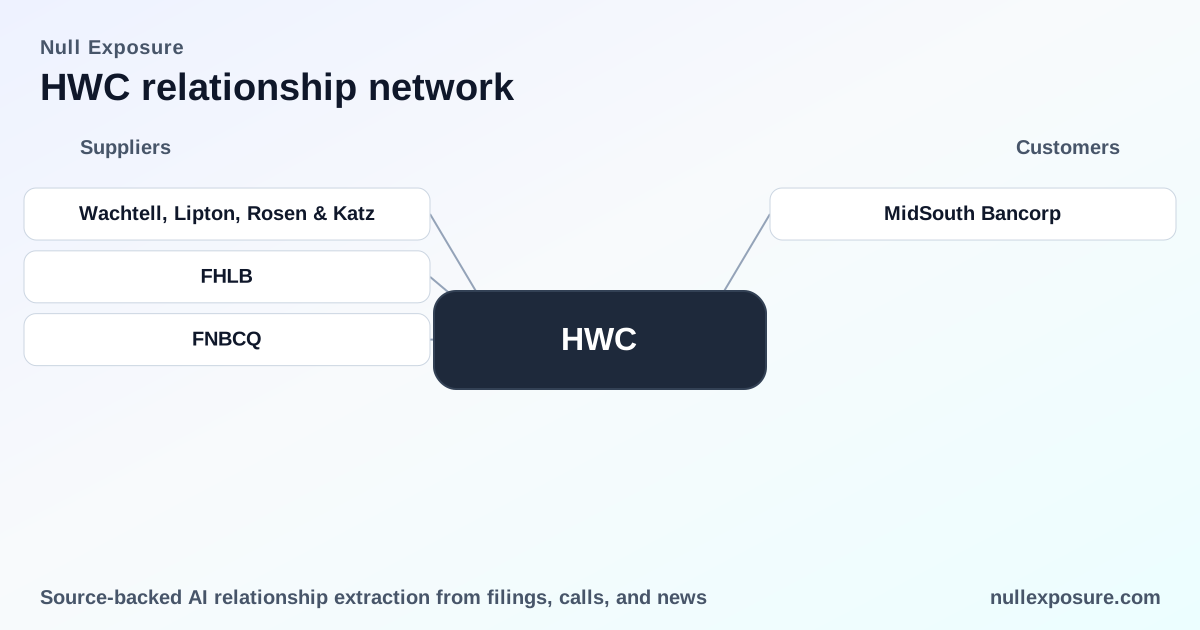
Hancock Whitney (HWC) — supplier and counterparty map for investors
Hancock Whitney operates as a regional banking holding company that earns net interest income and fees by taking deposits, underwriting loans, and managing an investment portfolio concentrated in U.S. agency and municipal securities; the bank also supplements earnings through acquisitions and fee-based trust and asset-management services. Monetization is driven by deposit capture and loan spread management, supplemented by sizable investment holdings and fee incomes, making funding partners and service providers central to execution and capital efficiency. For a quick overview of our vendor intelligence platform that informs this analysis, visit https://nullexposure.com/.
What Hancock Whitney does and why supplier relationships matter to returns
Hancock Whitney is a Gulfport, Mississippi–based bank holding company that services commercial, small business and retail clients through banking, trust and payments services. At a market capitalization near $5.08 billion and trailing revenue of roughly $1.46 billion, the company’s P/E and return metrics reflect a classic regional banking profile: earnings sensitive to funding mix and interest-rate dynamics, and operationally dependent on third-party technology and service providers.
Key business-model drivers:
- Deposit-centric funding: Deposits are the primary source of funding for interest-earning assets; wholesale and short-term borrowings are actively used to smooth liquidity.
- Large investment book: The investment portfolio (~$7.6 billion) is concentrated in U.S. agency and mortgage-backed securities with a targeted duration of 2–5.5 years, which means balance sheet sensitivity to rates is actively managed.
- Outsourced infrastructure: Material spends on data processing and professional services (data processing expense ~$121.9 million; professional services ~$41.9 million in 2024) indicate substantial reliance on third-party vendors for core operations.
For vendor-level intelligence and supplier risk scoring, see https://nullexposure.com/.
Active supplier and counterparty relationships to monitor
Below are the relationships surfaced in recent reporting and press coverage; each entry includes a concise plain-English summary and a direct source reference.
Wachtell, Lipton, Rosen & Katz — legal advisor on acquisition work
Wachtell, Lipton, Rosen & Katz served as legal counsel to Hancock Whitney in a transaction related to the purchase of Sabal Trust, indicating the bank’s use of high‑end external legal advisors for complex M&A work. According to a Dakota.com fundraising news report (March 2026), Wachtell acted as Hancock Whitney’s legal advisor on that transaction. Source: Dakota.com fundraising news, March 2026.
Federal Home Loan Bank (FHLB) — funding counterparty and liquidity source
Hancock Whitney reduced its level of FHLB advances during the quarter, which contributed to a lower overall cost of funds and better funding mix; the FHLB is therefore an active liquidity counterparty in the company’s funding stack. A Q4 2025 earnings call transcript on AlphaStreet (reported March 2026) notes the company ended the quarter with lower FHLB advances and a 7 bps decline in cost of funds to 1.52%. Source: AlphaStreet earnings call transcript, Q4 2025 (published March 2026).
First NBC Bank — legacy acquisition that added deposits and loans
In a prior strategic transaction, Whitney Bank acquired approximately $1.6 billion in deposits and roughly $1 billion in assets from First NBC Bank, a deal that materially expanded the franchise’s deposit base and branch footprint. WAFB documented the effective acquisition on April 28, 2017, including the net cash benefit to Hancock Whitney. Source: WAFB news report, April 2017.
What the constraint signals tell investors about operating posture
The collection of constraint excerpts from public filings conveys a clear, actionable profile of Hancock Whitney’s vendor and counterparty posture:
-
Contracting posture is mixed: long-term and short-term coexist. The company holds long-term leases and subordinated debt that extend decades (subordinated notes maturing in 2060) while actively using short‑term borrowings such as federal funds and repurchase agreements to manage immediate liquidity. This structure means strategic obligations are locked-in while tactical funding is flexible.
-
Licensing and usage‑based clauses exist but are not dominant. The firm licenses critical information‑technology systems and has leases with variable CPI-linked components; these create recurring vendor dependencies that are monitored but not presented as single-point failures in filings.
-
High criticality of third-party providers. Filings emphasize that deposits are the primary funding source and that third-party service providers support essential infrastructure (data processing, online banking, card processing). The vendor-management program classifies a set of vendors as critical and subjects them to ongoing monitoring, which underscores operational concentration risk.
-
Geographic concentration is domestic (U.S.). Investment policies restrict holdings primarily to U.S. Treasury, agency and municipal securities, and regulatory references are U.S.-centric, which concentrates interest-rate and regulatory risk to the U.S. market.
-
Maturity and lifecycle: active supplier engagements. Multiple active contracts and ongoing vendor monitoring indicate an operational state of active vendor management rather than wind‑down or transition.
-
Spend scale varies from mid-tier to very large. Spend signals range from the $100k–$1M band for some repo and short-term items to $100M+ for data processing, investment portfolios and wholesale funding lines — implying both transactional and enterprise-level vendor relationships.
Collectively, these constraints present a bank that balances long-dated structural obligations with active short-term liquidity management and significant third‑party reliance for core operations.
For deeper supplier rankings and scorecards, visit https://nullexposure.com/.
Investment implications and risk checklist
- Funding sensitivity: Because deposits drive funding and wholesale borrowings fluctuate materially, the company’s net interest income is sensitive to deposit behavior and short-term market funding costs. Watch deposit growth trends and brokered-deposit levels.
- Vendor concentration: Large, critical vendors support payments, core processing and technology; failure or contract disruption would be material to operations. Vendor continuity and SLAs warrant board-level oversight.
- Regulatory and M&A posture: The firm has used external legal advisors in strategic transactions and will require regulatory approvals for acquisitions; successful execution of acquisitions is a lever for earnings growth.
- Balance sheet asset composition: Heavy allocation to agency and MBS securities reduces credit risk but increases duration and market‑rate exposure; hedging programs and forward-starting swaps are active tools to manage those exposures.
Bottom line and next steps for investors
Hancock Whitney’s supplier and counterparty landscape is characterized by a balance of long-term contractual commitments and active short-term funding strategies, significant reliance on domestic government‑backed securities, and material third-party operational dependencies. For investors focused on execution and operational risk, vendor monitoring, funding mix disclosure, and deposit trends are the highest‑value data points to track next.
If you want structured supplier exposure profiles, detailed counterparty scoring, and alerts aligned with investor workflows, explore our platform at https://nullexposure.com/.
Final call to action: to compare Hancock Whitney’s supplier exposures against peers or to obtain a tailored briefing, start at https://nullexposure.com/.