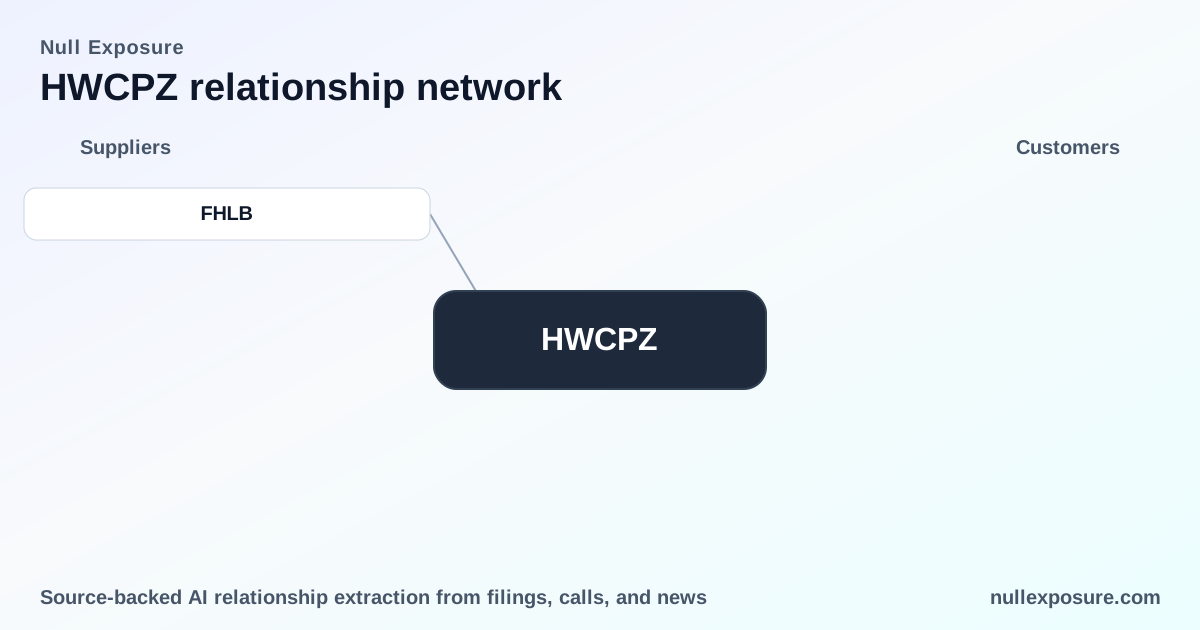
Hancock Whitney (HWCPZ) — supplier posture and what the FHLB relationship means for investors
Hancock Whitney (HWCPZ) operates as a regional bank holding company that monetizes through net interest margin, fee income, and dividend flows from its banking subsidiary, while managing liquidity with a mix of customer deposits, wholesale borrowings and targeted investment portfolios. The vehicle represented by the HWCPZ ticker reflects exposure to the bank’s capital and funding decisions; key commercial levers for supplier and counterparty risk are funding mix, long-duration leases and critical third‑party technology licensing. Market-cap sits at roughly $1.67 billion and the security yields a high dividend yield (~6.3%), underscoring the income-sensitive profile of this exposure (company overview, latest public disclosures).
For a deeper read on counterparty exposures and supplier mapping, visit https://nullexposure.com/.
How Hancock Whitney structures supplier relationships in practice
HWCPZ combines a conservative investment focus with an active reliance on external vendors for infrastructure and operations. The company’s disclosures show a dual contracting posture: a material base of long‑term commitments (operating leases, long‑term debt and multi‑year tax credit investments) alongside a meaningful short‑term funding program (federal funds, repos, FHLB advances and other short‑term borrowings). This mix creates both durability (through long-term contractual commitments) and liquidity sensitivity (through short-term wholesale funding).
- Long-term commitments include branch and corporate leases commonly ranging from five to 20 years and multi-year tax credit projects recognized over multi-year schedules (10-year LIHTC windows and seven-year NMTC recognition noted in filings).
- Short-term levers include repurchase agreements, federal funds and adjustable advances that the company uses to manage immediate liquidity and asset growth.
This structure drives an operational posture where service continuity and vendor stability are critical: the bank licenses critical IT systems and outsources core processing and back-office functions to third parties, and it runs ongoing vendor monitoring for providers deemed critical to operations.
What the constraint signals tell investors about HWCPZ’s operating model
The company’s risk language and evidence excerpts form a coherent picture for counterparties and operators:
- Contracting maturity and concentration: HWCPZ is committed to long-dated real estate leases and long-term debt, which implies predictable vendor cash flows for real estate and infrastructure providers, but also limited flexibility to exit without cost. Short-term borrowings remain a core tactical lever for funding.
- Criticality of vendors: The bank explicitly identifies “critical information technology systems” obtained under license and numerous third‑party service providers for data processing, core banking, and security monitoring; failures in those relationships are described as material to operations.
- Geography and counterparty profile: The book is predominantly North American and includes substantial government‑agency exposures (U.S. Treasury, U.S. government‑guaranteed mortgage securities) and membership obligations to the Federal Home Loan Bank system.
- Spend scale: Technology and processing run at a large scale — data processing expense was reported at approximately $121.9 million in 2024 — indicating meaningful vendor spend bands in the $100M+ range for certain categories.
These signals translate into familiar supplier risk tradeoffs: stable, high-dollar contracts that raise concentration and continuity requirements, coupled with short-term funding sensitivity that increases operational tempo and the need for resilient vendor SLAs.
For additional supplier and counterparty intelligence on regional financials, see https://nullexposure.com/.
Relationship detail — Federal Home Loan Bank (FHLB)
The company’s active relationship with the Federal Home Loan Bank network is both tactical and structural. In FY2026 earnings commentary the firm noted that lower FHLB advances contributed to a reduction in overall funding cost by 7 basis points to 1.52%, reflecting the direct funding impact of FHLB usage on the bank’s cost of funds (earnings-call transcript, InsiderMonkey, March 2026). Company filings also state that as an FHLB member the bank is required to purchase and hold FHLB capital stock in amounts tied to membership and activity, and those shares are recorded in other assets — a structural counterparty linkage reported in recent Form 10‑K materials (2024 filings).
Practical implications for counterparties and operators
The combined picture creates clear operational priorities for vendors and investors evaluating supplier relationships with HWCPZ:
- Vendor diligence must account for long-term obligations. Providers of branch-related services, facilities management, and core IT should plan for multi‑year engagements and expect rigorous vendor management and security attestations.
- Service-level reliability is non-negotiable. The company assigns materiality and criticality to third‑party failures, especially in cyber resilience and core processing; vendors that cannot demonstrate continuous monitoring, SOC reports, and incident response capabilities will be disadvantaged.
- Liquidity dynamics influence pricing and terms. Short‑term borrowings and periodic brokered deposits are used tactically; pricing and funding relationships with the bank will reflect that dynamic.
- Government and agency ties reduce credit risk on some portfolios, but increase regulatory exposure. Heavy holdings of agency MBS and municipal obligations mean counterparties should be familiar with regulatory reporting and custody arrangements.
Quick risk checklist for counterparties:
- Confirm long-term lease exposure and renewal options.
- Verify SOC/SLA and ongoing monitoring requirements.
- Price for potential counterparty concentration and regulatory reporting.
- Structure flexible settlement terms for short-term funding windows.
Closing takeaways and next steps
Hancock Whitney exhibits a dual-mode supplier profile: long-duration, high-dollar infrastructure relationships and active short-term funding counterparties, anchored by FHLB membership and substantial third‑party IT reliance. For investors and providers, the critical priorities are contractual clarity on duration and renewals, demonstrated cyber and operational controls, and awareness of funding sensitivity that can influence commercial terms. The FHLB link is both a funding lever and a structural counterparty requirement — reductions in FHLB advances materially affect funding cost (FY2026 earnings commentary).
To map counterparties or to evaluate supplier risk quantitatively for HWCPZ, visit https://nullexposure.com/ for tailored supplier analytics.
Summary: long-term commitments + critical IT licensing + sizeable vendor spend = high supplier continuity requirement; short-term funding posture = liquidity-driven commercial interaction. For supplier-focused diligence and relationship scoring, go to https://nullexposure.com/.