HWH International: supplier relationships that shape an early-stage marketplace
HWH International operates a consumer-facing marketplace platform—Hapi Marketplace—monetizing through product sales, membership and franchise commissions, and services tied to its health, wealth and happiness ecosystem. The company funds growth with capital markets activity and related-party financing while sourcing finished goods and operational services from a concentrated group of suppliers that carry outsized cost-of-revenue weight. For primary research and commercial due diligence on these supplier dynamics, visit https://nullexposure.com/.
Quick read: what this supplier map means for investors
HWH’s operating model mixes short-term commercial sourcing and leases with a handful of larger, strategic and related-party funding and service arrangements. Concentration is acute—five suppliers accounted for over 80% of cost of revenue in 2024—creating single-counterparty economics that amplify both scaling upside and vendor risk. Geographic exposure skews APAC for operations and retail footprint while corporate funding and administrative services run through U.S.-based related parties.
For direct access to the underlying relationship extraction and supplier signals, go to https://nullexposure.com/.
The public relationships you need on your radar
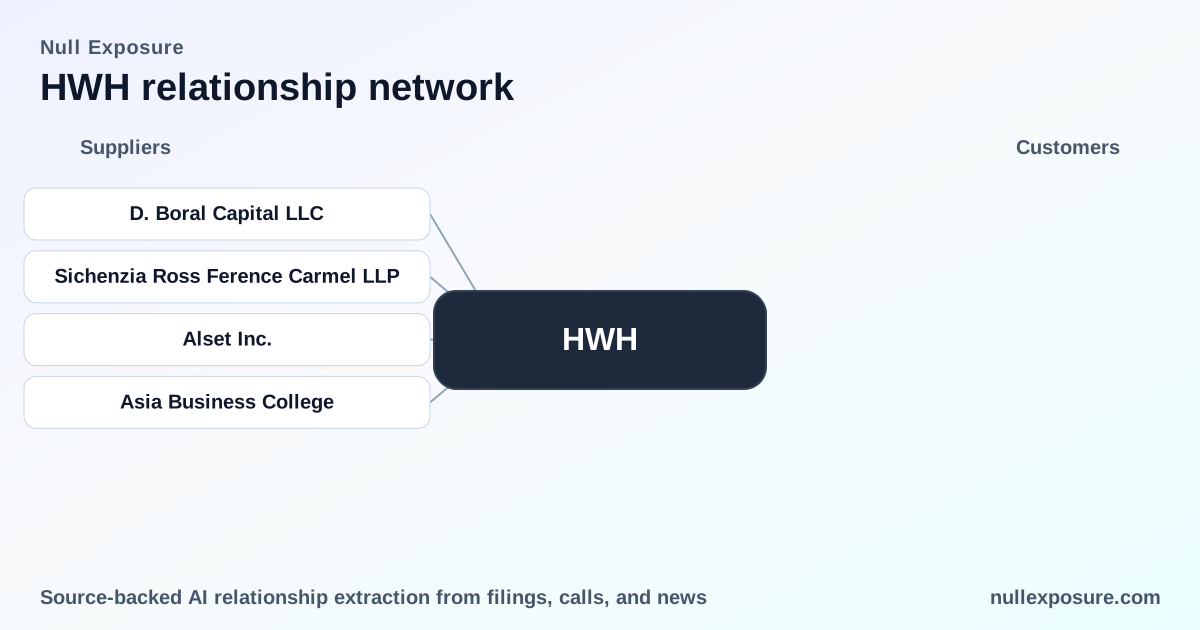
D. Boral Capital LLC
D. Boral Capital acted as sole placement agent for HWH’s roughly $1.76 million public offering, earning standard placement fees and expense reimbursement; the offering closed under terms disclosed in the company press release. According to the GlobeNewswire release dated January 6, 2025, D. Boral received a cash fee equal to 7.5% of gross proceeds plus a 1% expense allowance and up to $75,000 in out-of-pocket reimbursements (GlobeNewswire, Jan 6, 2025).
Sichenzia Ross Ference Carmel LLP
Sichenzia Ross Ference Carmel LLP served as legal counsel to HWH for the same financing transaction, providing deal legal services tied to the January 2025 offering disclosed by the company. The GlobeNewswire announcement lists the law firm as counsel to HWH (GlobeNewswire, Jan 6, 2025).
Alset Inc. — transfer agreement reported in early February 2026
HWH reached an agreement to receive more than 500 million shares in Hapi Metaverse via a transaction with its corporate parent Alset Inc.; press coverage described the transfer as strengthening HWH’s metaverse stake. A reporting outlet summarized the transfer arrangement in early February 2026 (ad-hoc-news.de, Feb 2026).
Alset Inc. — binding term sheet and convertible note to acquire 99.55% of Hapi Metaverse (Feb 5, 2026)
On February 5, 2026, HWH signed a binding term sheet and stock purchase agreement with parent Alset Inc. to acquire 505,341,376 shares of Hapi Metaverse—equal to 99.55% of the target—for $19.91 million to be financed by a five-year, 1% simple-interest convertible promissory note. The Globe and Mail press release provides the transaction terms and conversion structure (The Globe and Mail, Feb 5, 2026).
Asia Business College
HWH announced a strategic partnership with Asia Business College to launch its Hapi Wealth program in China in Q1 2025, positioning the company to commercialize its membership and education services in the Chinese market. The collaboration was publicized via a Finance Yahoo press release describing the program rollout timeline (Yahoo Finance, 2024 announcement).
Operating-model constraints and what they signal for supplier strategy
The relationship evidence and contractual excerpts reveal a blended contracting posture and clear commercial signals:
- Short-term operational posture: Numerous short-term advances, short-term leases and working-capital loans dominate daily operations, signaling a preference for flexible supplier terms and low committed fixed costs. The company treats many related-party advances as current liabilities due on request.
- Select long-term commitments: The Hapi Metaverse acquisition uses a five-year convertible promissory note and other arrangements (ROFRs and deferred underwriting liabilities) demonstrate pockets of multi-year obligations that increase balance-sheet duration risk.
- Concentration and criticality: Five suppliers accounted for over 80% of cost of revenue in 2024, indicating supplier concentration is operationally critical—loss of a key supplier would materially impact gross margins and operations.
- Geographic footprint: APAC is a meaningful operational region—Singapore, Hong Kong and South Korea are cited in lease and subsidiary arrangements—while administration and key financing flow through North America.
- Spend profile: Supplier spend ranges from sub-$100k administrative fees to multimillion-dollar underwriting/deferred commissions; typical working capital lines and credit facility draws align with the $100k–$1M and $1M–$10M spend bands.
These constraints translate into an operating model where flexibility in sourcing is balanced against high vendor concentration, and where related-party financing and service providers play central roles in liquidity and administration.
Risk and value implications for investors and operators
- Liquidity and funding dependency: Related-party credit facilities, short-term advances and deferred underwriting arrangements are the primary liquidity levers; investors must treat these as central to solvency and growth funding.
- Single-source supplier risk: With a small number of suppliers driving the majority of cost of revenue, negotiateability is limited and commercial shocks would compress margins quickly.
- Related-party operational overlap: Administrative, office and support services provided by Alset Management Group and fellow subsidiaries imply governance and transfer-pricing oversight is essential for independent minority investors.
- Strategic upside via Hapi Metaverse: The Alset-structured acquisition gives HWH near-total ownership of Hapi Metaverse through a convertible note structure—this is a strategic asset that changes enterprise value composition but introduces valuation and integration execution risk.
If you are building diligence materials or stress-testing supplier disruption scenarios, review the relationship map and contractual excerpts available at https://nullexposure.com/ for primary-source context.
Practical next steps for relationship monitoring
- Track ongoing funding events and promissory note covenants tied to the Hapi Metaverse acquisition. Confirm milestone payments and conversion triggers from public filings.
- Monitor supplier concentration metrics quarter-to-quarter—specifically the identity of the top five suppliers and their share of cost of revenue.
- Scrutinize related-party invoices and administrative agreements with Alset affiliates for potential governance red flags.
For actionable monitoring and supplier signal feeds tuned to corporate filings and media, visit https://nullexposure.com/.
Bottom line
HWH presents a classic early-stage marketplace risk/reward profile: rapid product and market expansion financed through concentrated supplier relationships and related-party funding. Investors should value the upside of strategic assets like Hapi Metaverse against the asymmetric downside from supplier concentration and short-term liquidity structures. The combination of APAC operational exposure, concentrated procurement, and related-party funding creates a set of operational priorities that deserve continuous oversight.