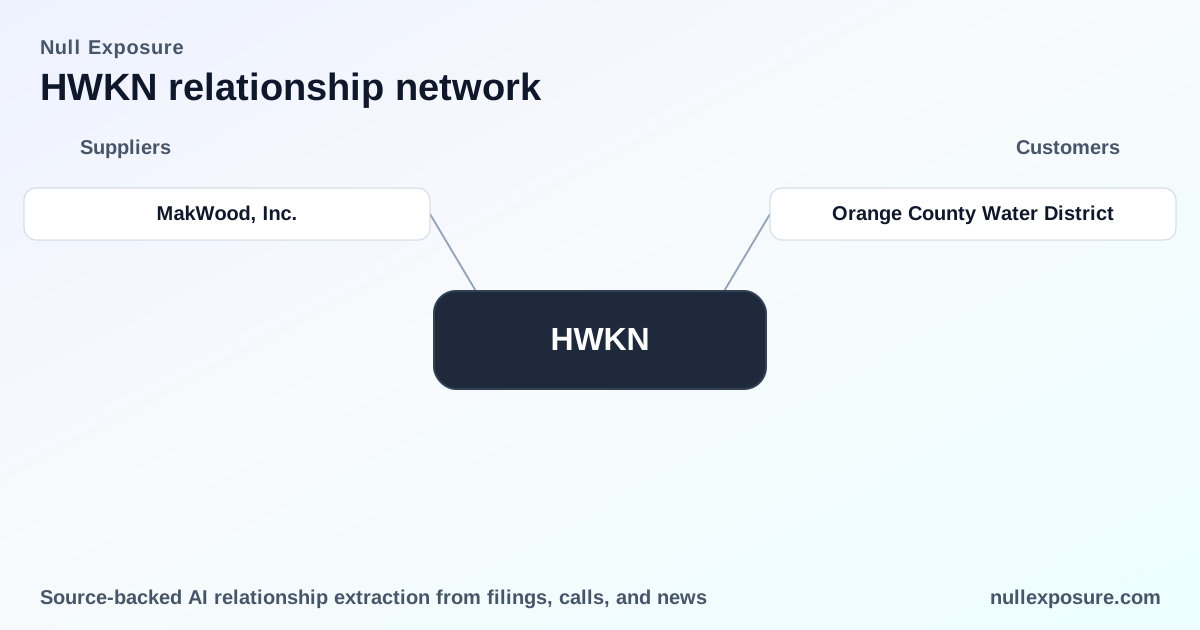
Hawkins Inc (HWKN) — supplier relationships, constraints and what investors should price in
Hawkins, Inc. blends, manufactures and distributes specialty chemicals and ingredients across water treatment, food & health sciences and industrial markets, monetizing through product sales, recurring distributorships and targeted acquisitions that expand route-to-market and product breadth. Revenue is driven by scale in bulk chemicals, a high share of distribution activity and periodic M&A, while margins reflect commodity price pass-through and logistics cost cycles; investors should value Hawkins as a specialty-chemicals distributor with embedded manufacturing and working-capital sensitivity.
For a focused supplier-risk view and counterparty mapping for underwriting or portfolio diligence, visit the Null Exposure homepage: https://nullexposure.com/
Recent supplier transaction that matters — a compact acquisition, strategic breadth
Hawkins completed a targeted acquisition from MakWood, Inc. that transfers a lactate product line into Hawkins’ Food & Health Sciences segment. This deal expands Hawkins’ nutrition and health offerings and is consistent with the company’s playbook of acquiring niche distribution/manufacturing assets to lift segment mix and gross margin opportunity. According to a trading report, the acquisition of the lactate business from MakWood was disclosed in Hawkins’ SEC filings for FY2026 and was presented as a means to broaden product offerings in nutrition and health markets (TradingView, March 10, 2026).
All supplier relationships found in the record
- MakWood, Inc. — Hawkins acquired the lactate business from MakWood, adding product capability to its Food & Health Sciences segment and expanding its presence in nutrition/health markets; this was disclosed in Hawkins’ FY2026 filings and reported March 10, 2026 by TradingView. (TradingView news, March 10, 2026)
How Hawkins sources and contracts — what the constraints reveal about operating leverage
The company filing language delivers a clear operational profile: a hybrid contracting posture with both short-term and long-term commitments, substantial dependency on third‑party logistics, and material sensitivity to raw-material price cycles. That mix defines Hawkins’ working-capital volatility and supplier finance risk.
- Contracting posture: filings show both short-term exposures (one‑year lease renewals, spot-market raw material purchases and short dated sales contracts) and long-term obligations (leases extending to 2044, multi-year credit facilities and pension withdrawal payments running to 2034). These coexistence of horizons creates asymmetric risk if commodity prices spike while some selling prices are fixed (company filings, FY2025).
- Counterparties and geography: Hawkins operates primarily in North America with selective global sourcing for health & nutrition raw materials; the company leases land from government entities (Port Authority of St. Paul) and engages large chemical producers as suppliers—so counterparties range from public authorities to global suppliers (company filings, FY2025).
- Criticality and materiality: the filings flag raw materials as both material and critical — constraints in supply, transport delays, tariffs or price swings can have a material adverse effect on margins and operations (company filings, FY2025).
- Role mix and maturity: Hawkins acts principally as a buyer of bulk chemicals and as a distributor through acquired regional water-treatment businesses; the company describes long‑standing supplier relationships it can lean on during shortages, signalling both maturity and concentrated strategic sourcing (company filings, FY2025).
- Spend and scale signals: corporate finance data and disclosed facilities show meaningful spend and balance-sheet scale — a $400M revolving facility (amended April 2025), $149M outstanding as of March 30, 2025, and acquisitions north of $100M (e.g., WaterSurplus acquisition ~ $150M) that place Hawkins clearly in the $100M+ supplier spend band for capital and M&A activity (company filings, FY2025).
These are company-level signals drawn from the FY2025–FY2026 filings and public reporting, not allocations to any single supplier unless explicitly named.
Why those constraints matter for investors and operators
- Working-capital volatility: Hawkins’ business model stores large volumes of bulk chemicals; inventory cost lags and non-hedged commodity exposure mean margins swing with raw-material markets. The company explicitly does not hedge commodity purchases, creating earnings sensitivity to input-price spikes (company filings, FY2025).
- Lease concentration risk: a portion of manufacturing and storage sits on leased land with staggered expirations through 2029–2044; losing or failing to extend key leases would materially disrupt production or storage capacity (company filings, FY2025).
- Logistics dependence: heavy reliance on third-party transport (truck, rail, barge, ocean) creates exposure to driver shortages, port congestion and infrastructure failures that can delay deliveries and increase costs (company filings, FY2025).
- Acquisition-driven growth: Hawkins uses acquisitive expansion (multiple water-treatment acquisitions in 2024–2025) to build distribution scale, which accelerates capex, working capital and integration risk; investors should model acquisition cadence into leverage and capex expectations (company filings, FY2025).
If you underwrite supplier credit or price premium finance products, stress scenarios should focus on input-price shocks, lease non-renewals, and transport disruption because these drive cash‑flow and margin pressure in Hawkins’ operating model.
For continued supplier risk mapping and to see Hawkins’ relationships alongside other chemicals suppliers, check the Null Exposure hub: https://nullexposure.com/
Practical signals to monitor next 12–18 months
- Commodity pass-through and margin trajectory: whether quarterly price adjustment clauses actually offset raw-material cost spikes will determine operating margin stability (company filings).
- Lease renewals and site continuity: monitor the renewal or replacement of leases due to expire through 2029; loss of any major storage/manufacturing site would be a high-impact operational risk (company filings).
- Integration of recent acquisitions: successful cross-sell and operating efficiency capture from Intercoastal, Water Guard, Amerochem and WaterSurplus will determine whether acquisitions are accretive to EBITDA and cash flow (company filings, 2024–2025 acquisition disclosures).
- Debt and liquidity posture: the Revolving Loan Facility (increased to $400M with $149M drawn at March 30, 2025) and $150M acquisition payments require monitoring of covenant headroom and near-term cash conversion (company filings).
For sourcing intelligence and supplier exposure tools that can help stress-test Hawkins counterparties, return to the Null Exposure homepage: https://nullexposure.com/
Bottom line
Hawkins is a distribution-led specialty chemicals company where margin and cash-flow are driven by commodity cycles, logistics, lease continuity and acquisition integration. The MakWood lactate acquisition fits the company’s strategy of bolt-on product expansion, but the more consequential risks for investors are company-level: input-price exposure, transport reliance, lease expiries and meaningful acquisition-driven capital needs. Active monitoring of those constraints and careful scenario testing are essential before extending supplier finance, credit or portfolio exposure to Hawkins.