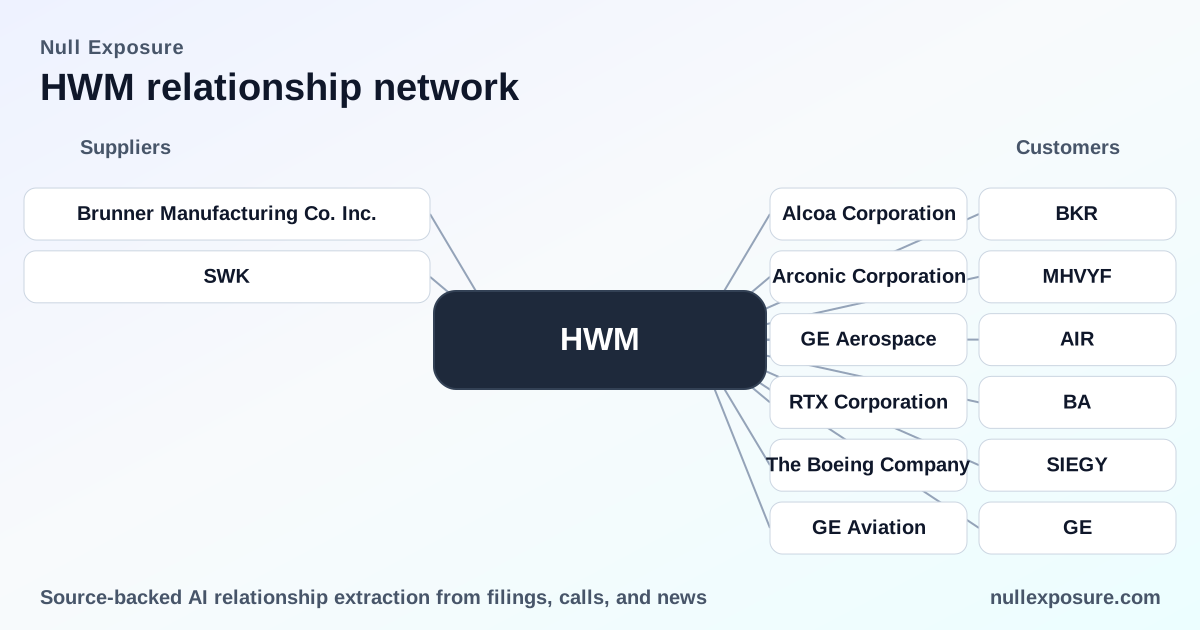
Howmet Aerospace (HWM): Strategic suppliers, recent bolt-ons, and what that means for investors
Howmet Aerospace manufactures precision components for jet engines, high‑strength fasteners, and forged wheels, monetizing through industrial scale manufacturing, long‑cycle OEM contracts, and selective acquisitions that expand capability and address supply‑chain gaps. Revenue derives from recurring aerospace and transport OEM demand plus periodic margin accretion from tuck‑ins and business‑unit acquisitions, with working capital programs that smooth supplier relationships but embed metal‑price and credit exposure.
If you evaluate counterparty risk or supplier concentration in aerospace supply chains, start with the supplier and acquisition map at Null Exposure: https://nullexposure.com/
Recent supplier and acquisition relationships that change the map
Howmet’s public filings and contemporaneous news coverage identify two strategic moves in late 2025–early 2026: a small fastener acquisition disclosed in the company 10‑K, and a larger business‑unit purchase reported in the press. Each item below is drawn from the record and summarized for investment due diligence.
Brunner Manufacturing Co. Inc. — acquisition disclosed in the FY2025 Form 10‑K
Howmet completed an all‑cash acquisition of Brunner Manufacturing Co. Inc., a U.S. fastener manufacturer, on February 6, 2026 — a classic bolt‑on aimed at expanding in‑house fastener capability and capture of aftermarket OEM spend. According to Howmet’s FY2025 Form 10‑K filing, the transaction closed on February 6, 2026 and was paid in cash (Form 10‑K, FY2025).
Stanley Black & Decker — Bitget news note on CAM purchase
News coverage reported that Howmet agreed to acquire Consolidated Aerospace Manufacturing LLC (“CAM”) from Stanley Black & Decker for about $1.8 billion in cash in December 2025, which would materially expand Howmet’s scale in aerospace manufacturing. A March 2026 Bitget news summary referenced the transaction value and timing as part of Stanley Black & Decker’s divestiture program (Bitget, March 2026).
Stanley Black & Decker — Globe and Mail press release mention (entry 1)
The Globe and Mail’s press release coverage also records that Stanley Black & Decker divested CAM to Howmet in December 2025, reinforcing the same transaction timeline and strategic rationale for consolidation in aerospace manufacturing capacity. The Globe and Mail press release covering markets and corporate divestitures referenced the CAM sale in March 2026 (The Globe and Mail, March 2026).
Stanley Black & Decker — Globe and Mail press release mention (entry 2)
A second Globe and Mail entry in our results reiterates the December 2025 divestiture of CAM to Howmet and underscores media confirmation across outlets of the same deal. This duplicate press mention provides additional corroboration of the transaction in public markets coverage (The Globe and Mail, March 2026).
What the supplier relationships and filings reveal about Howmet’s operating model
The combination of proactive acquisitions and structured supplier programs shows a multi‑dimensional operating posture:
- Contracting posture: Howmet runs a mix of long‑dated raw‑material purchase obligations (extending up to five years) alongside supplier payment terms and supplier‑finance programs, reflecting both committed procurement and working‑capital flexibility. Evidence in the FY2025 filing documents long‑term raw material purchase obligations and a supplier finance program that involves third‑party banks.
- Commercial roles: Howmet acts as buyer for raw materials, seller/sponsor of voluntary supplier‑finance arrangements that allow suppliers to sell receivables, and service provider in that the company transacts with banks to confirm and settle invoices on original maturities. These dual roles increase Howmet’s operational centrality to its supply chain.
- Concentration and scale: The disclosed raw‑material obligations and a spend band signal consistent procurement at scale (raw‑material commitment buckets documented in filings), supporting manufacturing continuity but increasing exposure to metal‑price cycles and supplier delivery risk.
- Maturity and staging: Supplier programs are active; the filing reports supplier invoices subject to future payment of $266 and $268 as of December 31, 2025 and 2024, respectively, indicating persistent usage of supplier finance mechanisms.
These characteristics position Howmet as a strategically central supplier to OEMs while retaining the working‑capital levers that smooth supplier relations but amplify commodity and credit sensitivity.
Explore deeper supplier mapping and supplier contract signals at Null Exposure: https://nullexposure.com/
Investment implications and risk checklist
- Strategic consolidation: The Brunner tuck‑in accelerates vertical capability in fasteners; the reported CAM deal (circa $1.8 billion) materially expands aerospace manufacturing scale. Together, these moves increase Howmet’s addressable market and capture more OEM spend, but integrate acquisition execution risk and near‑term cash outflow.
- Working‑capital exposure: Active supplier finance programs and multi‑year metal purchase obligations reduce short‑term supply volatility but create sensitivity to metal prices and the credit environment, particularly given the company’s revolving credit facility that extends only to mid‑2028 under current terms.
- Counterparty centrality: Howmet functions as both customer and liquidity sponsor for suppliers, which raises its operational criticality in OEM ecosystems but also concentrates counterparty credit and operational risk on Howmet’s balance sheet and cash flow.
- Execution focus: Investors should watch post‑close integration metrics for Brunner and CAM, and monitor supplier invoice balances, days payable outstanding, and any changes to raw‑material commitments disclosed in upcoming filings.
Practical next steps for due diligence
- Review the FY2025 Form 10‑K for the Brunner acquisition disclosures and supplier‑finance program notes to confirm purchase accounting and contingent liabilities (Howmet’s FY2025 10‑K).
- Track public confirmations of the CAM acquisition and its purchase price in subsequent Howmet releases and Stanley Black & Decker filings; news coverage in March 2026 referenced a roughly $1.8 billion cash consideration (Bitget, The Globe and Mail, March 2026).
- Monitor near‑term cash flow statements and the company’s credit agreement schedule for maturity and covenant language given the multi‑year raw‑material commitments.
For a complete supplier and acquisition map to support portfolio and operational decisions, visit Null Exposure: https://nullexposure.com/
Final takeaways
Howmet is executing a clear strategy of capability consolidation and supply‑chain centralization, demonstrated by the Brunner acquisition and the reported CAM purchase from Stanley Black & Decker. These initiatives strengthen Howmet’s manufacturing footprint and influence over supplier economics but increase exposure to metal prices, integration risk, and working‑capital dynamics. Investors should weigh strategic growth by acquisition against the incremental balance‑sheet and execution risks disclosed in the filings and press coverage.