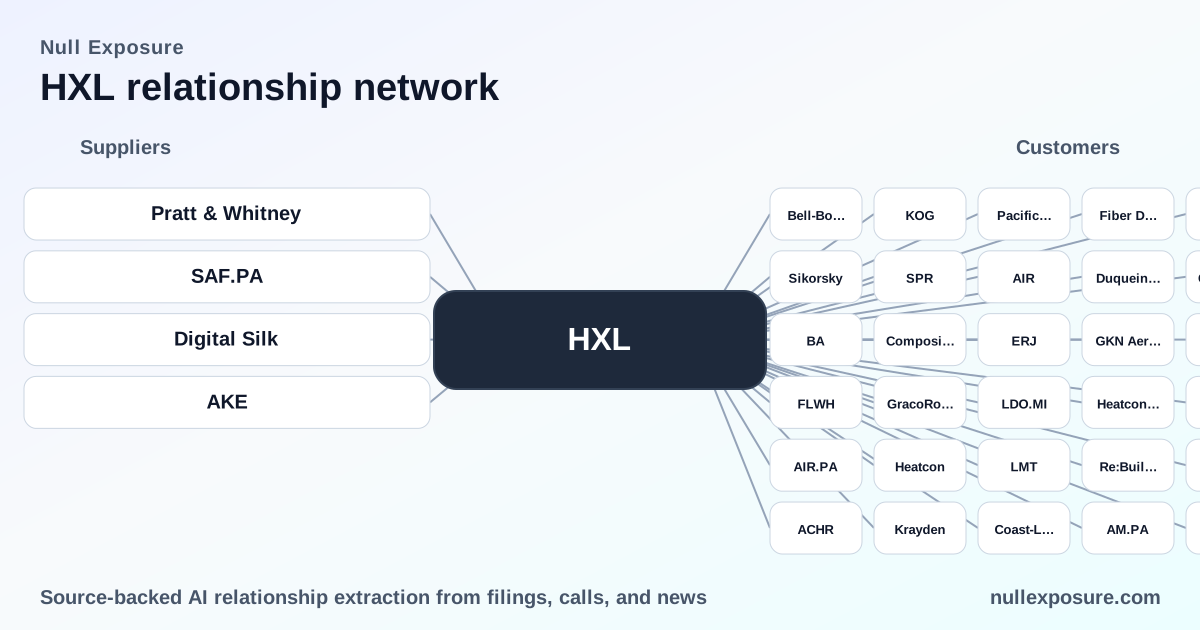
Hexcel (HXL) — supplier relationships that shape aerospace exposure
Hexcel manufactures advanced composite materials and sells into aerospace, space and defense OEMs and Tier 1s, monetizing through engineered-material sales, long-term supply contracts and program-based commitments tied to aircraft and engine production. Revenue sensitivity follows aircraft and engine build rates, while margin capture depends on mix, contract tenor and raw-material pass-through. For investors assessing counterparty and supply-chain risk, focus on program customers, strategic material partnerships, and web/marketing vendor disclosures that reveal corporate communications infrastructure. Learn more about supplier relationship analytics at https://nullexposure.com/.
What the recent relationship signals mean for revenue and risk
Hexcel’s disclosed relationships in our coverage fall into three practical categories: program OEMs that drive demand (Pratt & Whitney, Safran), materials partners enabling product innovation (Arkema), and service vendors supplying Hexcel’s public presence (Digital Silk). Each relationship has different implications for order visibility, contractual stability and supply-chain concentration.
Pratt & Whitney — program demand driver
Hexcel referenced Pratt & Whitney’s GTF engine shipments increasing and forecasted further growth in 2026, which directly translates into higher demand for engine-related composite parts that Hexcel supplies. This linkage was disclosed on Hexcel’s 2025 Q4 earnings call on March 7, 2026, indicating direct program exposure to Pratt & Whitney production cadence.
Source: Hexcel 2025 Q4 earnings call transcript, March 7, 2026.
Safran — OEM capacity expansion affects order timing
Management noted that Safran is expanding LEAP engine production capacity with a new final assembly line in Morocco and that A320 engine supply has been a constraint; capacity changes at Safran shift Hexcel’s delivery schedules and backlog realization. This observation came from Hexcel’s 2025 Q4 earnings call (March 7, 2026) and signals sensitivity to third-party OEM capacity and production ramp activity.
Source: Hexcel 2025 Q4 earnings call transcript, March 7, 2026.
Arkema — materials partnership for next‑generation composites
Hexcel announced a joint demonstrator using Arkema’s Kepstan® PEKK resin with Hexcel carbon fibers, marking a step into thermoplastic composite structures that enable higher performance and manufacturability. The collaboration was disclosed on Hexcel’s corporate site in a press release dated March 10, 2026, and represents strategic upstream material partnerships that expand Hexcel’s product roadmap and potential margin profile.
Source: Hexcel press release on collaboration with Arkema, March 10, 2026 (Hexcel.com).
Digital Silk — vendor for web and product page design
Hexcel’s website credits "Webdesign by Digital Silk" on multiple product and news pages, indicating Digital Silk provides Hexcel’s digital design and web presence services; this affects investor-facing communications and disclosure delivery but is not material to product supply. These credits appear across Hexcel product and news pages dated March 10, 2026.
Source: Hexcel product and news pages on Hexcel.com (site credits to Digital Silk), March 10, 2026.
Company-level constraints that shape contracting and supply posture
Hexcel’s disclosures reveal a contracting posture characterized by multi-year commitments, global sourcing, critical supplier dependence, and a buyer role in raw-material markets:
- Long-term purchase commitments: Hexcel reports purchase commitments extending through 2030 and beyond (e.g., $18.4M for 2026 and $38.1M thereafter), showing multi-year procurement visibility and contractual maturity that supports program continuity and planning.
- Global supplier footprint: The company sources glass yarn and other inputs from suppliers in the United States, Europe and Asia, signaling geographic diversification that reduces single-region disruption but requires complex logistics and supplier management.
- Supplier criticality: Management states Hexcel is "highly dependent on our suppliers in order to meet commitments," which positions suppliers as critical nodes—not single points of failure but essential to revenue delivery.
- Buyer and hedging behavior: Hexcel uses commodity swaps to hedge key raw-materials (e.g., propylene), demonstrating an active buyer role that manages input-price volatility and protects margins.
These constraints form company-level signals for investor due diligence: program revenue visibility is strengthened by long-term contracts, but operational execution is contingent on a globally dispersed supplier base and constrained OEM capacity cycles.
What investors should watch next
- Order flow vs. engine and airframe ramps: Given direct callouts to Pratt & Whitney and Safran, track OEM engine build rates and Safran’s Morocco ramp for forward revenues. These program linkages convert directly into Hexcel sales timing and backlog realization.
- Material partnerships and IP leverage: The Arkema collaboration advances Hexcel into thermoplastic composites with potential to command premium pricing where manufacturability and performance converge.
- Supplier concentration and purchase commitments: Monitor changes in purchase commitments and vendor concentration metrics in Hexcel’s 10‑K and quarterly disclosures; material supply continuity is a structural risk to program delivery.
- Communications and investor outreach: Vendor credits to Digital Silk indicate Hexcel’s website and product messaging are externally managed; investors should confirm that investor-facing disclosures remain centralized and timely.
Explore deeper supplier analytics and relationship mapping at https://nullexposure.com/ to quantify these signals and model cash‑flow timing against OEM ramps.
Risk‑adjusted conclusions and portfolio actions
Hexcel’s exposure is positively correlated to aerospace OEM and engine production cycles, while its margin trajectory benefits from product innovation with materials partners like Arkema. Supply-chain criticality and global sourcing are structural constraints that require active monitoring; long-term purchase commitments provide planning clarity but do not eliminate execution risk from supplier disruptions or OEM capacity shifts.
For investors and operators: prioritize scenario models that link Hexcel revenue and EBITDA realization to Pratt & Whitney and Safran build-rate scenarios, stress-test raw-material price hedges, and quantify the value of thermoplastic product commercialization. To continue rigorous supplier due diligence and receive structured relationship intelligence, visit https://nullexposure.com/.
Bottom line
Hexcel’s supplier relationships paint a clear picture: program customers drive demand, materials partners expand value capture, and service vendors manage investor and customer communication channels. Investors should align valuation assumptions to OEM ramp cycles, incorporate supplier criticality into downside scenarios, and treat long-term purchase commitments as a stabilizing factor for near‑term procurement visibility. For tailored exposure analysis and ongoing supplier monitoring, go to https://nullexposure.com/.