Haymaker Acquisition Corp. 4 (HYAC): Sponsor economics, counterparty map, and material supplier relationships
Haymaker Acquisition Corp. 4 operates as a blank-check vehicle listed on the NYSE that raises capital in an IPO, holds proceeds in a trustee-managed Trust Account and seeks an initial business combination in the consumer or consumer-related sectors. The company’s economics are driven by sponsor-promote mechanics, deferred underwriting commissions, and contingent payments to related parties for administrative and advisory services, with realized monetization occurring only upon closing an initial business combination or through sponsor/affiliate arrangements. For investors evaluating counterparties and execution risk, the focus is on the underwriters, legal advisors and the network of related-party service agreements that generate recurring and contingent costs.
Learn more at https://nullexposure.com/.
Why the counterparty map matters to investors
Haymaker is a SPAC: it carries no operating revenue and substantial cash in trust ($232.3 million placed at IPO), and it incurs professional and transaction costs as it pursues a target. The company’s public filings show material dependency on service providers and sponsor support — including monthly administrative fees accrued to affiliates and deferred underwriting fees that are releasable only upon completion of a business combination. These commercial mechanics create alignment but also concentration and conflict-of-interest vectors that investors must weigh when assessing financing risk, deal incentives, and post-merger dilution. The company is publicly traded (NYSE: HYAC) with a market capitalization shown in filings and market data; it reports zero operating revenue and contingent related-party fees recorded as accruals in 2023–2024.
If you track counterparty risk across SPACs, our platform centralizes these exposures — check the homepage for broader coverage: https://nullexposure.com/.
Supplier and advisor relationships — the complete list investors need
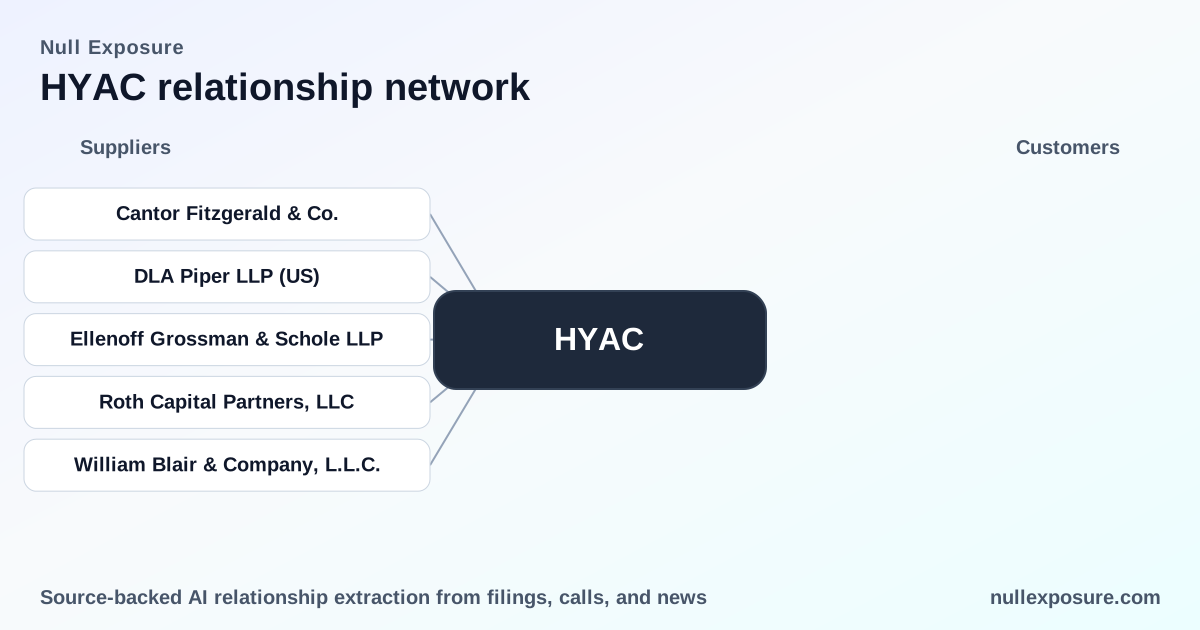
The public record tied to Haymaker’s recent deal activity names a small set of investment banking and legal counterparties; each relationship is listed below with the supporting source.
-
Cantor Fitzgerald & Co. — One of the underwriters on Haymaker’s July 2023 IPO, Cantor Fitzgerald participated alongside two other firms in the underwriting syndicate that received both immediate and deferred underwriting compensation. A PR Newswire release covering the proposed business combination referenced Cantor's role in the IPO (PR Newswire, March 10, 2026).
-
William Blair & Company, L.L.C. — William Blair served as an IPO underwriter for Haymaker in July 2023 and is party to the deferred commission structure tied to closing a business combination, as noted in the same press release (PR Newswire, March 10, 2026).
-
Roth Capital Partners, LLC — Identified as an underwriting participant in Haymaker’s July 2023 offering; Roth received the same underwriting economics described for the syndicate (PR Newswire, March 10, 2026).
-
DLA Piper LLP (US) — Retained as legal counsel to Haymaker; DLA Piper is described as acting as a legal advisor in the public announcement of the proposed business combination (PR Newswire, March 10, 2026).
-
Ellenoff Grossman & Schole LLP — Also acting as legal advisor to Haymaker on the transaction announced in March 2026, alongside DLA Piper, per the company’s public announcement (PR Newswire, March 10, 2026).
Each of these relationships is documented in the March 10, 2026 PR Newswire release announcing the Suncrete business combination with Haymaker and mirrors disclosures in the company’s registration materials and proxy filings.
What the counterparties and agreements imply for commercial posture
Haymaker’s operating model combines short-term working capital arrangements with longer-term contingent service contracts. Key company-level signals from public disclosures:
-
Contracting posture: the company uses both short-term promissory notes (repaid at or shortly after IPO) and longer-term accrued service arrangements that are payable only on successful completion of a business combination. This creates built-in contingent liabilities that sit off the balance sheet until a closing event.
-
Counterparty mix and criticality: Haymaker relies on both traditional capital markets counterparties (underwriters) and related-party service providers for office, advisory and administrative functions; the related-party payments are material relative to corporate expenses and structured as accrued contingent fees.
-
Concentration and spend profile: disclosed spend bands range from sub-$100k professional fees (transfer agent, audit fees) to multi-million dollar underwriting commissions and up to $1.5 million in sponsor working-capital promissory capacity; recurring related-party administrative fees were $240k in 2024, indicating non-trivial concentrations with affiliates.
-
Geographic footprint and custodial risk: operating and administrative services are centered in New York (501 Madison Avenue), and the Trust Account balance materially exceeds FDIC insurance thresholds, increasing custody and counterparty deposit risk.
-
Maturity and stage: relationships are active and transactional while Haymaker pursues a target; certain counterparties (underwriters and auditors) have payment triggers contingent on consummation, producing alignment with deal flow but also incentive to consummate transactions.
These characteristics create a hybrid risk profile: underwriters and legal advisors are standard market relationships, but the company’s economics are substantially affected by sponsor and affiliate arrangements that are both sizable and contingent.
Tactical takeaways for investors and operators
-
Underwriting economics create clear incentives. Deferred commissions and the size of underwriting fees channel incentives for deal completion and shape post-deal economics for public shareholders. Haymaker’s filings disclose both cash underwriting discounts and deferred fees tied to successful business combinations (company filings and PR Newswire, 2023–2026).
-
Related-party administrative costs are material and pre-funded. The company accrued thousands-per-month to affiliates for office and advisory services, with $240,000 recorded in 2024; these accruals will be payable only if a business combination closes, aligning vendor payment timing with the sponsor’s objectives (company filings).
-
Trust Account custody is central to counterparty risk. With over $232 million in trust at IPO and balances regularly exceeding FDIC limits, any claims against the Trust Account are a primary litigation and liquidity vector described in the filings.
If you want a consolidated view of how these commercial dynamics compare across SPACs, visit our hub at https://nullexposure.com/.
Bottom line and next steps
Haymaker Acquisition Corp. 4 is a classic SPAC structure: no operating revenue, a large trust balance, and a web of underwriters, legal advisors and related-party service providers whose fees govern sponsor monetization and deal incentives. For investors, that means valuation and governance risk is concentrated in the structure of deferred underwriting fees and related-party accruals as much as in target selection. Monitor underwriter economics, related-party accruals and Trust Account protections as the primary levers that will determine shareholder outcomes.
For a comparative, counterparty-focused view across issuers and transactions, go to our homepage: https://nullexposure.com/.