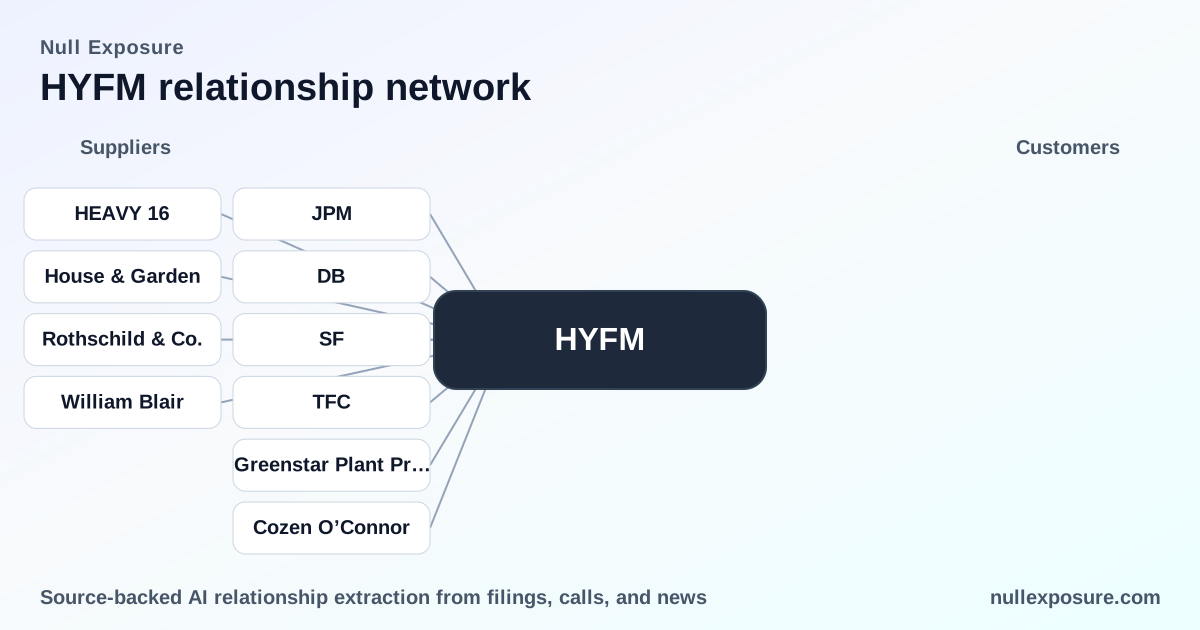
Hydrofarm (HYFM) — supplier and counterparty map investors need to digest
Hydrofarm builds and distributes controlled-environment agriculture (CEA) equipment and supplies, monetizing through the sale of proprietary durable hardware, branded consumables, and distribution of third‑party product lines across North America and Europe. The company combines in-house manufacturing where strategic, long-term contract manufacturing arrangements elsewhere, recurring product sales, and acquisition-driven brand aggregation to drive revenue. Key revenue levers are product sales, distribution margins, and cost synergies from contract manufacturing and M&A.
For a quick reference on HYFM counterparties and supplier signals, visit the NullExposure homepage: https://nullexposure.com/.
How HYFM’s operating model shapes supplier risk and commercial posture
Hydrofarm runs a hybrid model: direct manufacturing for select durable items, broad distribution for multi-brand portfolios, and outsourced contract manufacturing for efficiency. The company’s operating posture is defined by several structural constraints:
- Contracting is predominantly long-term. Multiple non-cancellable leases (many with multi-year terms and renewals) and multi-year credit arrangements create fixed-cost leverage in the model, imposing runway pressure when demand softens.
- Supplier concentration is material. Management discloses a supplier that accounted for over 10% of purchases in 2023–2024, which elevates single‑vendor exposure and inventory risk when paired with minimum‑purchase obligations.
- Supply chain is global but North America‑centric in critical operations. HYFM sources components from the U.S., Canada, China and Europe, operates peat bogs in Alberta, and maintains distribution centers in Canada and Spain; this creates sensitivity to tariffs, logistics disruption and FX.
- Commercial relationships are active and transactional. HYFM uses framework supply agreements that include minimum purchase commitments and exclusive supply or contract-manufacturing provisions, reflecting a move to lock in cost and capacity advantages while transferring manufacturing risk.
- Leverage and covenant discipline matter. The company carries term debt (maturing in 2028) and historically used a JPMorgan‑led revolving facility (with maturity and amendment activity through 2026), making financing counterparties a strategic risk vector.
These characteristics combine to produce an operational profile where supplier continuity, working capital management, and creditor relationships determine near‑term viability.
Counterparty map — the institutions and vendors that shape HYFM's strategy
Below are every relationship surfaced in the available results, with a one‑to‑two sentence plain‑English summary and source reference.
-
JPMorgan (Revolving credit termination) — Hydrofarm entered a termination agreement dated February 17, 2026 to end the Revolving Credit Agreement originally signed March 29, 2021 with JPMorgan as administrative agent and a syndicate of lenders; this materially changes the company’s revolving liquidity posture. According to TradingView reporting on the March 2026 announcement, the credit facility termination is confirmed (TradingView, March 2026).
Source: https://www.tradingview.com/news/tradingview:78411a3f985e5:0-hydrofarm-terminates-2021-revolving-credit-agreement-with-jpmorgan-led-lender-group/ -
Deutsche Bank Securities (IPO underwriter) — Deutsche Bank Securities was listed among the underwriters for Hydrofarm’s public offering, indicating institutional capital markets engagement early in the company’s public lifecycle. MarketRealist documented the underwriter syndicate in its coverage (MarketRealist, FY2020).
Source: https://marketrealist.com/p/is-hydrofarm-hyfm-stock-ipo-a-good-buy/ -
J.P. Morgan (IPO underwriter / banking counterparty) — J.P. Morgan appears both as an underwriter in HYFM’s offering and as a lead administrative agent on credit facilities in later years, signaling a long-term banking relationship across capital markets and lending roles. MarketRealist lists the firm among IPO underwriters (MarketRealist, FY2020).
Source: https://marketrealist.com/p/is-hydrofarm-hyfm-stock-ipo-a-good-buy/ -
Stifel (IPO underwriter) — Stifel was part of the underwriting syndicate for Hydrofarm’s offering, evidencing regional investment banking involvement in the company’s public float. MarketRealist includes Stifel in the underwriter list (MarketRealist, FY2020).
Source: https://marketrealist.com/p/is-hydrofarm-hyfm-stock-ipo-a-good-buy/ -
Truist Securities (IPO underwriter) — Truist Securities served as an underwriter on the equity issuance, reflecting diversified capital markets placement among mid‑market banks. MarketRealist cites Truist in the underwriting syndicate (MarketRealist, FY2020).
Source: https://marketrealist.com/p/is-hydrofarm-hyfm-stock-ipo-a-good-buy/ -
Greenstar Plant Products, Inc. (acquisition target) — Hydrofarm completed an acquisition of Greenstar Plant Products for approximately $83 million to expand its agribusiness brand and nutrient product portfolio, strengthening HYFM’s consumables mix. Local reporting covered the transaction as part of Hydrofarm’s 2021 M&A push (BucksCo.today, FY2021).
Source: https://bucksco.today/2021/08/hydrofarm-acquires-ag-nutrient-company/ -
Cozen O’Connor (legal advisor on acquisitions) — Cozen O’Connor acted as legal counsel to Hydrofarm in connection with a 2021 acquisition, indicating the company’s use of established law firms for transaction-level legal work. NewCannabisVentures reported the firm’s role as legal advisor (NewCannabisVentures, FY2021).
Source: https://www.newcannabisventures.com/hydrofarm-to-pay-125-million-for-2nd-nutrient-company-acquisition-in-2021/ -
HEAVY 16 (acquisition of nutrient manufacturer) — Hydrofarm announced the acquisition of HEAVY 16 as part of a strategy to accelerate scale in nutrient manufacturing and broaden product offerings in 2021. NewCannabisVentures covered the HEAVY 16 acquisition as part of Hydrofarm’s acquisition cadence (NewCannabisVentures, FY2021).
Source: https://www.newcannabisventures.com/hydrofarm-to-pay-125-million-for-2nd-nutrient-company-acquisition-in-2021/ -
House & Garden (acquisition / supplier integration) — Hydrofarm entered into an agreement to acquire House & Garden, expanding its hydroponic nutrient and equipment product line to consolidate market position. NewCannabisVentures details the House & Garden transaction in 2021 coverage (NewCannabisVentures, FY2021).
Source: https://www.newcannabisventures.com/hydrofarm-to-pay-125-million-for-2nd-nutrient-company-acquisition-in-2021/ -
Rothschild & Co. (financial advisor) — Rothschild & Co. acted as financial advisor to Hydrofarm on acquisition activity, signaling use of top-tier advisory services for deal execution and valuation. NewCannabisVentures lists Rothschild in the advisory role (NewCannabisVentures, FY2021).
Source: https://www.newcannabisventures.com/hydrofarm-to-pay-125-million-for-2nd-nutrient-company-acquisition-in-2021/ -
William Blair (IPO underwriter) — William Blair participated in the underwriting syndicate for Hydrofarm’s IPO, demonstrating the company’s engagement with boutique and regional underwriters for distribution coverage. MarketRealist includes William Blair in its underwriter list (MarketRealist, FY2020).
Source: https://marketrealist.com/p/is-hydrofarm-hyfm-stock-ipo-a-good-buy/
If you want a consolidated counterparty risk matrix or to monitor covenant timelines and supplier concentration proactively, start here: https://nullexposure.com/.
What this means for investors — risk, runway, and upside
- Liquidity and covenant timeline are priority issues. The termination of the JPMorgan‑led revolving facility in February 2026 alters HYFM’s short-term liquidity profile and increases the importance of the term loan schedule (maturity in 2028) and cash generation from operations.
- Supplier concentration and minimum‑purchase frameworks create inventory and margin risk. One supplier’s outsized role and framework commitments mean HYFM must manage inventory turns tightly to avoid obsolescence and margin compression.
- M&A and contract manufacturing reduce capital intensity but shift operational risk to partners. The sale of durable manufacturing assets combined with exclusive supply agreements shows a deliberate trade of fixed costs for outsourced execution; this lowers capex but increases reliance on third‑party manufacturing performance.
- Global sourcing demands proactive trade, logistics and FX management. Exposure to China, Europe and Canada requires active tariff and logistics mitigation to protect margins.
If you want NullExposure to produce a tailored counterparty briefing or covenant-watchlist for HYFM, request a briefing at the homepage: https://nullexposure.com/.
Bottom line
Hydrofarm’s business model balances branded hardware sales with distribution and bolt‑on acquisitions, but the company’s near‑term prospects are highly sensitive to counterparty funding, a concentrated supplier base, and execution of outsourced manufacturing arrangements. Investors should prioritize covenant schedules, supplier diversification, and inventory management when evaluating HYFM exposure. For ongoing monitoring and a deeper counterparty risk profile, visit https://nullexposure.com/ and request the HYFM supplier dossier.