HYFT (MindWalk Holdings): financing-driven supplier exposure and what it means for investors
MindWalk Holdings (ticker HYFT) operates as a small-cap biotechnology / healthcare company that reports core revenue from commercial activity but relies materially on capital markets to fund growth. The company reports $28.1M in trailing twelve‑month revenue and a $56.0M market capitalization, while posting negative EBITDA and EPS; it therefore monetizes through a combination of operating receipts and periodic equity placements mediated by broker-dealers. For investors evaluating supplier and capital-market counterparties, the JonesTrading sales arrangement is the primary active relationship to factor into funding, dilution, and liquidity scenarios. Learn more about counterparty exposure and supplier mapping at https://nullexposure.com/.
How to read this supplier profile in investment terms
MindWalk’s operating profile is typical of an early-stage public biotech that has achieved revenue traction but remains unprofitable. The balance of operating revenue (Revenue TTM $28.08M; Gross Profit $16.06M) against negative operating margin (-88.4%) and EBITDA (-$10.485M) highlights the dual reliance on commercial receipts and external financing. That financing dependence elevates the strategic importance of any broker-dealer or capital markets supplier because such relationships function as the on-ramp for incremental capital and liquidity.
- Capital-market access is a material supplier relationship for HYFT: agreements to sell common shares directly impact available cash, dilution, and timing of R&D or commercial expansion.
- Ownership concentration is low: insiders ~8.94% and institutions ~9.71%, indicating a loosely held register that increases sensitivity to retail flows and short-term financing arrangements.
- Financial maturity is early: positive revenue growth (Quarterly Revenue Growth YoY 52.4%) coexists with negative profitability metrics, so supplier relationships shift between operational vendors and financing counterparties.
If you need a mapped supplier exposure report or an investor-grade counterparty risk briefing, explore the service page at https://nullexposure.com/.
Active supplier relationships (what’s on the public record)
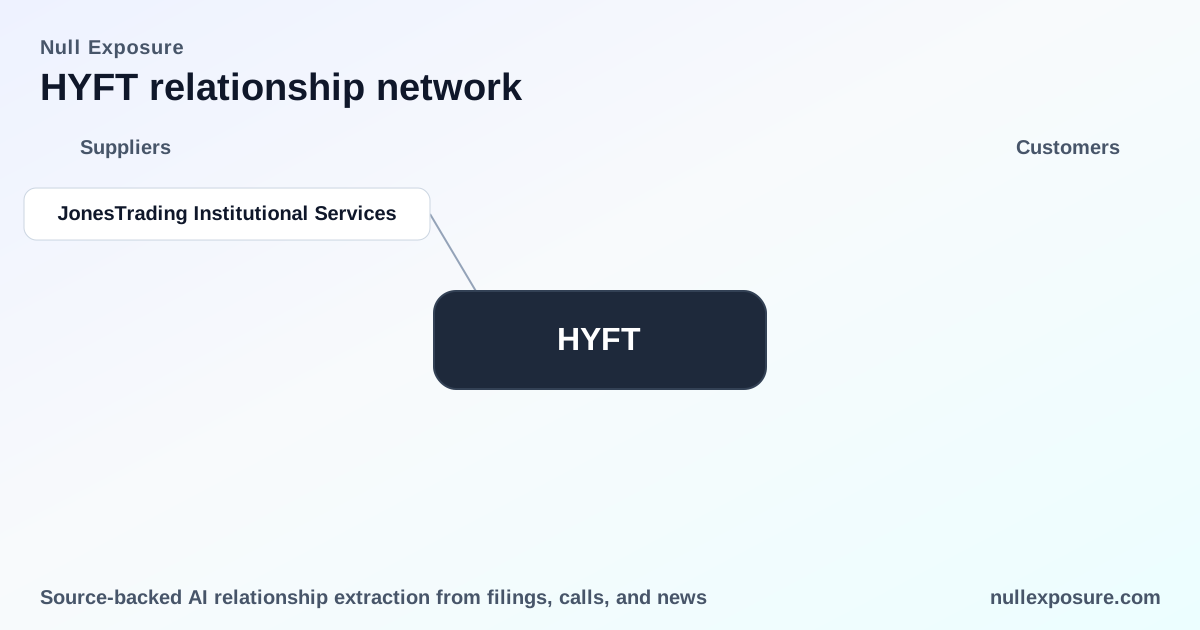
JonesTrading Institutional Services — MindWalk executed a sales agreement that allows JonesTrading to offer up to $30 million of common shares under an at-the-market or similar sales arrangement dated in FY2026. This agreement is a direct channel for equity issuance and liquidity generation, giving JonesTrading an active execution role in any incremental share placement program. The arrangement was reported by MarketScreener on March 10, 2026. (MarketScreener news, March 10, 2026)
That is the only named supplier relationship disclosed in the results provided. The prominence of an active equity sales agreement is consequential because it directly governs the company’s ability to raise cash without pursuing more dilutive or conditional financing structures.
What the JonesTrading relationship implies for investors
The JonesTrading arrangement communicates three practical signals:
- Execution capability for equity raises: with a $30M facility available, MindWalk has an immediate mechanism to monetize future share issuances, which reduces friction for near-term capital needs and supports planned spending or opportunistic acquisitions.
- Dilution pathway clarity: the existence of a committed sales agreement clarifies a concrete dilation vector; investors should model incremental share issuance against outstanding shares (Shares Outstanding ~46.7M) and current market capitalization when stress-testing equity dilution.
- Market-access dependency: given limited institutional ownership and negative operating cash flow indicators, the company has structural dependence on broker-sold equity for runway extension.
These are not hypothetical—this is how capital markets suppliers operate for small public biotechs, and the JonesTrading agreement is the tangible manifestation of that dynamic for HYFT.
Company-level constraints and operating model signals
There are no discrete constraint excerpts tied to specific supplier entities in the source material; however, company-level metrics produce clear operating signals relevant to supplier risk and contracting posture:
- Contracting posture: the company demonstrates a short-term financing orientation through equity sales agreements rather than long-duration debt commitments—this is consistent with high-growth, negative-EBITDA issuers that prefer flexible equity execution partners.
- Concentration and criticality: with minimal institutional ownership (~9.7%) and modest insider stakes (~8.9%), counterparty relationships such as sales agreements with broker-dealers become critically important for liquidity and continuity of operations.
- Maturity and risk profile: negative profitability (Operating Margin TTM -88.4%; Diluted EPS -$0.10) combined with positive revenue growth implies a growth-phase company that is still establishing operational leverage; supplier relationships will therefore skew transactional and financing-focused rather than long-term supply contracts.
- Capital structure sensitivity: market capitalisation (~$56M) and available sales facilities imply that single financing arrangements can materially alter the capitalization table; that elevates governance and disclosure expectations around any supplier that executes capital raises.
Investors should treat these company-level signals as indicators of where supplier diligence delivers the most value: understand execution capacity, contractual terms for placement agreements, fees and lockups, and disclosure cadence.
Risk and opportunity framework for operators and buyers
- Risk — dilution and timing: the existence of an at-market sales agreement creates a clear dilution risk if market conditions trigger frequent or large issuances; plan for modeled share count increases under conservative financing scenarios.
- Opportunity — rapid access to capital: a committed broker-dealer facility provides the optionality to raise funds quickly without negotiating separate financing events, which is valuable when pursuing time-sensitive commercial or R&D initiatives.
- Operational implication: vendors selling into MindWalk should expect intermittent payment stability tied to financing cycles; counterparties that provide strategic services should assess the company’s runway and planned use of the $30M facility.
Takeaway for investors and counterparties
MindWalk (HYFT) is a revenue-generating but unprofitable small-cap biotech with material dependence on equity market channels for funding. The JonesTrading sales agreement is the single disclosed supplier relationship in the record provided and functions as the principal mechanism for raising equity capital. That makes counterparty terms, execution capacity, and disclosure cadence immediate first-order risks for investors and commercial partners.
For deeper supplier mapping, counterparty risk scoring, or a bespoke exposure report, visit https://nullexposure.com/ and request the HYFT supplier briefing.
Final considerations and next steps
Track the cadence of filings and press releases tied to any executed tranches under the JonesTrading agreement; that is the most direct lead indicator for changes in dilution, cash runway, and strategic optionality. For institutional investors, the interaction between limited institutional ownership and a committed public-sales facility creates both trading liquidity and governance levers worth active monitoring.
To commission a proprietary supplier risk profile or to subscribe for ongoing counterparty alerts, start at https://nullexposure.com/ — our coverage includes execution history, fee analysis, and impact modeling for equity placements and broker-dealer relationships.