Hycroft Mining (HYMC) — supplier relationships, contracts, and investor implications
Hycroft Mining operates a single large, Nevada-based gold and silver mine and monetizes primarily through mineral production and concentrate sales while servicing a complex capital structure: secured term loans, subordinated notes, and perpetual royalty obligations that materially influence cash flow and strategic choices. Investors should view Hycroft as an asset-driven operator whose near-term performance is governed as much by external technical consultants and service contractors as by commodity prices; supplier relationships play an outsized role in resource modeling, permitting and future restart plans. For a more complete view of Hycroft’s supplier map and how it affects credit and operational risk, visit the NullExposure homepage: https://nullexposure.com/.
How Hycroft runs the mine and where suppliers fit in
Hycroft conducts exploration, development and limited production at the Hycroft Mine in Humboldt and Pershing counties, Nevada, relying on a mix of third‑party engineering, geological and environmental consultants, short-term contractors for operations, and long-term royalty and loan financiers. Technical consultants prepare the company’s Mineral Resource Estimates (MREs) and TRS reports that underwrite capital allocation decisions; contractors supply equipment, labor and specialist services that determine whether development timelines and budgets are met. The company’s operating model is therefore a hybrid: capital intensive and asset‑specific, with critical external dependencies for technical validation and execution.
Who Hycroft contracted to prepare the latest MRE (and what that means)
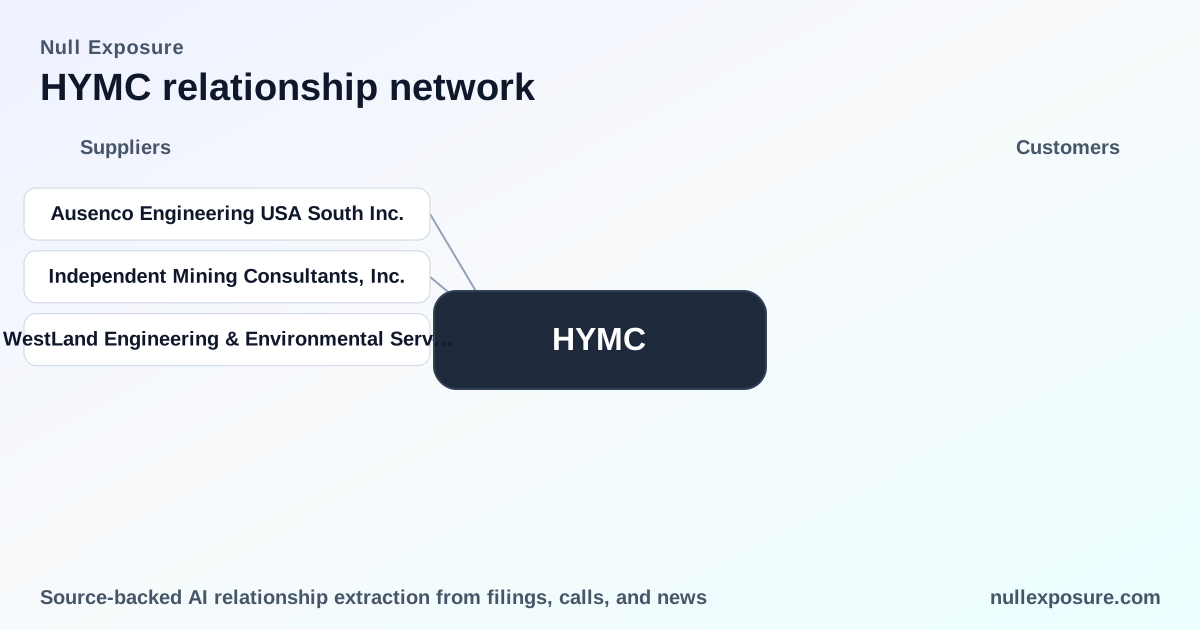
A February 18, 2026 press release highlighted that Hycroft’s updated Mineral Resource Estimate was prepared by three external technical firms: Ausenco Engineering USA South Inc., Independent Mining Consultants, Inc. (IMC), and WestLand Engineering & Environmental Services, Inc. These three names define the immediate supplier footprint for Hycroft’s project-level technical work.
Ausenco Engineering USA South Inc.
Ausenco led engineering and technical reporting work for the 2026 MRE and provided due‑diligence and technical report services for the Hycroft TRS; Hycroft’s filings show payments of approximately $0.4 million in 2024 and $0.3 million in 2023 to Ausenco for TRS preparation and due diligence. According to a Sahm Capital press release (Feb 18, 2026) the MRE was prepared by Ausenco alongside IMC and WestLand, and Hycroft’s 2024 Form 10‑K itemizes historical payments to Ausenco for technical studies.
Independent Mining Consultants, Inc. (IMC)
IMC acted as an independent qualified person for the resource estimates and performed model visual checks and variable validation for Hycroft’s block models; the company’s technical disclosures reference IMC’s role in preparing and reviewing MRE inputs. The Sahm Capital release (Feb 18, 2026) lists IMC as a co‑author of the MRE, and Hycroft’s SEC filings describe IMC’s verification work on the 2023–2024 TRS.
WestLand Engineering & Environmental Services, Inc.
WestLand participated with Ausenco and IMC as a qualified third‑party reviewer for the MRE and provided environmental and permitting input for Hycroft’s technical reporting. The Sahm Capital announcement (Feb 18, 2026) credits WestLand on the MRE, and Hycroft’s technical and permitting disclosures cite WestLand as one of the independent parties responsible for portions of the TRS.
(Each of the above relationships is cited in Hycroft’s public technical disclosures and reflected in the Feb 18, 2026 company announcement through Sahm Capital.)
Company-level constraints that shape supplier exposure
Hycroft’s supplier profile must be read against a set of company‑level contractual and financial constraints that govern how suppliers are engaged and how critical those relationships become.
- Contracting posture: Hycroft runs a combination of long‑term financial arrangements and short‑term service contracts. The company is subject to long‑dated debt and perpetual royalty commitments while engaging contractors and consultants on mostly as‑needed, short‑term agreements. This creates a dual posture where strategic financing obligations constrain operational flexibility while day‑to‑day execution depends on spot contracting.
- Usage and royalty economics: The company is obligated to usage‑based royalty payments — a perpetual 1.5% net smelter returns royalty under the Sprott Royalty Agreement and a 4% net profit royalty on certain claims (the Crofoot royalty, with a stated cap and advance payment mechanics)—which make future cash flow sensitive to production volumes rather than just fixed fees.
- Concentration and criticality: Hycroft’s operations are geographically concentrated in Nevada and are critically dependent on a relatively small set of technical providers for resource estimation and permitting; this raises execution risk if key consultants or contractors change terms or availability.
- Maturity and financial discipline: The company carries significant indebtedness under the Sprott Credit Agreement and subordinated notes with maturities clustered in the 2025–2027 window, and debt covenants require minimum cash and working capital thresholds; these factors increase the stakes on supplier cost control, timing of capital projects, and ability to secure favorable contractor terms.
- Counterparty mix and regulatory touchpoints: Suppliers range from individual employment agreements to government agencies (BLM, NDEP, NDWR) that control permits; the permit‑heavy nature of mining makes relationships with regulators as important as commercial suppliers.
- Spend profile: Supplier spend is heterogeneous: Hycroft records consultant and engineering fees in the $100k–$1m band for recurring technical work, but remediation, reclamation and financing flows show exposures in the $10m–$100m and $100m+ bands, indicating that supplier and capital commitments can escalate rapidly during major capital programs.
What these supplier ties mean for investors and operators
- Technical providers drive optionality. The MRE and TRS prepared by Ausenco, IMC and WestLand underpin project economics; changes to those relationships or their findings directly affect capital allocation and financing needs. Sahm Capital’s Feb 2026 release confirms the role of these three firms in the latest MRE.
- Royalties and secured lenders constrain upside. Perpetual and advance royalties plus secured credit facilities reduce free cash flow available to pay contractors or fund expansions, making staged investment and contractor flexibility essential.
- Operational risk is third‑party dependent. Hycroft outsources considerable technical and specialist work; the company’s filings document dozens of service provider relationships and explicit risk language around contractor availability and costs.
For investors and operators who need a clear map of supplier exposure and contractual constraints, NullExposure provides focused supplier intelligence and relationship analytics. Explore detailed profiles at https://nullexposure.com/.
Practical next steps for stakeholders
- Lenders and bondholders should require regular technical updates from the named qualified firms (Ausenco/IMC/WestLand) as condition precedent for material facility advances.
- Operators and procurement should negotiate flexible, performance‑tied contracts with consultants and contractors to align payments with milestone delivery and preserve liquidity.
- Portfolio managers should stress‑test Hycroft’s cash flow against royalty payments and covenant triggers in the 2025–2027 maturity window to assess refinancing or restructuring risk.
If you require a tailored supplier risk memo or a consolidated view of Hycroft’s counterparty exposures, visit the NullExposure homepage and request a profile: https://nullexposure.com/.
Bottom line
Hycroft is a capital‑intensive, single‑asset mining operator whose near‑term trajectory is determined by a small circle of technical suppliers and a binding set of financial and royalty obligations. The MRE authors — Ausenco, IMC, WestLand — are not peripheral vendors: their analysis materially affects Hycroft’s ability to access capital and execute a sulfide processing restart, and the company’s long‑term royalties and debt covenants materially constrain operational flexibility. For investment and operational decisions, focus on the interplay between technical validation, contractor terms and the debt/royalty structure. For a deeper supplier intelligence briefing, go to https://nullexposure.com/.