Hycroft Mining (HYMCW): Supplier Relationships and Contractual Constraints That Drive Credit and Operational Risk
Hycroft Mining Holding Corporation operates as a U.S.-based gold and silver producer that monetizes its asset through metal sales, structured financing, and royalty obligations tied to mine production. Revenue comes from oxide and sulfide processing operations at the Hycroft Mine, while capital is raised through secured credit facilities, note issuances, and public equity offerings; recurring outflows include perpetual and net-profit royalties that scale with production. For investors and operators evaluating supplier counterparty risk, the combination of long-dated financing covenants and usage-based royalty commitments defines the company’s working capital flexibility. Learn more about the supplier signals and provider mapping at https://nullexposure.com/.
Why supplier relationships matter for Hycroft’s valuation
Hycroft’s supplier network is not a conventional procurement story — it is a financing plus operations story. Long-term secured lenders and perpetual royalty holders effectively sit alongside contractors and auditors in the company’s capital structure, creating a blended set of commercial dependencies: lenders control refinancing risk and covenants; royalty holders collect a share of production cash flow; third-party service providers control on-site execution and technical reporting. The company routinely uses short-term, as-needed contracts for operational inputs while maintaining high-impact long-term financial and royalty obligations that constrain strategic optionality.
The named counterparties that showed up in public reporting
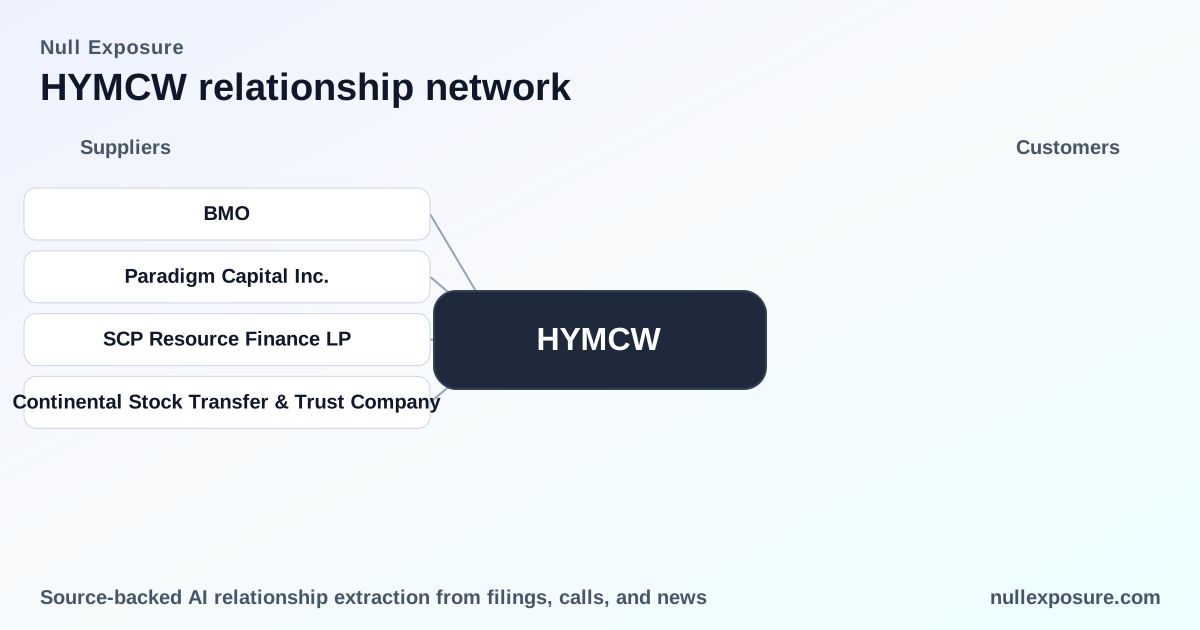
Hycroft’s recent press and filings name a small set of external parties tied to capital and corporate actions. Below I list each relationship detected in the public material, with a concise plain-English description and the source.
BMO Capital Markets
BMO Capital Markets is acting as a joint book-running manager for Hycroft’s public offering of units, placing BMO in an underwriting and distribution role for equity capital. — PR Newswire and Macau Business coverage, March 2026.
Paradigm Capital Inc.
Paradigm Capital Inc. joins BMO as a joint book-running manager on the same offering, supporting syndication and market placement functions for the transaction. — PR Newswire and Macau Business coverage, March 2026.
SCP Resource Finance LP
SCP Resource Finance LP is serving as a capital markets advisor to Hycroft, providing strategic advice and execution support around the public offering and financing activities. — PR Newswire and Macau Business coverage, March 2026.
Continental Stock Transfer & Trust Company
Continental Stock Transfer & Trust Company is the company’s transfer agent and served as the exchange agent for a previously announced reverse stock split, handling shareholder communications and exchange logistics. — PR Newswire release regarding the reverse stock split (FY2023).
How the company-level constraints shape supplier risk and bargaining power
Hycroft’s contractual landscape produces a predictable set of commercial characteristics that drive supplier and investor decisions:
- Contracting posture — mixed but lender-driven: the company uses short-term operational contracts and long-term financial arrangements. Debt agreements and royalty contracts are the dominant constraint on corporate action (company-level signal); they impose covenants, maturity profiles and restrictions that limit cash deployment and restructuring flexibility.
- Concentration and criticality — financing and royalties are existential: long-term obligations, including a perpetual 1.5% net-smelter royalty and net-profit royalties tied to portions of the property, are critical to the economic model because they are both perpetual (usage-based) and secured against material assets. The Sprott credit arrangements, referenced in the filings, embed cross-default and collateral protections that could lead to foreclosure if covenants are breached.
- Maturity profile — mixed tenor with long tails: reporting highlights long-term credit facilities and subordinated notes extended into the mid-2020s and beyond, alongside ongoing perpetual royalty flows; operational contracts are often short-term or as-needed, creating potential mismatch between predictable financial obligations and variable operational spend.
- Spend and scale — concentrated but tiered: procurement and advisory spend runs from sub-$100k routine items up to $10–100M financing tranches (company-level signals), so suppliers range from small engineering consultants to major capital markets banks. This creates different negotiation leverage across the supplier base.
- Service dependency and vendor risk — operationally material: Hycroft relies heavily on third-party contractors for technical studies, processing expertise, and field execution; interruptions or contractor insolvency would be material to timelines and costs.
Mid-read action: for a structured view of counterparties and contractual constraints, visit https://nullexposure.com/ to map Hycroft’s supplier and finance relationships.
Key investment and operational implications
- Liquidity and refinancing are the principal near-term risks. Debt maturities and covenant packs reduce free cash flow flexibility; suppliers tied to capital-raising (underwriters/advisors) are central to managing that risk.
- Royalty obligations create a production-linked cash outflow that cannot be easily scaled down. Usage-based royalties (1.5% NSR and 4% net-profit royalties for certain claims) ensure that any increase in production increases recurring outflows.
- Regulatory and permitting exposure elevates counterparty execution risk. Government permit renewals and federal claim status are company-level constraints that can affect the economics of licensed land and the necessity of third-party reclamation providers.
- Third-party technical advisors and auditors are active and visible. The company uses external qualified persons and consultants for technical reporting—these relationships are operationally essential and fall in the material-to-critical range depending on the activity.
Consider the following checklist when assessing supplier exposure or negotiating terms with Hycroft:
- Confirm whether your contract is short-term (operational) or long-term (financial/royalty) and the implications for termination and cure rights.
- Ask whether payments are usage-based (royalties) that scale with production, or fixed-fee, and price accordingly.
- Factor in the company’s covenant restrictions when assessing payment terms or collateral requests.
- Evaluate counterparty concentration: large advisory or underwriting engagements will command different risk premia than routine supplies.
Final recommendations and next steps
For investors and operators, the strategic priority is monitoring liquidity, covenant compliance, and royalty cash flow dynamics—these are the levers that determine whether suppliers receive timely payment and whether material assets remain unencumbered. Institutional counterparties like BMO, Paradigm, and SCP are focused on capital formation; transfer agents such as Continental execute corporate actions that affect shareholder structure. These roles are visible in the company’s filings and press releases and reflect a financing-first posture.
If you want a mapped supplier view and a prioritized risk register for Hycroft, visit https://nullexposure.com/ to request a tailored exposure report. For transaction support or to benchmark contract terms against peer mining operations, start your review at https://nullexposure.com/ and align procurement strategy to Hycroft’s capital structure and royalty profile.