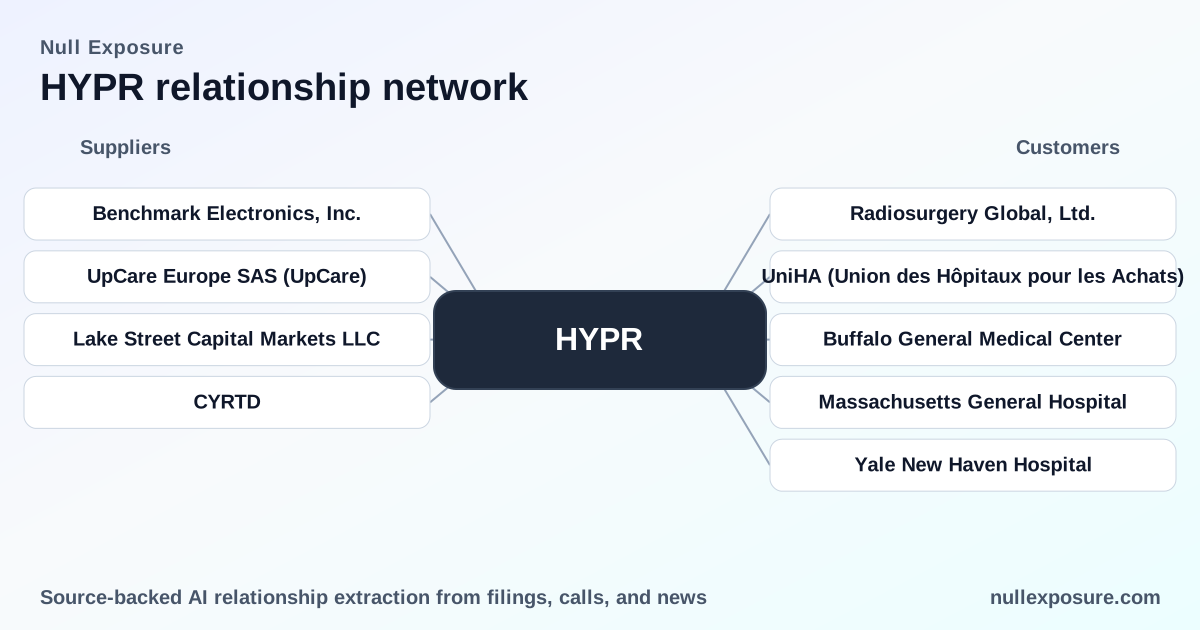
Hyperfine Inc (HYPR) — Supplier relationships that determine production, risk and runway
Hyperfine commercializes the Swoop® point-of-care MRI by selling hardware and supporting services to hospitals and care networks; the company monetizes primarily through device sales and related support, with revenues concentrated in a low-double-digit million run-rate and gross margins dependent on outsourced manufacturing. The company’s operating model is defined by a single, dominant contract manufacturer, a handful of critical component suppliers in Europe, and recurring vendor relationships that shape cost, regulatory exposure and manufacturing continuity. For detailed supplier intelligence and to map concentration risk into procurement strategies, visit https://nullexposure.com/.
Why supplier relationships matter to an investor evaluating HYPR
Hyperfine’s value proposition—portable MRI at the bedside—requires consistent, regulated manufacturing and a tight supply chain for specialized components (notably the magnet). The company’s ability to scale revenue beyond modest TTM sales hinges on stable production volumes, component cost control, and uninterrupted regulatory compliance across the U.S., EMEA and APAC. Supplier counterparty risk is therefore a principal operational and valuation lever.
- Single-source manufacturing: Benchmark Electronics is the company’s primary contract manufacturer; production, testing, shipping and warranty fulfillment route through that relationship.
- Component concentration: A European single-source magnet supplier drives cost and geopolitical exposure.
- License and IP structure: Hyperfine licenses its manufacturing technology to its contract manufacturer under the Master Services Agreement.
If you want a concise supplier risk brief for portfolio due diligence, see https://nullexposure.com/.
The relationships that matter — what the records show
Below I enumerate every relationship surfaced in the available records and provide a succinct investor-facing takeaway.
Benchmark Electronics, Inc. — contract manufacturer and critical production partner
Hyperfine relies on a single contract manufacturer, Benchmark, to test, assemble, ship and support each Swoop device, and the parties operate under a long-form Manufacture and Supply Agreement (MSA) with automatic renewals after an initial three-year term. This is the company’s most material supplier dependency: production continuity, quality compliance and magnet procurement are routed through Benchmark. According to Hyperfine’s FY2024 Form 10‑K (filed for the year ended December 31, 2024), all Swoop systems are manufactured, tested and supported by Benchmark from its Nashua, NH facility. (Source: Hyperfine FY2024 Form 10‑K, Dec 31, 2024.)
Benchmark (duplicate listing / CYRTD inferred) — confirmation of single-source reliance
The filings reiterate the single-manufacturer posture and the operational consequences: inventories, finished goods and production overhead are driven by Benchmark’s deliveries. Operational metrics such as inventory on hand and manufacturing overhead are directly tied to Benchmark’s performance. (Source: Hyperfine FY2024 Form 10‑K, Dec 31, 2024.)
UpCare Europe SAS (UpCare) — European distribution and market access partner
UpCare is Hyperfine’s distribution partner in Europe and has secured national referencing in France through UniHA for the Swoop system, which materially improves the device’s procurement visibility within France’s public hospital purchasing cooperative. This relationship increases commercial reach in a large, price-sensitive public healthcare market and supports EMEA adoption of the device. (Source: MarketScreener / news report referencing UniHA national referencing, March 2026.)
Lake Street Capital Markets LLC — underwriting partner for equity financing
Lake Street acted as underwriter on a public offering, with a 30-day option to purchase additional shares at the offering price; the securities activity is relevant because it indicates the financing channels Hyperfine has recently used to shore up cash and continue operations. Underwriting relationships affect liquidity and the company’s ability to raise capital without diluting strategic suppliers or altering procurement cadence. (Source: Hartford Business / offering report, March 2026.)
What the constraints signal about Hyperfine’s operating model
The disclosures produce a consistent picture: a concentrated manufacturing and component footprint, mixed contract tenors, and material dependency that is rated critical.
- Contract tenure: A long-term Master Services Agreement exists with automatic two-year renewals after the initial three-year term, reducing immediate renegotiation risk for manufacturing but locking in dependence on the incumbent until proper notice windows are observed. This contract framing supports production continuity but limits near-term supplier diversification if needed. (Company-level signal; MSA text in FY2024 10‑K.)
- Short commitments: A majority of open purchase obligations are due within a year, indicating near-term cash and working-capital exposure to suppliers and component lead times. (Company-level signal from FY2024 10‑K.)
- Licensing posture: Hyperfine granted Benchmark a non-exclusive, royalty-free, non-transferable license to use its technology to manufacture products, embedding IP-sharing into the manufacturing arrangement and increasing operational coupling. (This constraint explicitly names Benchmark.)
- Materiality and criticality: Several disclosures classify supplier relationships as material and, in several contexts, critical, with the magnet supplier (single source in Europe) explicitly called out as a concentration and cost driver. A loss of key suppliers would have a material adverse effect on sales and operations. (Company-level signal and explicit references to the magnet supplier.)
- Geography and regulatory complexity: Manufacturing and key components are concentrated in North America and Europe, with EMEA regulatory regimes (MDR, CE marking) and geopolitical events (Ukraine, Middle East) cited as specific supply and cost risks. (Company-level signal.)
- Spend scale: Reported payments to suppliers under the MSA and related services are in the low hundreds of thousands per year, consistent with a manufacturing spend band that is material on a small revenue base but modest in absolute dollars. (Company-level signal; reported payments in FY2023–FY2024.)
Investment implications — what investors and operators should prioritize
- Concentration is the dominant risk factor. Benchmark’s role and the European single-source magnet supplier mean that production outages, quality failures, or geopolitical disruption translate directly to revenue and margin volatility.
- Contract structure gives some runway for continuity but raises switching costs. The automatic renewal language reduces immediate termination risk but would make rapid manufacturer replacement costly and time consuming.
- Commercial expansion hinges on distribution partnerships. UpCare’s UniHA referencing unlocks French public procurement channels that can materially accelerate adoption in EMEA if manufacturing capacity scales in tandem.
- Capital strategy and supplier payments are linked. Recent equity transactions and underwriting activity inform how Hyperfine will fund inventory buildup or alternative supplier sourcing; underwriting partners therefore matter to procurement strategy and should be monitored.
If you need supplier concentration mapped to scenario-based valuation impacts or a procurement playbook to de-risk manufacturer dependence, start here: https://nullexposure.com/.
Bottom line and recommended next steps for investors
Hyperfine is a capital-constrained hardware company whose path to scale is bounded by supplier concentration and regulatory dependence. The company’s contracts and disclosures show that operations are stable while the MSA is active, but the cost and continuity risk around the magnet and single-manufacturer model are top-line threats that require active mitigation.
Recommended immediate diligence:
- Obtain the current MSA schedule, termination notice status and any documented capacity commitments from Benchmark.
- Validate magnet supplier contracts and explore time-to-source alternatives.
- Quantify the incremental contribution that UpCare’s UniHA referencing could deliver if manufacturing is scaled.
For an executive summary tailored to board-level or investment committee review, and a supplier-risk scorecard that converts these disclosures into action items, visit https://nullexposure.com/ and request the Hyperfine supplier brief.