MarineMax (HZO) — Supplier Relationships and Strategic Implications
MarineMax operates as the largest recreational boat and yacht retailer in the United States, monetizing through new-boat sales, parts and service, marina operations, yacht charters, and a growing portfolio of acquisitions that expand distribution and services. Revenue is driven by manufacturer relationships that supply new inventory and engines, while financing (the Floor Plan) and long-term leases fund working capital and physical presence. For investors and operator partners, supplier concentration, contract structure, and engine availability are the primary commercial levers that determine margin volatility and operational resilience.
Discover more supplier intelligence at https://nullexposure.com/ — actionable signals for procurement and investor due diligence.
How to read MarineMax’s supplier map: what matters for investors
MarineMax runs a hybrid contracting posture: a broad base of annually renewable, non‑exclusive dealer agreements for many brands, combined with multi‑year exclusives for marquee product lines. That mix produces flexibility in inventory sourcing but concentrated exposure where exclusivity or engine supply is centralized. The company finances inventory through a large Floor Plan facility (up to $950m), meaning supplier cadence directly impacts working capital and leverage.
- Contracting posture: short-term renewable dealer agreements across most brands, with explicit long‑term dealer agreements for Brunswick (Sea Ray, Boston Whaler) and Azimut‑Benetti Group. This creates operational optionality but also governance friction with manufacturers that control allocation and retail approvals.
- Concentration: Brunswick-related brands and outboard engines (Mercury Marine) represent a material share of revenue (Brunswick boats ~18% of 2025 sales), creating supplier concentration risk.
- Criticality: engine supply and select component sole-sourcing are critical to operations; engine shortages or regulatory changes (EPA) can have outsized financial impact.
- Maturity and scale: relationships range from short-term dealer agreements to long-term marina and real‑estate leases (many with multi‑decade terms), and strategic acquisitions (e.g., Williams Tenders USA) accelerate vertical integration.
Read deeper supplier profiles and signals at https://nullexposure.com/ for procurement and M&A teams.
The supplier roster, relationship by relationship
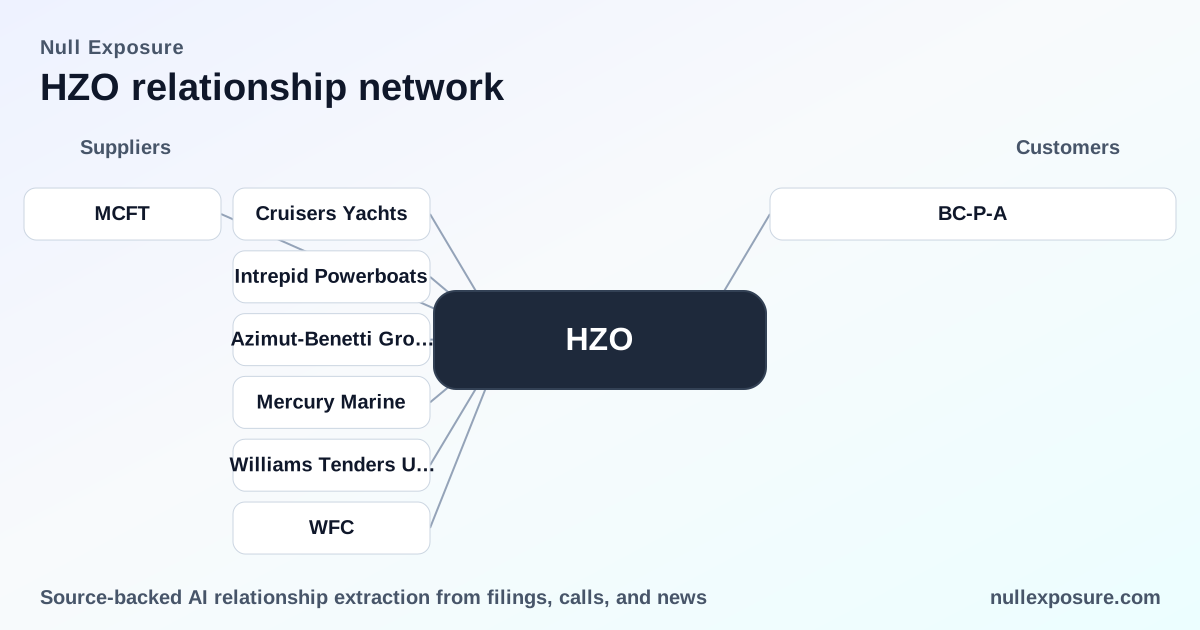
Below are the named counterparties the company discloses as suppliers, with plain-English summaries and source notes.
Cruisers Yachts
Cruisers Yachts supplies boats that MarineMax retails through select dealership locations and independent dealers, integrating Cruisers product lines into MarineMax’s retail network. According to MarineMax’s FY2025 Form 10‑K, Cruisers products (including Aviara) are recognized through MarineMax’s dealership channels (FY2025 10‑K filing).
Intrepid Powerboats
Intrepid Powerboats is another boat manufacturer whose products MarineMax sells through its retail dealerships and independent dealer partners, contributing to the company’s new‑boat inventory mix. This is documented in the FY2025 Form 10‑K discussion of manufacturer relationships (FY2025 10‑K filing).
Azimut‑Benetti Group
MarineMax is the exclusive U.S. dealer for Azimut’s Azimut yachts and Benetti mega‑yacht lines, a multi‑year relationship that provides geographic exclusivity and access to the luxury yacht segment; MarineMax flags this relationship as material to its success. The FY2025 10‑K states the multi‑year Azimut dealer agreement and notes Azimut’s importance to product mix and reputation (FY2025 10‑K filing).
Mercury Marine
A critical supplier: the majority of MarineMax’s outboard engines are manufactured by Mercury Marine, making engine availability and pricing central to MarineMax’s product delivery and margins. The FY2025 10‑K explicitly identifies Mercury as the primary source of outboard marine engines (FY2025 10‑K filing).
Williams Tenders USA
MarineMax acquired Williams Tenders USA in March 2024, giving the company a distribution and retail foothold for Williams Jet Tenders (rigid inflatable tenders) aimed at the luxury yacht market; the acquisition supports MarineMax’s vertical integration strategy. This acquisition is disclosed in the FY2025 10‑K (March 2024 acquisition note in FY2025 10‑K).
Wells Fargo
In a capital markets advisory capacity, MarineMax engaged Wells Fargo after receiving an unsolicited buyout approach in early 2026, reflecting the company’s use of major financial institutions for strategic transactions. Media coverage summarized on StockTwits cites Reuters reporting that MarineMax hired Wells Fargo after an offer from Donerail (March 2026 news coverage).
MasterCraft (Aviara brand reference)
MasterCraft’s Aviara brand rights were assumed by MarineMax’s Cruisers Yachts subsidiary in October 2024, adding a luxury dayboat line to the company’s offerings and demonstrating MarineMax’s strategy of brand acquisitions and integration. The FY2025 10‑K records the Aviara brand transfer and related manufacturing standards noted by MasterCraft (FY2025 10‑K filing).
What these relationships imply for commercial and credit risk
- Supplier control over distribution: Multi‑year dealer agreements with Brunswick (Sea Ray, Boston Whaler) and Azimut grant manufacturers approval rights over store openings and dealer consolidation, constraining MarineMax’s ability to reconfigure its retail footprint without vendor consent (FY2025 10‑K).
- Engine concentration is a single point of failure: Engine shortages or regulatory-driven cost increases at engine manufacturers (notably Mercury) are flagged as critical and materially relevant to margins (FY2025 10‑K).
- Short‑term vs long‑term contracts: The prevalence of annually renewable dealer agreements provides flexibility but increases revenue volatility tied to reorder cadence; simultaneously, long‑term marina leases and financing facilities increase fixed obligations and lock in cost structure for years (FY2025 10‑K).
- Working capital sensitivity: Large floor‑plan borrowings (~$715.7m outstanding in FY2025) tie MarineMax’s liquidity to timely inventory turnover and manufacturer allocations; disruption in supply or dealer incentives (interest assistance) can compress margins and strain covenant headroom (FY2025 10‑K).
Practical takeaways for investors and operators
- Monitor engine supply and manufacturer incentives (interest assistance and co‑op programs) as leading indicators of margin pressure.
- Track exclusivity clauses with Brunswick and Azimut when assessing expansion or acquisition plans — vendor consent provisions can delay integration.
- Stress-test liquidity for Floor Plan volatility: inventory financing is large and sensitive to sales cadence and allocation from manufacturers.
If your firm evaluates supplier relationships or is considering vendor risk for M&A or procurement, get tailored signals and relational detail at https://nullexposure.com/.
Final verdict and action items
MarineMax’s supplier architecture is a balance of scale and concentration: a diversified retail footprint and acquisition pathway, but with material exposure to a handful of manufacturers—especially engine suppliers and premium yacht makers. That combination drives attractive market access but requires active management of manufacturer covenants, financing capacity, and regulatory risk.
For procurement teams, legal counsel, and investors performing counterparty due diligence, explore MarineMax’s supplier signals and contract posture in depth at https://nullexposure.com/ — the next step for actionable supplier intelligence and competitive benchmarking.