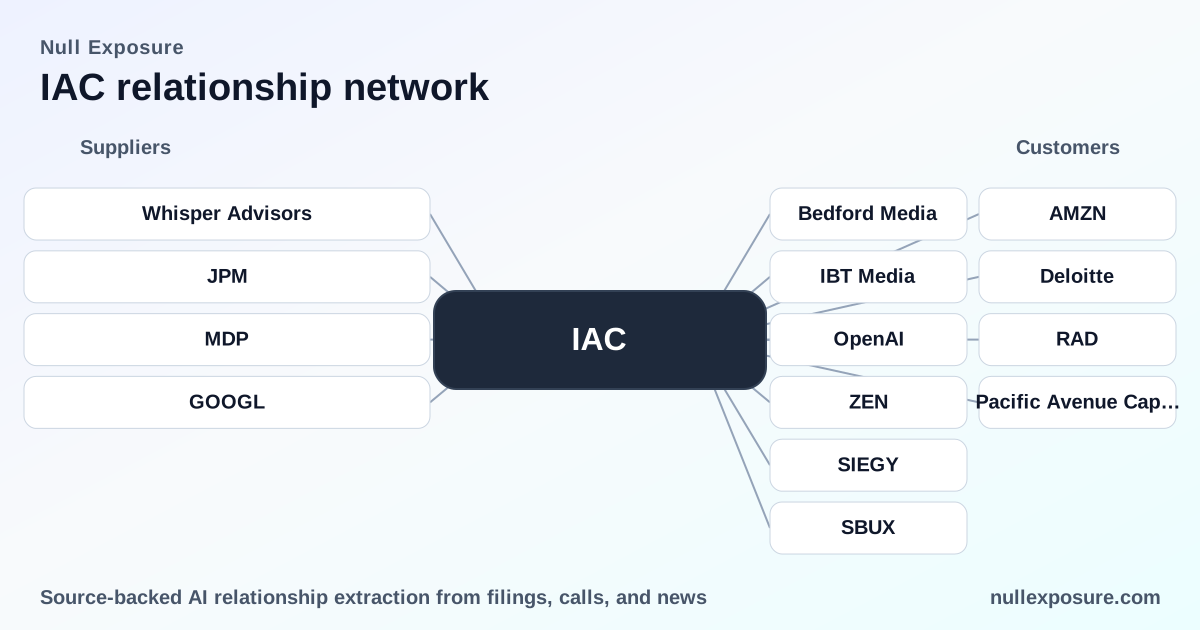
IAC Inc. — supplier relationships that shape profitability and risk
IAC (NASDAQ: IAC) is a diversified internet and media holding company that monetizes through advertising, subscription and lead-generation businesses, and platform fees, with material cash flow generated by search-driven traffic and Dotdash Meredith’s content properties. The company operates as a platform operator and aggregator: it invests in consumer-facing verticals, buys and finances businesses, and extracts margins through advertising, subscription upsells, and traffic monetization agreements. For investors and operators evaluating supplier exposure, the critical levers are traffic partnerships, large-scale financing arrangements, print/distribution dependencies, and concentrated vendor relationships. Learn more or run a deeper counterparty review at https://nullexposure.com/.
Quick read: what the supplier map reveals
IAC’s supplier network is a mix of high-dollar, strategic counterparties and numerous operational vendors. Google, major banks, legacy magazine counterparties, and boutique advisors surface repeatedly in filings and press — each relationship carries different contractual horizons, concentration risk and operational criticality.
- Concentration and criticality are real: search traffic and a handful of distribution partners materially affect revenue generation.
- Contracting mix is mixed-term: short-term cash instruments and app store fees coexist with multi-year term loans and long-dated lease liabilities.
- Spend profile is lumpy: there are numerous nine-figure credit facilities and advertising budgets alongside mid-to-large operational contracts.
If you want a full supplier risk briefing, visit https://nullexposure.com/ for tailored reports.
The relationship roster — what each partner contributes
Whisper Advisors (FY2024)
Whisper Advisors acted as IAC’s boutique advisor in a deal involving Ben Sherwood and Joanna Coles, representing IAC in the transaction execution. This is a deal advisory role supporting M&A activity rather than an operational supplier engagement (Variety, 2024). Source: https://variety.com/2024/digital/news/daily-beast-ben-sherwood-joanna-coles-iac-1235971445/
J.P. Morgan (FY2021)
IAC financed an all-cash acquisition through J.P. Morgan, which served as the financing bank for the Meredith transaction; this reflects conventional external financing and syndication of credit for strategic M&A activity (Des Moines Register, October 2021). Source: https://www.desmoinesregister.com/story/money/business/2021/10/06/des-moines-iowa-meredith-corporation-bought-barry-dillers-iac-interactive-corp-dotdash/6027634001/
Meredith — acquisition headlines (FY2022)
In October (FY2022 reporting context), Meredith unveiled a $2.7 billion sale of its magazine business to Dotdash, the digital publisher owned by IAC, representing the core content consolidation that underpins Dotdash Meredith’s scale and print/digital distribution economics (InPublishing, 2022). Source: https://www.inpublishing.co.uk/articles/and-then-there-were-two-20642
Meredith — acquisition talk (FY2021)
Earlier reporting flagged IAC in advanced talks to acquire Meredith, framing the strategic rationale for IAC’s expansion into legacy magazine brands and subscription revenue streams; these negotiations presaged the formal financing and integration activity described in later filings (New York Post, September 2021). Source: https://nypost.com/2021/09/24/barry-dillers-iac-in-talks-to-buy-people-magazine-publisher-meredith/
Google (FY2025 context)
Google supplies the majority of paid listings and search traffic through a named Services Agreement; IAC receives a revenue share for making search traffic available and faces material traffic and policy risk from Google’s unilateral changes to search and ad policy. The Services Agreement has been amended repeatedly and was extended into 2026, underscoring both dependence and formal contractual governance (SimplyWall and IAC filings, 2023–2025). Source: https://simplywall.st/stocks/us/media/nasdaq-iac/iac/news/did-vivian-healths-ai-launch-just-shift-iacs-iac-digital-inn and related IAC filings (Services Agreement exhibits and amendments).
How constraints shape the supplier strategy (what operators must monitor)
IAC’s filings and excerpts deliver a clear set of operating model characteristics investors and counterparties should treat as structural:
- Contracting posture — mixed-term: The company runs short-term cash equivalents and app-store/subscription contracts alongside multi-year credit facilities and long-dated lease liabilities. This creates liquidity flexibility but also multi-horizon refinancing and covenant management needs.
- Concentration — high in critical channels: IAC relies heavily on Google for search traffic and on a single magazine printer plus two wholesalers for print distribution, which introduces single-point failure risk for both digital traffic and legacy print economics.
- Criticality — differentiated by counterparty: Some suppliers are critical (search engine partners, print distributors, postal services) while many vendors are operational and replaceable; filings note a small number of suppliers that are sole providers for specific functions.
- Maturity profile — significant long-term obligations: Dotdash Meredith term loans mature into the late 2020s, and interest rate swaps and lease schedules stretch across multiple years; credit profile and hedging behavior therefore matter materially to counterparty stability.
- Spend concentration — large-scale and mid-scale: IAC’s cash commitments include nine-figure debt facilities and advertising budgets as well as multiple mid‑to‑upper‑seven-figure operational contracts; procurement and working capital are consequently material drivers of P&L volatility.
- Counterparty mix — government, individuals, very large enterprises: The company deals with governmental distributors (USPS), individual professionals and caregivers (Angi/Care.com supply-side), and very large internet platforms (Google, Apple), each bringing different compliance, regulatory and dependency profiles.
- Contract formality and renewal mechanics: Several agreements (notably the Google Services Agreement) are governed by amendment and automatic renewal mechanics, creating renewal risk that requires active management.
These constraints are company-level signals derived from public filings; they explain why IAC’s supplier risk profile combines platform dependency with large credit commitments.
Investment implications and operational actions
- Revenue exposure is concentrated around search: Any strategic or policy move by Google will compress traffic and ad revenue; hedge operating assumptions and model sensitivity to reduced search volumes. (High priority for diligence.)
- Debt and covenant management are strategic levers: Dotdash Meredith term loans and swaps create refinancing and interest-rate sensitivity; monitor maturities through 2026–2028. (Balance-sheet focus for credit investors.)
- Print and distribution remain operational risks: Even as digital grows, print supply and USPS distribution are material to specific lines, and single-supplier dynamics persist. (Operational contingency planning recommended.)
Mid-deal or portfolio diligence? Start with a tailored supplier risk brief at https://nullexposure.com/ to model counterparty impact across scenarios.
Bottom line
IAC operates a hybrid digital/media platform whose profitability is shaped by a small set of high-leverage supplier relationships (notably Google and Meredith-related counterparties) and by significant financing arrangements that extend into the late 2020s. For investors and operators, the priorities are monitoring traffic dependence, refinancing risk, and supplier concentration in physical distribution. For a focused counterparty assessment or monitoring program, visit https://nullexposure.com/ to request a customized report.