IACVV supplier relationships: what investors and operators should price in now
IAC Inc. is a New York–based media and internet holding company that monetizes through its portfolio of online properties via paid listings, advertising, subscription and marketplace fees, and periodic corporate divestitures. Recent activity—most notably the announced sale of Care.com and renegotiations with Google over paid listings for AMG—makes supplier and advisor relationships immediate drivers of near-term cash flow and strategic optionality. Investors should treat advisory and platform contracts as active value levers, not neutral background relationships.
Learn more about supplier intelligence at https://nullexposure.com/.
Transactional advisers are executing portfolio reshaping — why that matters
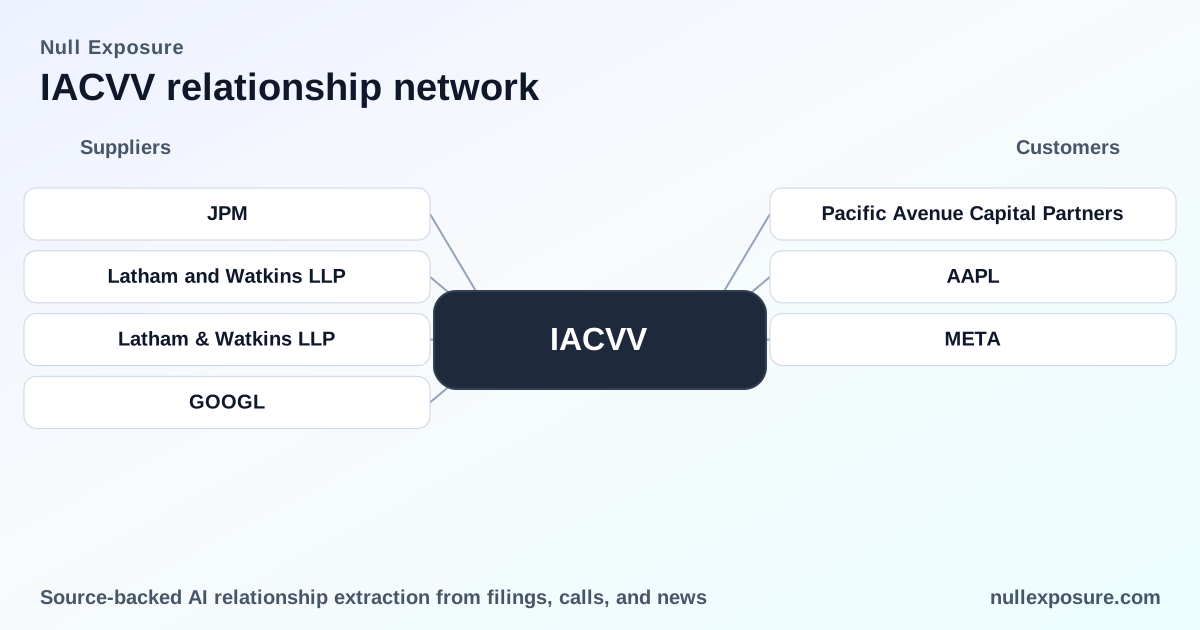
IAC has placed a visible, high-cost advisory footprint around strategic disposals. J.P. Morgan Securities LLC is acting as exclusive financial advisor to IAC on the Care.com sale, signaling a controlled, sale-driven capital allocation process that prioritizes execution certainty. This role was reported in a Reuters summary carried on TradingView in March 2026 and reiterated by transaction coverage at Pulse2 in the same period.
Concurrently, Latham & Watkins LLP is providing legal counsel for the transaction, which underlines IAC’s reliance on top-tier external counsel for complex M&A work and regulatory review. Latham’s own announcement described the deal team supporting the sale in March 2026.
These advisories indicate an institutional contracting posture: IAC hires marquee advisers for high-stakes exits, which increases execution credibility but also raises advisory cost and process lead times.
Google negotiations create a revenue risk vector
A separate supplier relationship is operational and recurrent: Google supplies paid listings to IAC’s AMG business, and IAC is negotiating revised terms for a Services Agreement that expires on March 31, 2026. The company disclosed this in its recent 8‑K and discussed the negotiations in its quarter-end commentary; an earnings call transcript published in March 2026 highlights that the outcome will determine the future of that business line. Analyst discussion from Barclay’s and coverage in industry outlets stressed the company’s push to reduce reliance on Google-sourced traffic and transaction flow.
This is not merely a pricing negotiation—this is a concentration and criticality issue for revenue continuity in AMG if third‑party platform economics change.
Supplier relationship ledger — each named counterparty and what they mean
- J.P. Morgan Securities LLC — J.P. Morgan is the exclusive financial advisor to IAC on the announced sale of Care.com, a role that places the investment bank at the center of valuation, process management, and deal negotiations. This engagement was reported by Reuters via TradingView and echoed in Pulse2’s March 2026 coverage.
- Latham & Watkins LLP — Latham & Watkins serves as legal counsel to IAC on the Care.com transaction; the firm published a client advisory naming its deal team and role in the March 2026 sale process.
- Google (Alphabet Inc.) — Google supplies paid listings to IAC’s AMG business and is the counterparty in a Services Agreement set to expire March 31, 2026; IAC disclosed ongoing negotiations that will affect future revenue streams and distribution economics, as discussed in recent 8‑K commentary and the company’s Q4 2025 earnings call transcript.
Each of these relationships is documented in public reporting and press coverage from March 2026, and together they capture both the transactional and operational supplier exposures that will influence cash flow and margins in the next two quarters.
Operating model signals and commercial constraints investors should price
No explicit constraint documents were provided in the supplier results, but the pattern of relationships produces clear company-level signals about IAC’s operating model:
- Contracting posture: IAC engages top-tier advisers and global law firms for disposals, indicating a preference for conservative execution and reputational capital in sale processes. That increases probability of deal completion but elevates upfront advisory spend.
- Concentration risk: AMG’s paid-listing dependence on Google is a material concentration, with the Services Agreement renegotiation acting as a possible single-point vulnerability for near-term digital revenue.
- Criticality and leverage: The Google relationship is operationally critical to specific revenue streams; the Care.com sale demonstrates IAC’s ability to monetize non-core assets to reallocate capital.
- Maturity of supplier relationships: Use of legacy platform partners (Google) with periodic contract renewal cycles contrasts with ad-hoc M&A advisory engagements—one is ongoing and revenue-driving, the others are episodic and value-realizing.
Together, these signals imply a hybrid model: operational dependence on platform suppliers for recurring revenue, and active portfolio management via high-cost, high-certainty external advisers to reshape business mix.
https://nullexposure.com/ has deeper records and tracking on these counterparty dynamics for investors who need to model downside scenarios.
What this means for risk-adjusted valuation and procurement strategy
For investors, the takeaway is twofold. First, value recognition from disposals is immediate and explicit—careful monitoring of advisor announcements and deal close timelines is necessary because advisory relationships (J.P. Morgan, Latham & Watkins) are direct signals of executable liquidity events. Second, platform negotiations like the Google Services Agreement are a recurring earnings risk that should be stress-tested in forecasts: model scenarios where listing economics shift unfavorably and where AMG needs to accelerate alternate distribution channels.
For operators and procurement teams, the practical implications are clear:
- Price and contract terms with Google (or similar platforms) need to be treated as strategic negotiations, not routine renewals.
- Maintain documented fallbacks and alternate distribution investments to lower single-supplier exposure.
- During disposals, expect aggressive use of boutique and bulge‑bracket advisers to maximize sale proceeds, which will influence deal timelines and cash realization.
Bottom line and next steps
IAC’s near-term value trajectory is being shaped by two types of supplier relationships: transactional advisers that convert assets into liquidity, and platform partners that underpin recurring revenues. Investors should allocate attention and scenario analysis accordingly—model deal outcomes and platform contract renewals separately and prioritize real-time monitoring of adviser disclosures and company filings.
If you want continuous supplier tracking and alerts that map advisory roles and platform contract timelines to valuation scenarios, visit https://nullexposure.com/ to subscribe and set up tailored intelligence.