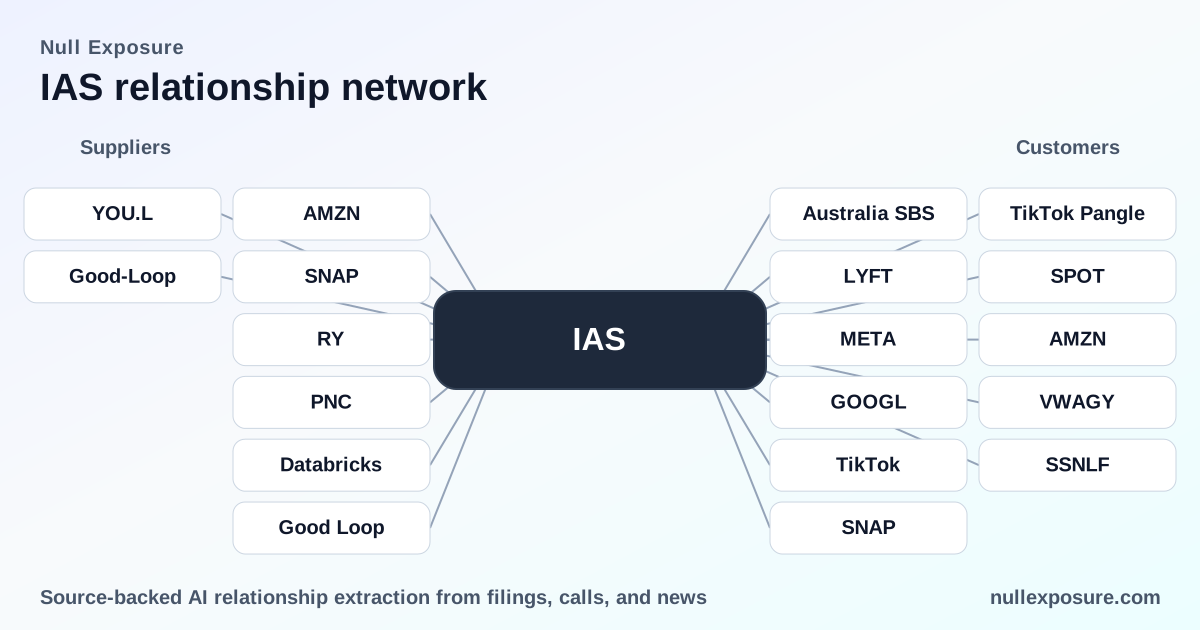
IAS supplier relationships: who Integral Ad Science partners with and what it means for investors
Integral Ad Science (IAS) operates as a measurement and verification provider for digital advertising, monetizing through enterprise contracts with advertisers, agencies and platform partners that pay for measurement, attention and quality signals, plus higher-margin products built on analytics and agentic tooling. Revenue derives from platform integrations, SaaS-like product licensing and bespoke measurement services delivered to DSPs, social platforms and large media brands — a model that ties growth to the distribution and adoption of IAS signals inside major buy-side and sell-side systems. For deeper operational and supplier risk mapping, see Null Exposure for continued monitoring: https://nullexposure.com/
The investment thesis in one line
IAS sells indispensable quality signals into the ad stack; its commercial success depends on distribution inside the big DSPs and strategic integrations with cloud and research partners, while corporate funding and bank facilities shape balance-sheet flexibility and M&A optionality.
Why partnerships and supplier contracts matter for valuation
IAS is neither a pure software vendor nor a media owner; it is a measurement infrastructure provider whose unit economics and pricing power are a function of (1) how many major platforms embed its signals, (2) how sticky enterprise contracts are, and (3) the financial cushion provided by its credit structure. These inputs drive renewal rates, cross-sell opportunities (for new products such as IAS Agent) and downside protection during ad-market slowdowns.
- Platform distribution is the single most important commercial lever. Integration inside DSPs and social platforms converts measurement into recurring revenue.
- Cloud and analytics partnerships accelerate product development while providing enterprise-grade governance and observability that large customers require.
- Banking and credit relationships define strategic optionality — the ability to refinance, execute acquisitions, or invest in product R&D.
Explore supplier-level exposure and monitoring at Null Exposure: https://nullexposure.com/
Partner map: every relationship in the provided results
Amazon DSP
IAS reported that its Quick Score Product (QSP) is available across major DSPs and noted launch on Amazon DSP late in the prior year, underscoring distribution on one of the largest programmatic marketplaces. According to IAS’s 2025 Q2 earnings call (first surfaced March 2026), Amazon DSP is now a functional channel for IAS measurement. (IAS 2025Q2 earnings call, Mar 2026)
Snap
In June, IAS announced a strategic partnership with Snap and Lumen Research to deliver customized attention measurement on Snapchat, positioning IAS inside a social platform where attention metrics are highly valuable to advertisers. This was disclosed on IAS’s 2025 Q2 earnings call. (IAS 2025Q2 earnings call, Mar 2026)
Royal Bank of Canada (RBC)
IAS entered a new credit agreement in connection with its merger, with RBC serving as administrative and collateral agent alongside a syndicate of lenders, giving IAS a refreshed financing structure for corporate needs. TradingView reported on the new credit agreement (reported Mar 2026). (TradingView, Mar 2026)
PNC Bank
Concurrently with the new financing, IAS terminated its 2021 credit agreement led by PNC Bank, releasing related liens and obligations — a signpost that the company restructured its bank relationships as part of its corporate transaction. TradingView covered the facility update (reported Mar 2026). (TradingView, Mar 2026)
Databricks
IAS built its new agentic product capabilities on Databricks Agent Bricks, reflecting a partnership that leverages Databricks’ enterprise tooling for governance and observability while enabling real-time campaign insights. PR Newswire and subsequent coverage in December 2025 highlight this technical-commercial tie-up. (PR Newswire / Sahm Capital, Dec 2025)
Good Loop / Good-Loop
IAS is collaborating with Good-Loop to embed carbon emissions tracking into ad impressions, aligning media quality metrics with sustainability and net-zero commitments — an initiative cited in FY2024–FY2025 press and analyst commentary. Coverage appears across SimplyWall.St and StocksToTrade summarizing the partnership and its ESG framing. (SimplyWall.St / StocksToTrade, FY2024–FY2025)
YouGov
IAS partnered with YouGov on an industry pulse survey of nearly 300 U.S. media experts to surface market perceptions of quality in the AI-dominated media landscape, underpinning IAS’s thought leadership and research-driven sales enablement. This collaboration was reported in an IAS industry report referenced on Finviz (FY2025). (Finviz / IAS Industry Pulse, FY2025)
What these relationships collectively tell investors
- Distribution is broad but platform-dependent. Presence on Amazon DSP and Snap indicates access to significant demand channels; sustaining and expanding those integrations is essential for revenue growth.
- Product sophistication is increasing. The Databricks partnership signals IAS is investing in agentic and real-time tooling, which supports higher-value product tiers and stickier enterprise relationships.
- Corporate financing has been refreshed. The RBC-led credit facility and termination of the PNC-led 2021 agreement demonstrate a deliberate reshuffle of capital partners that improves flexibility after the merger.
- ESG and research tie-ins strengthen demand across client segments. Collaborations with Good Loop and YouGov enhance IAS’s positioning with brand-conscious advertisers and agency buying frameworks.
Operating model signals and company-level constraints
IAS operates through enterprise contracting with platform integrations (a centralized contracting posture with major DSPs and social platforms). Concentration risk is present because meaningful distribution depends on a handful of large platforms; diversification through multiple DSPs and social integrations reduces single-counterparty exposure but does not eliminate platform dependency. Criticality to customers is high: brands and agencies rely on independent measurement to validate spend and optimize campaigns. Maturity signals are mixed but positive — bank-led credit facilities and partnerships with established cloud vendors indicate corporate scale and governance consistent with an enterprise SaaS/info-services firm.
Key risks and monitoring triggers
- Platform concentration risk: loss or de-prioritization by a tier-one DSP would materially affect distribution and pricing leverage. Monitor contract renewals and adoption metrics within DSP partners.
- Financing and covenant exposure: the new RBC-led facility replaces older credit arrangements; track covenant compliance and any amendments that could constrain strategic flexibility.
- Product execution: scaling agentic capabilities requires consistent performance and enterprise governance; failures would slow monetization of higher-value offerings.
If you want supplier-focused monitoring and alerting for IAS and comparable ad-tech names, start tracking those relationships with ongoing signals at Null Exposure: https://nullexposure.com/
Bottom line: where investors should focus
IAS’s revenue growth and margin expansion hinge on distribution inside major DSPs and social platforms, the commercial success of higher-value products built with enterprise cloud partners, and the stability of its financing relationships. For investors, the most actionable inputs are platform integration depth (Amazon DSP, Snap), product adoption (Databricks-enabled agentic tools), and financing runway (RBC facility). Monitor those three vectors for signs of either acceleration or deterioration ahead of quarterly results.
Learn how we map supplier risk and translate it into investable signals at Null Exposure: https://nullexposure.com/