IB Acquisition Corp. (IBAC) — supplier map, commercial posture and investor implications
Thesis: IB Acquisition Corp. operates as a SPAC vehicle that monetizes through its initial public offering proceeds and post-combination economics by sourcing an acquisition target and charging transaction and success fees to service providers; its primary cash flows today are underwriting proceeds, trust-account interest and contractual fees payable on consummation of a business combination. For investors and counterparties, the relevant commercial signals are a short-term, transaction-driven contracting posture, concentrated service-provider relationships (notably investment bankers and counsel), and material but discrete contingent fee liabilities tied to closing events. Explore the supplier footprint and the practical risks for sponsor, counterparty and target selection decisions. For a broader supplier-risk and counterparty-screening framework, visit https://nullexposure.com/.
How IBAC structures and pays for services
IBAC’s economics are conventional for a blank‑check vehicle: it holds IPO proceeds in a trust invested in short-dated U.S. government obligations, pays routine administrative fees, and commits defined success-based payouts to investment banks and other advisers that are triggered on closing. The company has already allocated underwriting discounts and a marketing/M&A fee structure that converts to cash or equity at the time of a business combination. These arrangements produce predictable short-term cash usage but create meaningful contingent claims on the pool of funds intended for a transaction.
- Short-term liquidity focus: the trust is invested in treasuries or qualified money market funds with maturities ≤185 days, which preserves capital and limits duration risk.
- Transaction-driven liability: significant fees are payable only upon consummation of a business combination (e.g., the 3.5% M&A fee to I-Bankers), concentrating counterparty upside on deal completion.
- Operational overhead is modest (small monthly administrative payments), but cumulative transactional and underwriting fees are significant versus a shell company’s operating budget.
If you want to map comparable supplier exposure across SPACs, see our platform at https://nullexposure.com/.
Supplier relationships: who does IBAC contract with and why
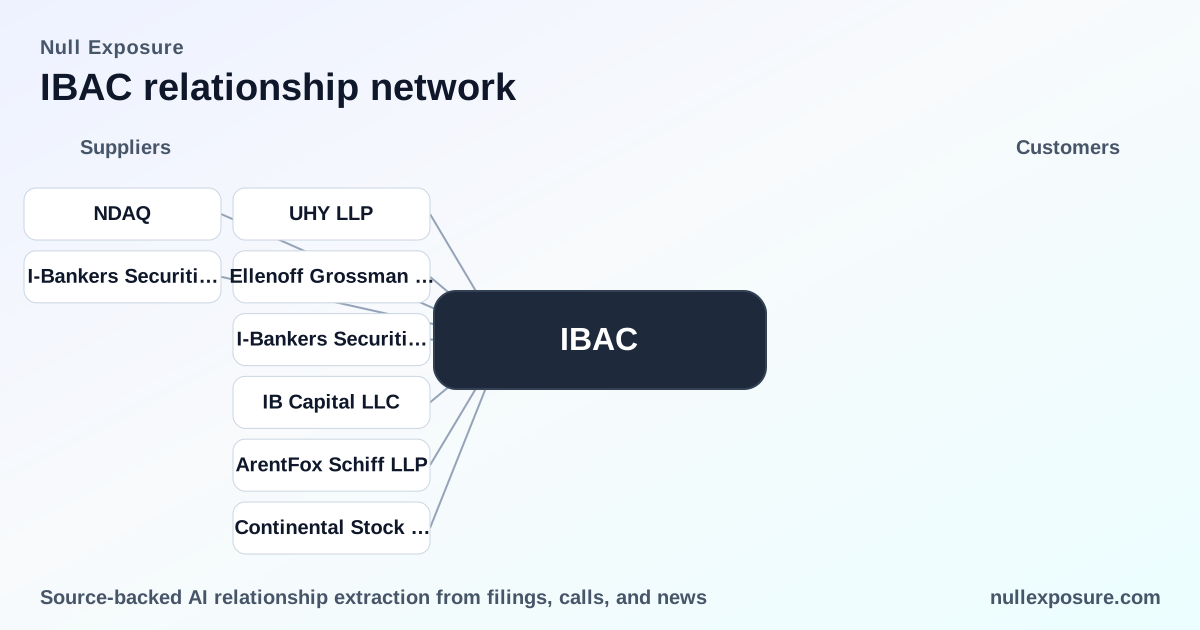
Below are every supplier relationship reported in the public results, with concise, plain‑English descriptions and source references.
UHY LLP
UHY LLP serves as IBAC’s auditor for the fiscal period noted, handling the audit and financial review tasks that support public disclosures. Source: SPACInsider news post on the IPO (FY2024), https://www.spacinsider.com/news/headline-post/ib-acquisition-corp-ibacu-prices-100m-ipo.
Ellenoff Grossman & Schole LLP
Ellenoff Grossman & Schole LLP is identified as the underwriter’s counsel, providing legal advice and documentation to the underwriters in connection with the IPO. Source: SPACInsider news post on the IPO (FY2024), https://www.spacinsider.com/news/headline-post/ib-acquisition-corp-ibacu-prices-100m-ipo.
I‑Bankers Securities, Inc.
I‑Bankers is a joint book‑running manager and the representative underwriter; IBAC has contracted I‑Bankers for underwriting and for a business combination marketing agreement that entitles I‑Bankers to an M&A fee equal to 3.5% of the IPO gross proceeds payable at closing. This makes I‑Bankers a primary, fee‑linked service provider whose compensation is usage‑based and spot in nature. Source: SPACInsider (IPO announcement and filings, FY2024) and business combination marketing agreement referenced in filings, https://www.spacinsider.com/news/headline-post/ib-acquisition-corp-ibacu-prices-100m-ipo.
IB Capital LLC
IB Capital LLC is co‑manager on the offering alongside I‑Bankers, participating in book‑running and underwriting distribution responsibilities and sharing underwriting economics. Source: SPACInsider and RTT News IPO reports (Mar 2024 / FY2024), https://www.spacinsider.com/news/headline-post/ib-acquisition-corp-ibacu-prices-100m-ipo and https://www.rttnews.com/3434655/ib-acquisition-prices-ipo-of-10-mln-units-at-10-00-unit.aspx.
ArentFox Schiff LLP
ArentFox Schiff LLP is acting as issuer’s counsel, advising IBAC on securities, regulatory and transaction documentation required for the IPO and future combination activity. Source: SPACInsider news post (FY2024), https://www.spacinsider.com/news/headline-post/ib-acquisition-corp-ibacu-prices-100m-ipo.
Continental Stock Transfer & Trust Company
Continental Stock Transfer & Trust Company is the trustee and rights agent for the trust account and registered rights, handling the mechanics of the trust, transfers and shareholder records. This role places Continental at the center of trust‑account liquidity management and redemption processing. Source: SPACInsider (IPO/reporting filings, FY2024), https://www.spacinsider.com/news/headline-post/ib-acquisition-corp-ibacu-prices-100m-ipo.
Nasdaq Global Market
Nasdaq Global Market is the listing market where the IBAC units were expected to commence trading (symbol “IBACU”), providing the public market venue and listing oversight. Source: RTT News IPO report (Mar 2024 / FY2024), https://www.rttnews.com/3434655/ib-acquisition-prices-ipo-of-10-mln-units-at-10-00-unit.aspx.
Notes on source coverage: SPACInsider’s IPO coverage (linked above) is the primary origin for counsel, underwriter and trustee listings; RTT News provides parallel reporting on the offering and trading symbol.
Operational constraints and what they imply for counterparties
The public filings and reported excerpts produce clear company-level signals about IBAC’s operating model:
- Contracting posture — short‑term and transaction-centric. The trust is invested in short-maturity government obligations and many supplier fees are pay‑on‑closing, which makes IBAC a short-duration counterparty focused on discrete events, not long-term service retainers.
- Fee structure — concentrated, usage-based exposure. The M&A fee (3.5% of IPO proceeds) and underwriting discounts create significant contingent spend concentrated in a small set of professional service providers; these are material to transaction economics but are not recurring operating expenses.
- Counterparty mix — institutional and individual. The company works with large institutions (auditor, transfer agent, underwriters) and individual contractors/executives with monthly administrative fees; this combination raises standard operational governance considerations around conflicts and indemnities.
- Geography & supply risk — U.S.-centric with global deal-risk exposure. Trust‑account investments and offices are U.S.-based, but IBAC’s potential targets and supply chains can be global, exposing the post‑combination business to geopolitical and cross‑border operational risk.
- Materiality posture — both critical and material exposures. Trust-account shortfall or inability to raise incremental funding is critical (could force liquidation); transactional costs and insurance/capacity constraints are material and affect deal feasibility and valuation.
Where a constraint explicitly names a relationship it is informative: the filings explicitly commit an M&A fee to I‑Bankers and a trustee role to Continental Stock Transfer & Trust Company; likewise, the monthly administrative payment to the named CFO is a short-term subscription-like obligation. Those are direct, contract-level obligations.
Mid-article resource: if you want a concise supplier exposure dashboard for comparable SPACs, see https://nullexposure.com/.
Investor implications and recommended actions
- Monitor contingent-fee concentration. The success-fee structure channels material value to a small set of banks and advisers; investors should adjust deal return expectations accordingly.
- Treat the trust account as the principal source of execution risk. Any litigation or unexpected claims against the trust materially impair ability to consummate a deal—this is a primary counterparty risk vector.
- Validate independence and indemnities. Given overlap between underwriters, finders and sponsor-affiliated parties, confirm independent fairness opinions and enforceable waivers where critical.
Final steps: for ongoing supplier surveillance and counterparty risk scoring for SPACs and shell companies, explore our tools and reports at https://nullexposure.com/.
Closing takeaway: IBAC’s supplier footprint is lean, transaction-focused and concentrated, which simplifies counterparty management but creates single-event execution risk tied to underwriting and M&A fee obligations. Investors and operators must price that concentrated, closing‑dependent spend into valuation and diligence.