Innovation Beverage Group (IBG): Supplier relationships that shape an early-stage capital story
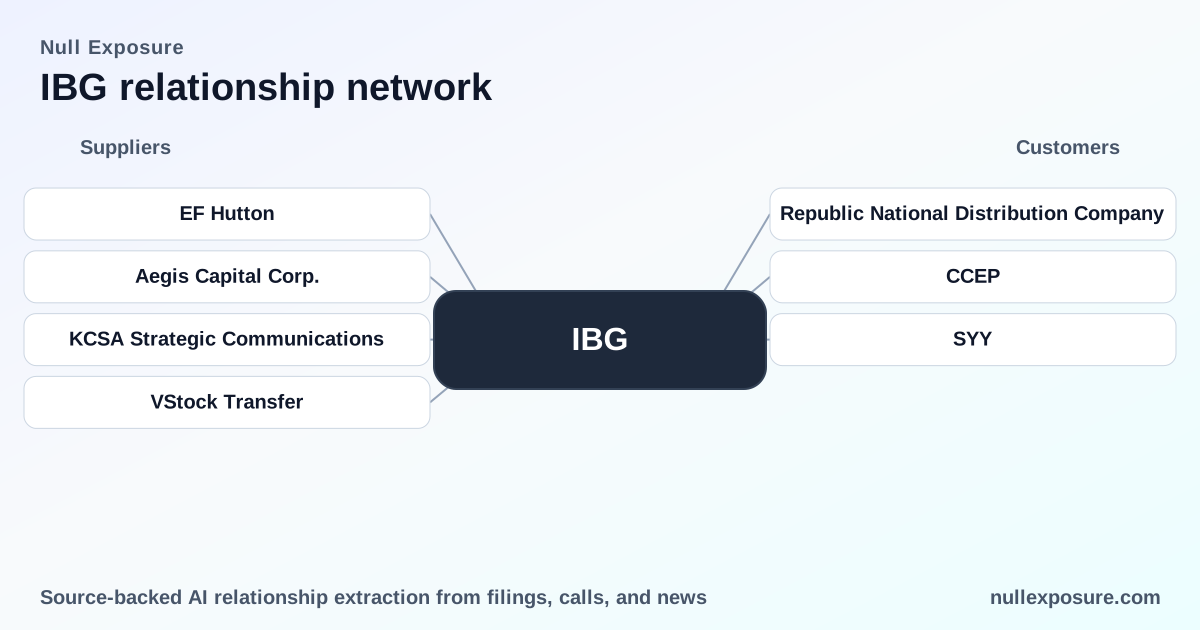
Innovation Beverage Group monetizes by developing and distributing a portfolio of health-oriented and alcoholic beverages while supplementing cash flow and strategic flexibility through capital markets activity. The company sells products across functional, alcoholic and traditional soft-drink categories and routinely uses third-party capital-market and investor‑relations suppliers to support liquidity, corporate communications, and shareholder services — a mix that directly influences its financing runway and public-market perception. For an investor evaluating supplier risk, IBG’s supplier footprint is small but strategically concentrated around capital markets functions and investor communications, which amplifies the operational impact of each relationship. Learn more on the firm’s supplier profiles at https://nullexposure.com/.
What IBG does and why suppliers matter to value
IBG is an early-stage public company listed on Nasdaq with negative profitability, modest revenue, and a sub‑million market capitalization as of the latest filings. Revenue generation is product-driven, but survival and growth depend as much on access to equity capital and effective investor communications as on distribution execution. Suppliers that facilitate capital raises, at‑the‑market liquidity and shareholder administration therefore operate as de facto extensions of the company’s financing engine rather than peripheral vendors.
View a concise supplier intelligence overview at https://nullexposure.com/.
Supplier relationships every investor needs to know
Below I cover every supplier relationship surfaced in public reporting and press notices. Each entry includes a plain-English summary and a source reference.
-
EF Hutton — EF Hutton acted as the sole bookrunner on IBG’s US IPO process; this positions EF Hutton as the primary underwriter for that capital-markets transaction and places execution responsibility squarely with the bank. According to Renaissance Capital’s IPO coverage (FY2022), EF Hutton was listed as sole bookrunner. (Renaissance Capital, FY2022 — https://www.renaissancecapital.com/IPO-Center/News/94287/Australia-based-Innovation-Beverage-Group-files-for-a-$20-million-US-IPO-of)
-
Aegis Capital Corp. — IBG entered into an at‑the‑market (ATM) sales agreement with Aegis on January 14, 2026, enabling up to $2.5 million of incremental equity issuance under an effective Form F‑3 shelf; Aegis earns a 3% commission on gross proceeds and the program increases financing flexibility while introducing dilution as shares are sold. This arrangement was disclosed in the company’s press release reporting the ATM agreement (FY2026). (The Globe and Mail press release / company filing, January 2026 — https://www.theglobeandmail.com/investing/markets/stocks/IBG-Q/pressreleases/37161955/innovation-beverage-group-sets-up-2-5-million-at-the-market-equity-program/)
-
KCSA Strategic Communications — KCSA is listed as the investor relations contact in the company’s announcement regarding a merger and operational updates tied to Blockfuel Energy, signaling that IBG outsources formal investor communications and media handling to an external IR firm. The mention of KCSA as IR counsel appears in the company’s FY2026 press release. (GlobeNewswire via The Manila Times coverage, February 2026 — https://www.manilatimes.net/2026/02/11/tmt-newswire/globenewswire/innovation-beverage-group-provides-update-on-merger-with-blockfuel-energy-and-production-restart-to-advance-dual-revenue-model-spanning-energy-and-digital-asset-mining/2276192)
-
VStock Transfer — VStock Transfer functions as IBG’s transfer agent and handled communications around a five‑for‑one reverse stock split effective January 30, 2026; the transfer agent is the on‑the‑ground administrator for shareholder records and split logistics. Investor notices directed stockholders to VStock Transfer in the reverse-split announcement (FY2026). (Quiver Quant News / company notice, January 2026 — https://www.quiverquant.com/news/Innovation+Beverage+Group+Ltd+Announces+Five-for-One+Reverse+Stock+Split+Effective+January+30%2C+2026)
How these supplier choices define IBG’s operating posture
IBG’s supplier list is dominated by capital‑markets and communications providers rather than manufacturing, logistics, or retail partners in public filings. That composition signals several company-level operating characteristics:
-
Contracting posture: IBG is contracting for flexibility and market access — the ATM agreement and use of an external IR firm show a tendency to outsource capital-raising and investor communications to specialist suppliers rather than build those capabilities in-house.
-
Concentration: The supplier base is limited and concentrated in a few high‑impact vendors; single‑point relationships (sole bookrunner, single transfer agent, single IR firm) create operational dependence where supplier performance materially affects financing outcomes and investor perception.
-
Criticality: Capital‑markets suppliers and the transfer agent are critical to IBG’s short-term viability; the ATM facility, underwriter execution and transfer‑agent operations directly influence liquidity, share structure, and the speed at which capital can be deployed.
-
Maturity: Supplier selection reflects an early‑stage public company profile: externalizing specialized services is cost‑efficient for a firm with a small market cap and negative earnings, but it also leaves IBG exposed to execution risk if any provider underperforms.
Financial and operational implications for investors
IBG’s supplier footprint interacts with an already fragile financial profile. Key facts: negative EBITDA, negative margins, and a market capitalization under $1 million, with low institutional ownership and notable insider concentration. Those metrics amplify the importance of supplier execution for capital continuity and market confidence.
-
Capital structure: The ATM with Aegis provides a mechanism for incremental funding, but incremental issuance will dilute shareholders and is limited to $2.5 million in gross proceeds under current terms. The 3% commission reduces net raise efficiency.
-
Liquidity and market perception: A single underwriter designated on the IPO and an active IR engagement suggest management prioritizes market visibility and capital access; investor reception to these suppliers’ execution will influence trading liquidity and the effective cost of capital.
-
Corporate actions: The reverse split handled through VStock Transfer is a standard microcap housekeeping move to regain exchange compliance or adjust marketability, but it does not in itself materially improve underlying revenue or margins.
Key takeaway: IBG’s financial runway is contingent on successful, repeated use of capital markets suppliers to provide liquidity and on the transfer agent and IR firms to maintain orderly shareholder relations.
Discover deeper supplier risk analytics at https://nullexposure.com/.
Risks, opportunities and investor actions
IBG’s supplier profile creates a list of actionable risk and opportunity points for investors and operators:
-
Risks: Supplier concentration and dependence on capital markets suppliers create single‑point failures that could interrupt access to liquidity; a small market cap and low institutional ownership increase sensitivity to execution risk by these suppliers.
-
Opportunities: The ATM program and active IR engagement provide a clear pathway for management to shore up cash if market conditions permit; efficient use of the ATM and effective messaging could materially extend runway without onerous debt.
Recommended investor actions:
- Monitor ATM drawdowns and commission structures closely as a leading indicator of cash flow strategy.
- Track press releases routed through KCSA and transfer-agent notices from VStock for signs of operational adjustments or compliance moves.
- Assess underwriter involvement in future raises to gauge the market’s commitment; any change from lone underwriter arrangements is noteworthy.
Bottom line and next steps
Innovation Beverage Group is an early-stage beverage operator whose supplier choices reveal a financing-first operating model: capital‑markets intermediaries and investor‑relations vendors are more consequential to IBG’s near-term survival than traditional production suppliers listed publicly. For investors, the health of the company depends on the continued performance of those suppliers and the company’s discipline in managing dilution.
For a deeper look at supplier exposures and to track IBG’s evolving relationships, visit https://nullexposure.com/ for structured supplier intelligence and alerts.