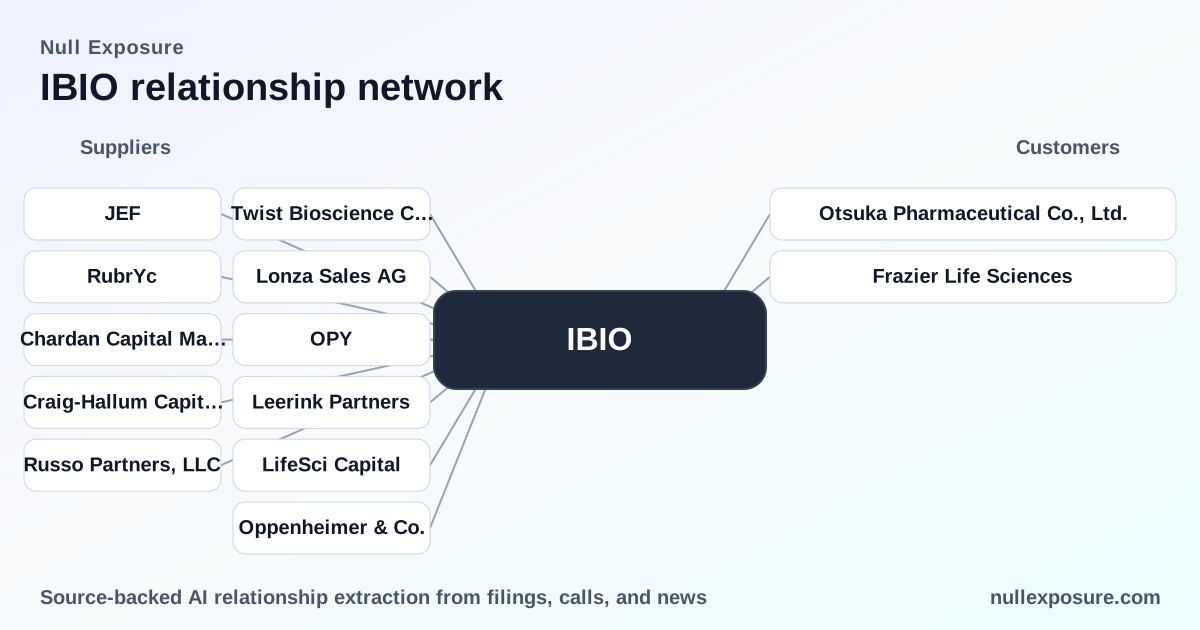
iBio (IBIO) — Supplier relationships and the commercial implications for investors
iBio operates as a hybrid biotech services and discovery company that monetizes through a combination of licensing, milestone-driven R&D arrangements, equity-backed acquisitions, and selective capital markets activity. The company licenses core antibody IP, outsources manufacturing and development work to established contract manufacturers, and raises capital through placements and ATM programs to fund pipeline advancement. For investors, the commercial value rests on the exclusivity and scalability of licensed assets, the stability of outsourced manufacturing and service providers, and the company’s ability to finance development through capital markets.
If you want a structured supplier-risk view for portfolio or vendor decisions, start here: https://nullexposure.com/.
How iBio runs the business and where revenue comes from
iBio’s operating model is licensing-first plus outsourced execution. The firm acquires or licenses antibody programs (notably via agreements with AstralBio and RubrYc), invests in preclinical development, and relies on third-party manufacturers and CROs for CMC and toxicology work. Revenue sources are currently limited and front-loaded toward licensing milestones and future commercialization; near-term funding flows come from equity financings, placement agents and ATM programs. Value creation depends on IP commercialization and uninterrupted third-party manufacturing and clinical support.
The relationship map — counterparties you need to know
Below I cover each reported counterparty referenced in iBio’s filings and press coverage, with a concise plain-English summary and the source.
Lonza Sales AG
iBio outsources certain functions and supplies to Lonza Sales AG as one of its third‑party suppliers for development and manufacturing-related inputs. According to iBio’s FY2025 Form 10‑K, Lonza is cited among external suppliers the company relies on for outsourced functions and supplies (FY2025 10‑K).
Twist Bioscience Corporation
Twist Bioscience is listed by iBio as a third‑party supplier for functions and supplies, indicating a procurement relationship for specialized reagents or gene‑synthesis services. iBio discloses Twist in its FY2025 Form 10‑K as part of its outsourcing mix (FY2025 10‑K).
Oppenheimer & Co.
Oppenheimer acted as a co‑placement agent on a $26 million private placement announced in January 2026, providing capital‑markets distribution support to iBio. The GlobeNewswire press release dated January 9, 2026 names Oppenheimer among co‑placement agents for that offering (GlobeNewswire, Jan 9, 2026).
Leerink Partners
Leerink Partners served as the lead placement agent for the same January 2026 private placement, handling underwriting and placement responsibilities for the financing. iBio’s press release identifies Leerink as lead placement agent for the offering (GlobeNewswire, Jan 9, 2026).
LifeSci Capital
LifeSci Capital participated as a co‑placement agent alongside Oppenheimer in the January 2026 private placement, supporting distribution and investor access for the raise. iBio’s January 2026 announcement lists LifeSci Capital as a co‑placement agent (GlobeNewswire, Jan 9, 2026).
Jefferies
Jefferies was appointed sales agent for an ATM program launched to bolster liquidity, earning commissions on potential sales under the program and providing sell‑side execution capability. TradingView coverage of the FY2026 ATM launch details Jefferies’s role and commission structure (TradingView, FY2026).
RubrYc
iBio acquired assets and licenses from RubrYc, including antibody programs and an AI drug‑discovery platform, and has since been marketing oncology programs obtained in that transaction. TradingView reporting on iBio’s SEC filings and prior asset purchase documentation describes the RubrYc acquisition and subsequent marketing activity (TradingView / SEC references, FY2026).
Chardan Capital Markets
Chardan previously served as an ATM sales agent under an earlier prospectus; iBio terminated that prior ATM arrangement as it transitioned to a new program. TradingView reporting on the ATM change notes termination of the program with Chardan (TradingView, FY2026).
Craig‑Hallum Capital Group
Craig‑Hallum was the co‑agent on the prior ATM program that was later terminated; the company ended further sales under that earlier prospectus. TradingView’s ATM coverage describes Craig‑Hallum’s prior role and the termination (TradingView, FY2026).
Russo Partners, LLC
Russo Partners functions as iBio’s investor‑relations / media contact on multiple investor communications and conference participation announcements, supporting corporate messaging and investor outreach. iBio’s press materials and investor conference notices reference Russo Partners as media contact (Yahoo Finance and GlobeNewswire, FY2025–FY2026).
What the supplier and contracting constraints say about the business
iBio’s public disclosures reveal a mixed contracting posture: both short‑term operational arrangements and meaningful long‑term commitments coexist. The company records short‑term financing and insurance premium financings and elects not to capitalize leases under the practical expedient for under‑one‑year terms, signaling flexible short‑term obligations. Simultaneously, iBio holds multi‑year leases and long‑dated credit agreements tied to facility financing, indicating material long‑term commitments that affect capital allocation and working capital needs.
Licensing is central to monetization and risk transfer. iBio holds exclusive worldwide licenses (e.g., from AstralBio and former RubrYc assets) that are material to its pipeline, with upfront consideration in the $750k range per license and up to tens of millions of dollars in milestone exposure, implying asymmetric upside for license holders and contingent liabilities for iBio.
Third‑party relationships are operationally critical and material: manufacturing, CMC development and CRO services underpin timelines to clinical milestones and potential commercialization, and the company documents that supplier failure could delay or prevent approvals. Spend profiling in filings shows most supplier engagements cluster in the $100k–$10m range, with several strategic purchases and financings in the multi‑million band for facilities and asset acquisitions.
Geography and coverage are mixed: the supplier base is anchored in North America operationally, while licensed IP and regulatory strategy are global, exposing iBio to cross‑jurisdiction regulatory and supply‑chain risk.
Active and terminated relationships coexist: the company has both ongoing outsourcing and placement agent engagements and explicitly terminated arrangements tied to its strategic pivot (for example, CDMO divestiture and prior ATM terminations), signaling a maturity transition from manufacturing operator to IP‑centric developer.
(If you want a visual supplier‑risk heatmap and counterparty profiles, see https://nullexposure.com/.)
Investor takeaways and next steps
- Licensing is the revenue lever; supplier continuity is the execution risk. Investors should underwrite milestone realization and the stability of third‑party manufacturing/CRO contracts before assigning upside.
- Capital markets are an active part of the model. iBio relies on placement agents and ATM programs to finance operations; placement partners like Leerink and Oppenheimer played central roles in recent raises (GlobeNewswire, Jan 9, 2026).
- Counterparty diversification is limited in places. The company names a handful of service firms and manufacturers; loss of a single critical supplier could have material impact under current disclosures.
For a deeper due‑diligence brief that maps each supplier to contractual terms, spend bands and termination exposure, request an expanded supplier report at https://nullexposure.com/.
For portfolio teams seeking a tailored vendor‑risk assessment tied to their exposure limits, contact our research desk via https://nullexposure.com/.