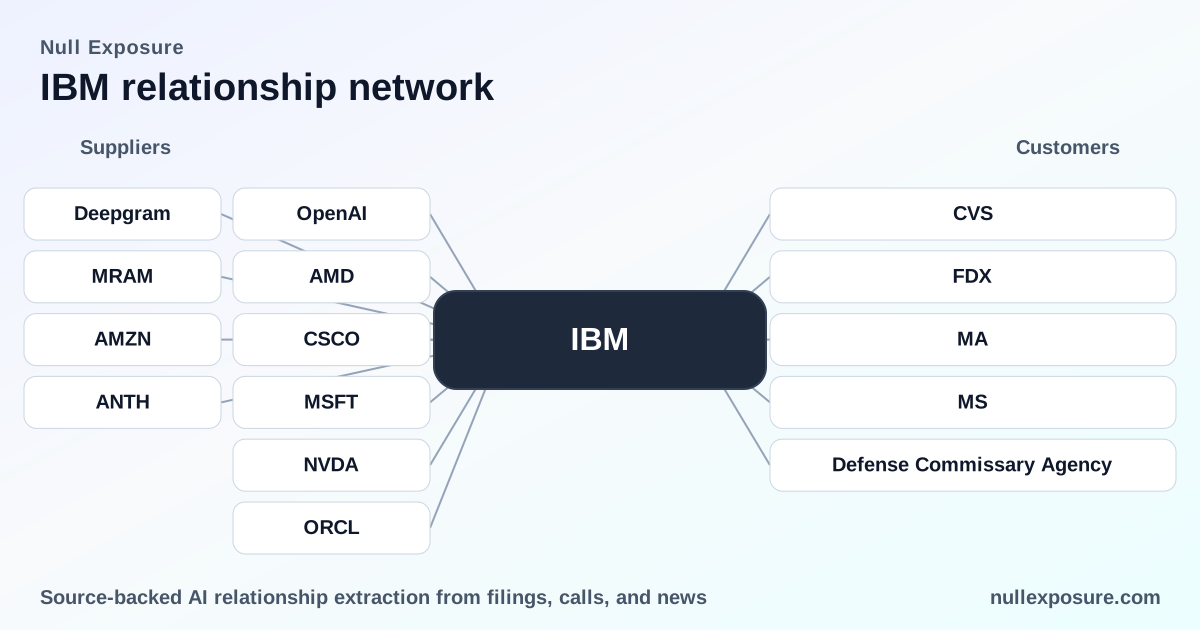
IBM’s supplier map: strategic partners, critical dependencies, and what investors should price in
Thesis: International Business Machines monetizes through a diversified mix of software licensing, enterprise services (consulting and managed hosting), and recurring cloud and AI subscriptions, anchored by large, long-term commercial relationships and strategic technology partnerships that drive product differentiation in hybrid cloud and enterprise AI. For investors and operators, the supplier picture is both a growth lever—via AI and chip partnerships—and a concentration risk where a handful of technology suppliers and service providers shape IBM’s product roadmap and execution.
Explore deeper supplier signals at https://nullexposure.com/.
How IBM structures supplier relationships and what that implies for investors
IBM operates with a predominantly long-term contracting posture across financial and operational relationships: public filings document multi‑billion dollar credit facilities and an ongoing capital allocation program that imply long-duration financial commitments and scale purchasing. Licensing is a core commercial mode for technology inputs—IBM both licenses third‑party security tools and builds offerings that incorporate open source and third‑party software with limited warranties. These are company-level characteristics drawn from IBM’s disclosures.
- Concentration and criticality: IBM’s filings note reliance on a limited set of suppliers for certain server processor technology and other components, signaling single‑vendor risk for hardware-dependent lines.
- Global and multi‑segment exposure: IBM sources hardware, software and services worldwide and the supplier footprint spans hardware, infrastructure, software and services, consistent with its enterprise model.
- Spend scale and maturity: Contractual evidence (large credit facilities, long-term programs) indicates spend bands well into the $100m+ range and relationships that are operationally mature and active.
- Third‑party service provider posture: IBM treats many counterparties as service providers and maintains a supplier risk program focused on cybersecurity and operational resiliency.
These constraints and structural signals should be treated as company-level operating model features rather than assertions about any single supplier.
Supplier relationships called out in IBM’s latest public commentary
AMD
IBM identified AMD as a strategic partner in its 2025 Q4 earnings commentary; the relationship supports expanded AI and compute collaborations that feed IBM’s hybrid cloud and AI offerings. According to IBM’s 2025 Q4 earnings call (March 7, 2026), AMD was listed among new or deepened strategic partnerships announced during the year.
Microsoft
Microsoft is included in the same set of strategic partnerships IBM highlighted during its 2025 Q4 earnings call; this reflects cross‑cloud and enterprise software alignment relevant to go‑to‑market and customer deployments. IBM cited Microsoft in the 2025 Q4 earnings call (March 7, 2026).
OpenAI
IBM named OpenAI alongside other strategic partners in the 2025 Q4 earnings call, signaling continued alignment with leading AI model providers as part of its enterprise AI strategy. IBM referenced OpenAI in its 2025 Q4 earnings call (March 7, 2026).
Oracle
Oracle was also listed among partners that IBM either newly engaged or deepened during the year, indicating continued enterprise database and cloud interoperability considerations. IBM mentioned Oracle in the 2025 Q4 earnings call (March 7, 2026).
AWS (Amazon Web Services)
AWS appears in IBM’s public commentary as a strategic partner, reflecting multi‑vendor cloud strategy and potentially cooperative deployments or customer integrations. IBM included AWS in its 2025 Q4 earnings call (March 7, 2026).
Anthropic
Anthropic is part of the roster of AI partners IBM disclosed during its 2025 Q4 earnings call, underlining IBM’s multi‑model approach to embedding foundation models into enterprise workflows. IBM named Anthropic in the 2025 Q4 earnings call (March 7, 2026).
Cisco
IBM described a collaboration with Cisco in the context of quantum initiatives and broader systems partnerships, showing IBM’s approach to cross‑vendor hardware and research collaborations. The 2025 Q4 earnings call (March 7, 2026) referenced Cisco’s collaboration and joint participation in government initiatives.
NVIDIA
IBM disclosed a partnership alignment between Red Hat (an IBM subsidiary) and NVIDIA to combine hybrid AI solutions with NVIDIA’s AI stack, a clear product‑level coupling between IBM’s hybrid software and NVIDIA’s hardware/software AI ecosystem. IBM noted the Red Hat–NVIDIA alignment in its 2025 Q4 earnings call (March 7, 2026).
Deepgram
IBM announced a collaboration to integrate Deepgram’s speech‑to‑text and text‑to‑speech into watsonx Orchestrate, positioning Deepgram as a voice partner for enterprise automation and strengthening IBM’s conversational AI capabilities; this was covered in multiple March 2026 news reports. A Finviz report (March 2026) and TradingKey coverage (March 2026) described the Deepgram integration into watsonx Orchestrate and noted Deepgram as IBM’s first dedicated voice partner for enterprise automation.
Everspin Technologies, Inc.
Everspin referenced shipping STT DDR products to IBM in Q4 2025 commentary, indicating a supplier relationship for MRAM memory products used in IBM’s hardware stacks. The Globe and Mail transcript of Everspin’s Q4 2025 earnings call (covered March 2026) and related press reporting (InsiderMonkey, March 2026) described shipments to IBM.
What these relationships mean for valuation and operational risk
IBM’s supplier network is simultaneously a competitive moat and a concentration vector. Strategic AI partners (OpenAI, Anthropic, Microsoft, NVIDIA, Deepgram) increase product differentiation for watsonx and hybrid AI offerings and support recurring SaaS‑like revenue. Hardware and component suppliers (AMD, Everspin, Cisco) underpin infrastructure and create execution dependency where supply disruption or pricing shifts translate directly into margin pressure.
- Positive: Partnerships accelerate enterprise AI monetization and reduce time‑to‑market for product features.
- Negative: A concentrated set of critical suppliers and long‑term financial commitments raise the cost of supplier failure and increase switching costs.
- Operational control: IBM’s supplier risk and cybersecurity programs are material — this is a governance lever investors should track alongside contract terms and supplier diversification.
For investors, premium for strategic AI exposure should be balanced against discounts for supplier concentration and hardware dependency; scenario modeling should incorporate multi‑quarter procurement shocks and the impact of vendor pricing or allocation constraints.
Explore supplier intelligence and scenario analysis at https://nullexposure.com/ to map vendor concentration into your valuation model.
Practical next steps for investors and operators
- Monitor contractual disclosures and filings for changes to long‑term credit lines and large purchase commitments that reflect supplier spend bands.
- Track supplier diversification metrics within IBM’s segments—hardware, infrastructure, software, services—to quantify single‑vendor exposure.
- Integrate partner activity (NVIDIA, Microsoft, Deepgram) into revenue growth assumptions for Watsonx and hybrid‑cloud ARR trajectories.
- Validate supplier resilience through vendor performance and cybersecurity audit outcomes, since IBM treats many counterparties as service providers and runs a formal supplier risk program.
For a detailed supplier scorecard and to translate these relationships into portfolio signals, visit https://nullexposure.com/.
Conclusion: IBM’s supplier ecosystem is a strategic asset that fuels its AI and hybrid cloud roadmap, but the same network concentrates operational risk in a small group of high‑impact partners. Investors should reward partnership‑driven growth while pricing the non‑trivial exposure tied to hardware and critical vendor dependencies.