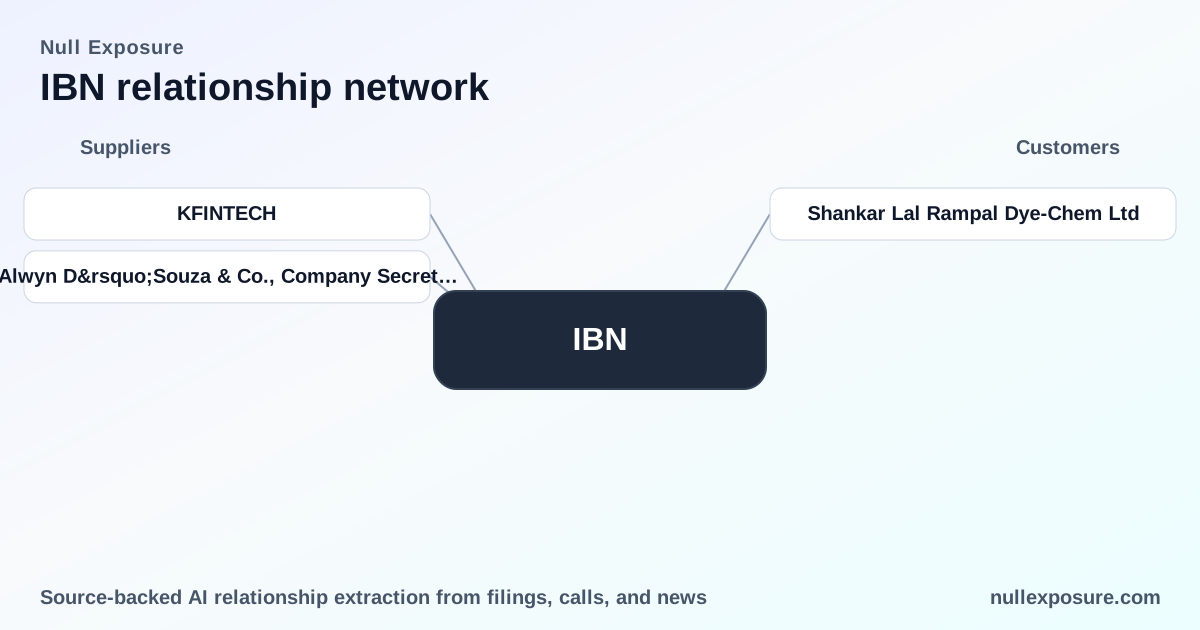
ICICI Bank (IBN) — Supplier relationships that matter for governance and operational continuity
ICICI Bank is a large, diversified Indian retail and wholesale bank that monetizes through net interest income, fee-based services, and cross-border banking operations. With significant scale (RevenueTTM ~1.92 trillion; Market Cap ~USD 98.4 billion) the franchise converts deposit and wholesale funding into lending and transactional products while outsourcing discrete governance and shareholder‑meeting functions to specialist vendors. For investors assessing supplier risk, the governance services flagged in public reporting are operationally concentrated, high‑visibility touchpoints that directly affect shareholder voting integrity and regulatory compliance.
Explore more supplier risk intelligence at https://nullexposure.com/ to see how these relationships influence counterparty exposure and operational resiliency.
What the supplier signals tell you about ICICI Bank’s operating model
ICICI Bank’s public footprint in the supplier layer highlights a structured contracting posture: the bank uses established external providers to execute regulatory and shareholder processes rather than building in‑house tools for voting and vote certification. This is consistent with a large financial services firm that prioritizes core banking capabilities while outsourcing specialized, repeatable administrative functions.
- Concentration: Public records show a small number of specialist vendors used for ballot management and scrutiny in the sampled period, indicating concentrated reliance for critical governance events.
- Criticality: These suppliers are mission‑critical for regulatory compliance and shareholder rights — failures or disagreements could disrupt proxy exercises and trigger regulatory scrutiny.
- Maturity and standardization: The named vendors are standard market participants in Indian corporate governance workflows, which signals mature, industry-standard procurement rather than bespoke, one‑off arrangements.
- Contracting posture (company-level): Contracts for these services are typically short to medium term and event-driven (e.g., annual general meetings, postal ballots), which reduces long-term lock-in but increases reliance during critical windows.
No supplier constraints were recorded in the supplied constraint inventory; as a company-level signal, that absence suggests no flagged contractual restrictions or dispute disclosures in the sampled dataset, but the underlying governance suppliers remain high‑impact by function.
Vendor relationships surfaced in public reporting
Below are the supplier relationships identified in the examined results; each entry includes a concise, plain‑English summary and a source reference.
KFin Technologies Limited — e‑voting and vote tabulation partner
ICICI Bank conducted its postal ballot entirely through remote e‑voting, with votes counted via KFin Technologies Limited, reflecting the bank’s use of a specialized registrar/transfer agent for electronic voting and tabulation. A PSUConnect news item reported this arrangement in connection with the FY2026 postal ballot process on March 10, 2026 (https://www.psuconnect.in/bank-news/icici-bank-appoints-vijayalakshmi-iyer-as-independent-director).
Alwyn D’Souza & Co., Company Secretaries — scrutinizer certifying compliance
The voting process for the same postal ballot was certified by Alwyn D’Souza & Co., Company Secretaries, which affirmed compliance with the Companies Act, SEBI (LODR) Regulations, and relevant MCA circulars — a standard external audit-style assurance for shareholder votes (PSUConnect report, March 10, 2026; same article at https://www.psuconnect.in/bank-news/icici-bank-appoints-vijayalakshmi-iyer-as-independent-director).
Why these governance suppliers matter to investors
These two service providers are not ancillary vendors; they are gatekeepers of shareholder consent and regulatory proof. Any disruption in e‑voting delivery, tabulation accuracy, or the independence of scrutinizers will immediately impact corporate actions such as director appointments and could attract regulatory follow‑up. For an investor base evaluating counterparty and operational risk:
- Operational risk is event‑concentrated. The bank’s dependence on third parties for discrete governance events concentrates operational exposure to specific calendar windows (AGMs, postal ballots).
- Reputational and regulatory risk is direct. Errors or contestation in vote outcomes escalate quickly into public and regulatory domains.
- Vendor selection is conventional. Using well-known governance vendors reduces idiosyncratic risk compared with niche providers, but it does not eliminate systemic or execution risk during peak event volumes.
For more detailed supplier mappings and to track changes across events, visit https://nullexposure.com/ and review our supplier intelligence dossiers.
What to monitor going forward (practical checklist for investors)
- Track future filings and press notices for naming or replacement of governance vendors; frequent turnover during consecutive events signals procurement, performance, or governance friction.
- Monitor any regulatory notices from SEBI or MCA relating to shareholder voting infrastructure — such notices directly influence the integrity of these supplier relationships.
- Watch for disclosures around service-level agreements or incident reports tied to e‑voting or vote tabulation; even limited outages in voting windows will be material to governance outcomes.
- Evaluate the bank’s broader outsourcing policy disclosed in annual reports and regulatory filings for evidence of escalation mechanisms and contingency arrangements.
Bottom line and action items
ICICI Bank relies on a narrow set of established external providers to execute critical shareholder governance functions. That reliance creates concentrated, high‑visibility operational exposure that investors should track alongside traditional financial metrics such as net interest margin and asset quality. Governance vendors like e‑voting platforms and scrutinizers are small in cost but large in consequence.
If you want continuous monitoring of supplier events and a mapped view of counterparty concentration, explore the platform at https://nullexposure.com/ — the site provides supplier-focused intelligence tailored for investors and operators.
Stay alert to governance event disclosures and vendor changes in ICICI Bank filings; these are the practical levers where supplier risk converts into investment‑relevant outcomes. For deeper supplier analytics and a tailored watchlist, visit https://nullexposure.com/ and request a briefing.